The shift supervisor's knowledge stops dying at handover
The supervisor of a blending and packaging plant spends the day walking between the tank farm, the pump room, the line and the hazardous goods store, in helmet, goggles and gloves, hands always busy. They cannot type, so they record nothing, and everything they know switches off at handover. With Connect in voice mode and an earpiece under the protective equipment, they talk while they walk: iLEAN listens, structures, stores and returns support in seconds.
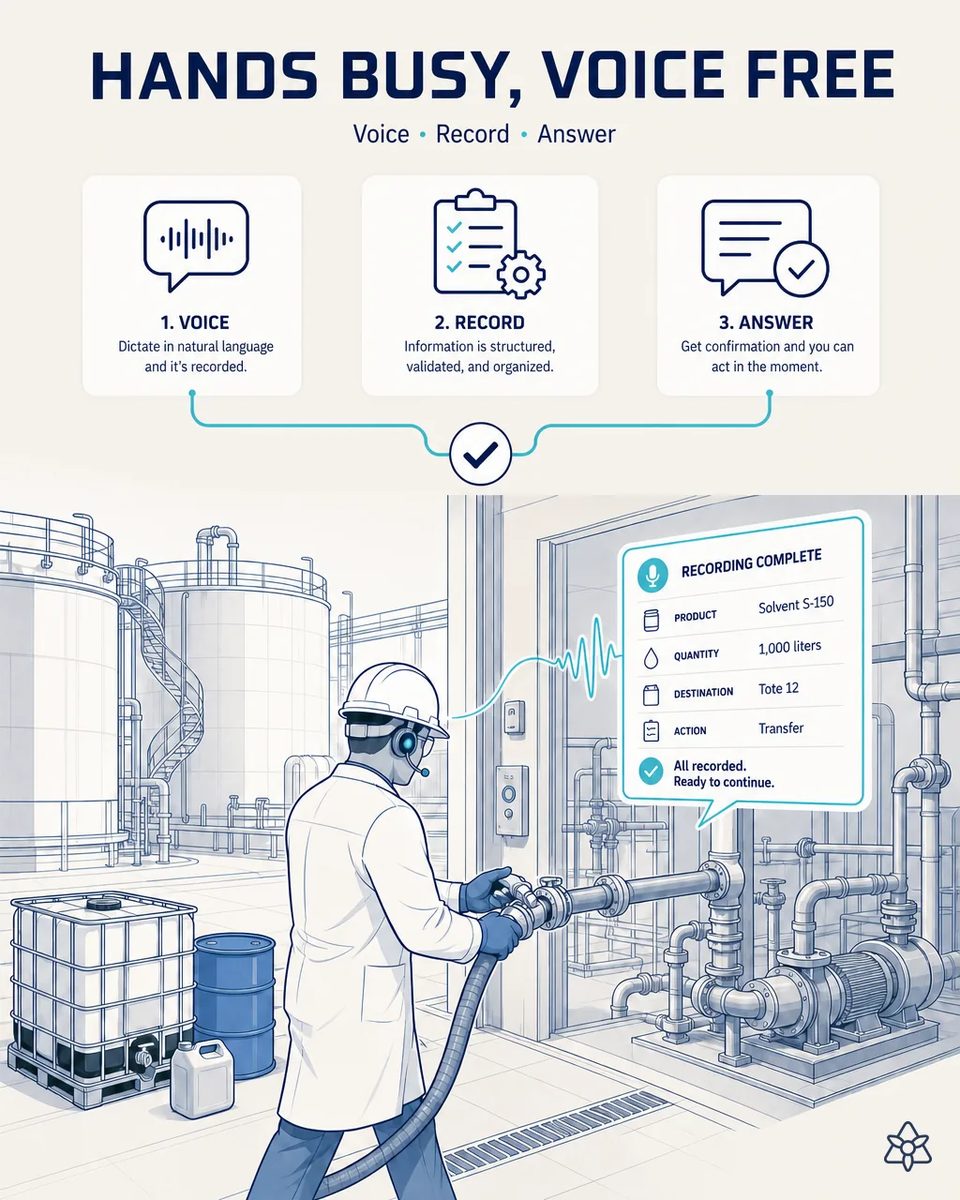
What the supervisor knows switches off at handover.
The operational knowledge of a chemical plant lives in the heads of three or four supervisors. That pump three has vibrated differently since the seal change. That one supplier's twenty-liter jugs come with a looser thread. That tank seven will only just cover tomorrow's order. None of it gets recorded, because recording means stopping, taking gloves off and typing. And what is not noted in the moment is never noted: nobody goes back to the office to write down what they saw five hours ago. The result is twofold. Incidents repeat across shifts because knowledge does not cross, and when a supervisor moves on or leaves, the plant loses in one go the detail that was preventing incidents.
- That pump three has vibrated differently since the seal change. That one supplier's twenty-liter jugs come with a looser thread. That tank seven will only just cover tomorrow's order. None of it is in any system.
- Recording it means stopping, taking off the gloves in a classified area and typing on a screen that is two buildings away. So it is not recorded, and what is not noted in the moment is never noted.
- The next shift starts from zero. The same weeping flange gets discovered again, the same tank runs short again, by a different supervisor with no memory of the last time.
- When a supervisor leaves, the plant loses in one go the detail that was preventing incidents, and it takes the new one a year of walking behind someone to rebuild it.
Connect in hands-free voice mode — iLEAN listens to the supervisor, not to the floor.
Connect in hands-free voice mode.
Humans in command, literally: the earpiece records what the supervisor chooses to dictate, when they choose to, and returns what they ask for. There is no continuous listening and no tracking of where anyone is. That distinction is what keeps the case alive in month six instead of being perceived as monitoring. The plant keeps the observation; the supervisor keeps their hands on the valve.
- Bluetooth earpiece under the protective equipment, working with plant noise in the background.
- The supervisor dictates what they observe without stopping.
- iLEAN structures what was said against central memory: which asset, which tank, which batch it refers to, and stores it as a timestamped observation.
- It returns, by voice or pushed to the line tablet, whatever the supervisor asks for: a tank level, the status of an order, whether maintenance received the notice.
Humans in command: the AI takes no action on its own, it supports the person in charge.
Today's round versus the captured round
| Aspect | Today | With iLEAN Connect |
|---|---|---|
| Observation in the tank farm | Kept in the supervisor's head | Timestamped, tied to the asset and the tank |
| Looking up a tank level | Walk back to the office | Ask, keep walking |
| Shift handover | Five verbal minutes | A written summary that already exists |
| A recurring incident | Solved again, by someone else | Detected as recurring |
| Ramp-up of a new supervisor | A year of walking behind someone | Backed by the history |
| Ordinary floor conversation | — | Not recorded |
from zero shift records to one observation captured as it happens · from knowledge that dies at handover to knowledge searchable by asset and by tank · from interrupting work to look something up to looking it up while walking.
Impact estimate — to be validated with your numbers.
The block below is an estimate to be validated against your plant's actual data. We put it forward so the committee has an order of magnitude; we refine it during the assessment.
- Estimated payback 4-9 months, mostly from incidents that stop repeating because knowledge crosses between shifts.
- Faster ramp-up for new supervisors, who inherit the history of every pump, tank and supplier's container instead of relearning it.
- The shift handover goes from five verbal minutes to a written summary that exists before the next shift walks in, so the incoming supervisor starts from what the outgoing one saw, not from a blank page.
- And a query — tank level, order status, whether maintenance got the notice — no longer costs a walk back to the office in full PPE.
repeat incidents that stop repeating because knowledge crosses between shifts, and faster ramp-up for new supervisors. Estimated payback of 4 to 9 months. *Estimate to validate.*
And the fair question from the production manager
“Is this for monitoring my people?” — no: iLEAN listens to the supervisor, not to the operators, and only to what they choose to dictate. Structuring a dictated observation against known assets — which pump, which tank, which batch — is an anchored task where the best models drop below 1.5% error [1], and every stored observation is shown back to the supervisor on the tablet, so what the plant keeps is what they meant to say.
[1] OpenAI paper "Why Language Models Hallucinate", 2025 — on the reliability of AI in anchored tasks.
What people ask about voice mode in the tank farm
Does it work under a helmet, goggles and hearing protection?
That is the design condition. The earpiece goes under the protective equipment and recognition is prepared for pump room noise and for the plant's own vocabulary: tank numbers, product names, container types. The first week is spent teaching it the names the plant actually uses, which are rarely the ones in the ERP.
Is the earpiece allowed in a classified area?
It depends on the zone. Intrinsically safe Bluetooth headsets exist for the zones where they are needed, and the equipment is chosen after checking the plant's area classification, not before.
Do they have to speak in a particular way?
No. They say it the way they would tell a colleague. iLEAN structures it afterwards: asset, tank, batch, symptom and criticality. A sentence that cannot be tied to a known asset is stored as free text and flagged, never discarded.
What can the supervisor ask for?
Anything already in central memory: a tank level, the status of a blending order, whether the maintenance request on pump three was received. The answer comes back by voice or pushed to the line tablet. The supervisor asks; nothing is read to them that they did not request.
Can it be trialed with one supervisor?
Yes, and it is the cheapest pilot in the matrix to set up: one earpiece, one shift, and an evaluation the next morning by comparing the handover with what was actually captured. If the written summary beats the verbal handover, the case has proven itself; if not, the earpiece goes back in the box.
More cases from this series
- No liter should lose its identity between the tank and the customerFour coordinated verification rings from receiving to the branch: not one mis-identified drum, not one…
- The audit stops being a two-week projectEvery changeover, release and shipment leaves its evidence; Agents sorts it by standard and the auditor…
- From a paper blending order to a live batch at second zeroTwo photos, at start-up and at close, and the blending order and packaging log are in the central system…
- The laboratory releases batches without anyone retyping into the ERPiLEAN reads the lab sheet as it is saved, drafts the certificate of analysis and, once validated, posts…
- Modern machines still worked by hand: closing the last connectionThe ERP publishes product, batch and pictograms to the labeler, and the scale returns the real weight of…
- The solvent recovery panel, digitized without touching the machineA camera reads the isolated distillation column panel and delivers recovery yield run by run, without…
Tell us how many times this year the same incident was rediscovered by a different shift.
We work on your plant's real data, not ours. Assessment with no commitment.
Request estimated ROI within 48h ‹ See all cases of chemical distribution See chemicals