Modern machines still worked by hand: closing the last connection
The labeler that prints the drum label is modern and has an interface. The filler scale returns the real weight through its port. And still, somebody keys product and batch in at the start of every run and somebody writes the weights down to transcribe later. They are almost integrated but not quite, which is the most expensive state of all. Connect stitches them through their interfaces, both ways, without replacing either.
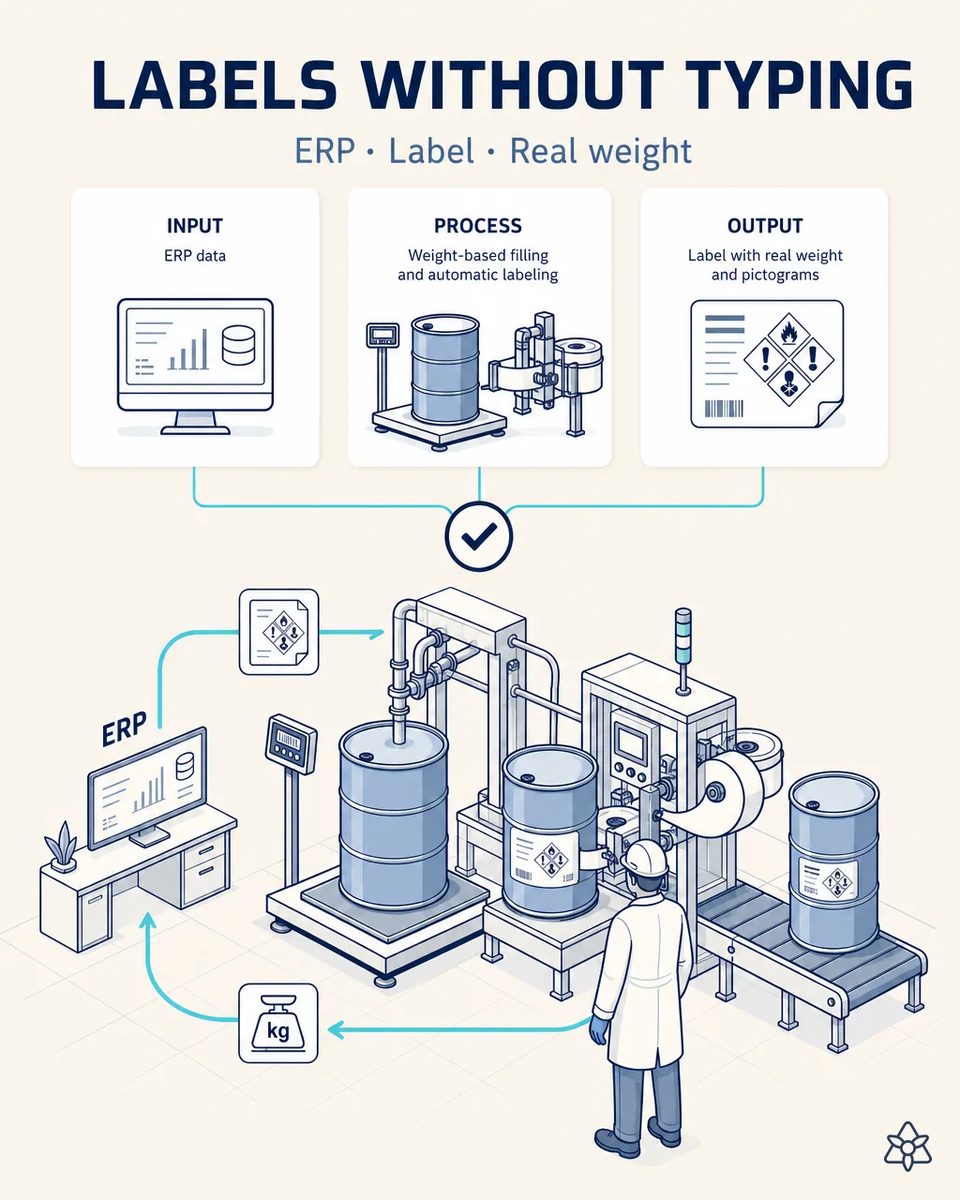
Two modern machines, both fed by hand, in the most expensive state of all.
Every keystroke of product and batch at the labeler is a chance to print a hundred wrong labels. And a chemical label does not just carry the batch: it carries the hazard pictograms, the precautionary statements and the product identifier. An error there is not administrative, it is a hazard communication failure with regulatory and safety consequences. On the other side, the real weights per container are the figure that would let you close the batch mass balance — how much went into the tank against how much came out packaged — and today they are lost on a handwritten log or recorded aggregated and rounded. The reason the connection is still open is never technical: it is that closing it is never the emergency of the day.
- The labeler that prints the drum label is modern and has a documented interface. Still, someone keys in product and batch at the start of every run. One wrong finger is a hundred labels with the wrong pictograms, the wrong precautionary statements or the wrong product identifier.
- A chemical label is not administrative: it is hazard communication. A drum that says corrosive when the content is flammable is a regulatory failure and a safety incident waiting in a customer's warehouse.
- The filling scale returns the real weight of every container through its port, and nobody is listening: the weights go on a handwritten log, or into the system aggregated and rounded.
- Without real weight per container the batch mass balance cannot close — liters into the tank against kilos packed — and the bulk shrinkage at month end stays a number without a cause.
Connect stitches the two machines through their interfaces, both ways, replacing neither.
Connect as the stitch between two modern systems.
From the ERP to the labeler: product, batch, pack size and the GHS pictograms and precautionary statements that match the product's SDS, published with zero keying. From the scale to the ERP: the real weight of every drum, jug and IBC, aggregated by batch. The machines do not change; their connections do.
- From the ERP to the labeler: product, batch, pack size and the set of pictograms and precautionary statements matching that product's safety data sheet, published through the interface. Zero keying.
- From the filler scale to the ERP: real weight per container, automatically aggregated by batch.
- Neither machine is replaced or reprogrammed: their connections change, not them.
- If the installed equipment does not expose an interface, an adapter is inserted: it raises the initial cost but does not break the case.
The isolated machines versus the stitched machines
| Aspect | Today | With iLEAN Connect |
|---|---|---|
| Product and batch at the labeler | Keyed once per run | Published by the ERP |
| Pictograms and statements | Chosen on the labeler panel | Taken from the product's SDS record |
| Weight per container | Handwritten or rounded | Real, per container, in the system |
| Batch mass balance | Estimated by eye | Closes itself per batch |
| A wrong label run | Discovered at the branch | Impossible by construction |
| Either machine | — | Neither replaced nor reprogrammed |
from one keying per run at the labeler to zero · from hand-written weights to real weight per container in the system · from a mass balance estimated by eye to a per-batch balance that closes itself.
Impact estimate — to be validated with your numbers.
The block below is an estimate to be validated against your plant's actual data. We put it forward so the committee has an order of magnitude; we refine it during the assessment.
- Estimated payback 4-10 months, subject to confirming that the installed labeler and scale really expose their interfaces.
- Elimination of the risk of an incorrect hazard label through keying, which is a regulatory exposure rather than a productivity figure.
- A weight database per container and per batch, which is the raw material the shrinkage control of case 12 is built on.
- And a mass balance that closes per batch instead of being estimated by eye at month end.
elimination of the risk of an incorrect hazard label through keying, plus the weight database that enables the shrinkage control of case 12. Estimated payback of 4 to 10 months. *Estimate to validate, subject to confirming that the installed labeler and scale really do expose their interfaces.*
And the fair question from the production manager
“Isn't a classic ERP integration cleaner?” — it is, the day the project reaches the top of the IT list, and that is the problem: this is the classic case of two modern machines still fed by hand because closing the loop was never the emergency of the day. Mapping an ERP product record to the labeler's fields and the SDS pictogram set is an anchored task where the best models drop below 1.5% error [1], and the first label of every run is shown on the tablet for the operator to confirm before the rest print.
[1] OpenAI paper "Why Language Models Hallucinate", 2025 — on the reliability of AI in anchored tasks.
What people ask about connecting the labeler and the scale
Do we have to replace the labeler or the scale?
Neither. Connect leans on the interfaces they already have. If one of them does not expose an interface, an adapter is inserted: it raises the initial cost but does not break the case. The adapter question is answered before the quote, not after.
Where do the pictograms come from?
From the product's safety data sheet record in the ERP, or from iLEAN's central memory if the ERP does not hold them. Either way they are never chosen by hand on the labeler panel at the start of a run.
How can you confirm within 48 hours whether our machines can be stitched?
From the model and firmware version: most labelers and filling scales from the last ten years document a port and a protocol. Send us both models and we check them against what we have already connected.
Does the weight per container really matter?
It is the figure that lets you close the batch mass balance and explain bulk shrinkage. Aggregated and rounded, it explains nothing; per container, it shows which drum or which filling head is losing product. It is also what tells you a filling head is drifting before the drum count does.
What if the labeler fails to print or prints twice?
The labeler reports back what it printed, and that confirmation is stored against the batch. Today a failed print raises no signal and is discovered when a drum arrives at the branch with no label.
More cases from this series
- No liter should lose its identity between the tank and the customerFour coordinated verification rings from receiving to the branch: not one mis-identified drum, not one…
- The audit stops being a two-week projectEvery changeover, release and shipment leaves its evidence; Agents sorts it by standard and the auditor…
- From a paper blending order to a live batch at second zeroTwo photos, at start-up and at close, and the blending order and packaging log are in the central system…
- The shift supervisor's knowledge stops dying at handoverThe supervisor talks while walking with gloves on and hands busy: iLEAN listens, structures, stores and…
- The laboratory releases batches without anyone retyping into the ERPiLEAN reads the lab sheet as it is saved, drafts the certificate of analysis and, once validated, posts…
- The solvent recovery panel, digitized without touching the machineA camera reads the isolated distillation column panel and delivers recovery yield run by run, without…
Send us the model of your labeler and your filling scale and we will tell you whether they can be stitched.
We work on your plant's real data, not ours. Assessment with no commitment.
Request estimated ROI within 48h ‹ See all cases of chemical distribution See chemicals