Six interconnected lines, truly in sync
In a continuous multi-line process, any local bottleneck spreads across the whole chain. The iLEAN flagship system coordinates Connect, Edge and Agents in several cross-checking verification rings, catching the deviation at its origin line before it hits the next ones.
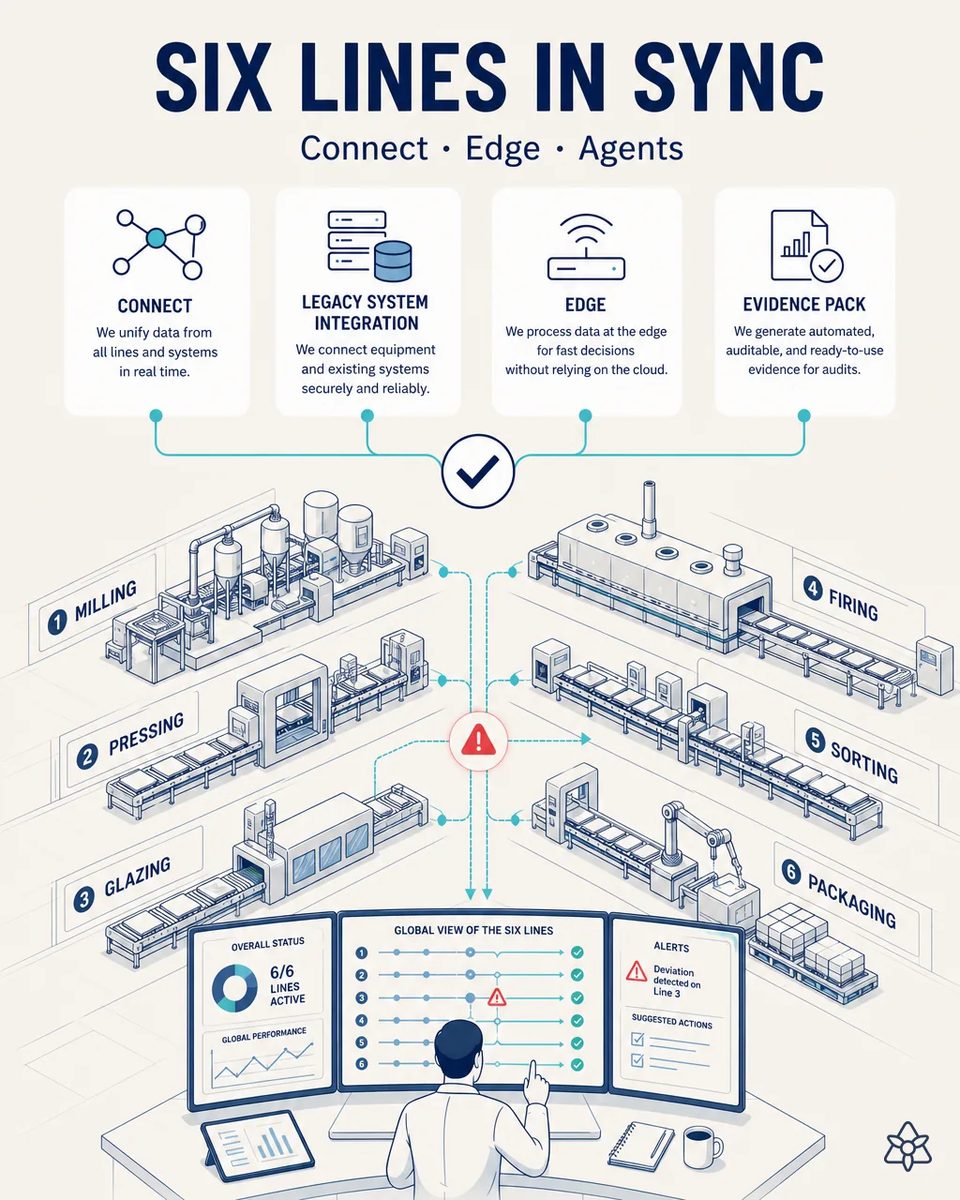
In a continuous tile process, a local deviation stops the whole chain.
Desynchronization between lines is the sub-sector's biggest operational and economic risk — every unplanned-downtime incident costs lost production on every downstream line.
- Milling and spray drying, pressing, glazing and digital decoration, firing, sorting and packaging run as six interconnected lines with little buffer between them. What one line produces, the next consumes within the hour.
- A late frit, a pressure drift at the press, a contaminated color change or a kiln curve out of range does not stay where it started: it moves downstream and multiplies.
- Every unplanned stop costs lost production on all the lines that follow, and the kiln, which cannot simply be switched off, keeps burning energy while it waits. Restarting the chain afterwards takes longer than the stop itself.
- Today the deviation is usually detected when it has already hit the whole chain, at sorting or at the customer. That is the sub-sector's biggest operational and economic risk. And the root cause gets lost because each line only sees its own part.
Connect, legacy integration, Edge and Agents — the eleven cases, orchestrated across six lines.
Connect captures the state of every line (format changes, supplier alerts, voice-dictated incidents, raw-material receiving); legacy integration stitches isolated systems together; Edge watches critical points and JIDOKA AI blocks before the problem spreads; Agents logs every incident for root-cause analysis; SMED AI speeds up changeovers so productivity isn't penalized.
No single case solves desynchronization: each one closes a gap on one line. The strength is in the cross-check, because when the press, the glazing line and the kiln stop agreeing, the system sees it on the line where it began, not three lines later. Agents logs every incident for root cause, and SMED AI keeps changeovers short so the checks do not cost productivity.
The six lines, and what each one stops at its origin
| Line | Which cases it draws on | Deviation stopped at origin |
|---|---|---|
| 1 · Milling and spray drying | Supplier alert (3) + receiving (7) | A missing or wrong raw-material batch |
| 2 · Pressing | Format change (1) + earpiece (4) | A pressure or caliber drift |
| 3 · Glazing and decoration | Printer link (8) + changeover (10) + tablet (5) | A wrong recipe or a contaminated color |
| 4 · Firing | Kiln panel (2) | A firing curve out of range |
| 5 · Sorting | Kiln-exit vision (9) + lab spreadsheet (6) | Defects and out-of-spec batches |
| 6 · Packaging and evidence | Evidence pack (11) | A shipped batch with no dossier |
Bottleneck detected only after hitting the whole chain → bottleneck detected and fixed at its origin line.
Impact estimate — to be validated with your numbers.
The block below is an estimate to be validated against your plant's actual data. We put it forward so the committee has an order of magnitude; we refine it during the assessment.
- Estimated payback 6-12 months, measured against the average cost of an unplanned-downtime incident.
- Fewer unplanned stops and protected combined OEE across the six lines.
- The bottleneck is detected and fixed on its origin line, instead of after it has hit the whole chain.
- And SMED AI speeds up format and color changeovers so the extra checks do not cost productivity. The checks protect the line; SMED AI protects the throughput.
Reduced unplanned downtime, protected combined OEE across lines. Estimated payback 6-12 months against the average incident cost. *Estimate to validate*.
And the fair question from the production manager
“Do we have to deploy all twelve cases to get this?” — no, and framing it that way is the surest way never to start. The system is built line by line and each case pays on its own. And when JIDOKA AI stops a line, it stops on a verifiable disagreement between sources — an anchored check where the best models drop below 1.5% error [1] — not on a model's uncertainty, which is escalated to a person. So each line keeps running unless there is a real reason to stop it.
[1] OpenAI paper "Why Language Models Hallucinate", 2025 — on the reliability of AI in anchored tasks.
What people ask about synchronizing a six-line tile process
Where does a tile plant usually start?
With the case that has the fewest dependencies, usually the format change at the press or the kiln panel. Each one pays on its own while the rest is added. The order is decided with your data, not with a fixed roadmap.
What does cross-checking the six lines add over each case alone?
The view of the chain. A pressure drift and a slightly hot kiln may each pass their own control, but together they produce the warpage that appears at sorting. Only by putting both sources side by side does the cause become visible.
Does it replace our MES or the kiln SCADA?
No. It reads and links what exists, including isolated systems, and cross-checks them against what actually happens on each line. The investment already made in your systems is kept, not replaced.
Can JIDOKA AI stop a tile line by mistake?
It stops on a verifiable discrepancy between sources, not on model doubt. When the doubt is the model's, the decision goes to a person. Every stop is logged with its reason, so false alarms can be reviewed and tuned.
How is the return of the six-line system estimated before committing?
With your history of unplanned stops, the average cost of an incident and your changeover frequency, the return per line is estimated before choosing the order. That is usually the first working session with your continuous-improvement manager.
More cases from this series
- The glaze printer, fully linked to the ERPHow iLEAN links the digital glaze printer to the ERP so the design recipe travels with no manual…
- The line lead's knowledge no longer dies at shift's endHow the line lead dictates incidents while walking between lines, hands-free.
- The kiln control panel, now connectedHow an external camera digitizes the firing curve of an isolated roller kiln, without touching its SCADA.
- The lab spreadsheet, connected to the ERP in real timeHow iLEAN automatically pushes the quality lab's spreadsheet to the ERP, with license savings.
- The raw-material delivery note, straight to the ERP by photoHow one photo of the delivery note and batch labels pushes everything to the ERP, with no typing.
- The supplier's alert, in seconds, not hoursHow iLEAN reads raw-material delay notices in real time and replans before the line actually stops.
Tell us what your last unplanned stop cost across the six lines.
We work on your plant's real data, not ours. Assessment with no commitment.
Request estimated ROI within 48h ‹ See all cases of porcelain tile See ceramics