The raw-material delivery note, straight to the ERP by photo
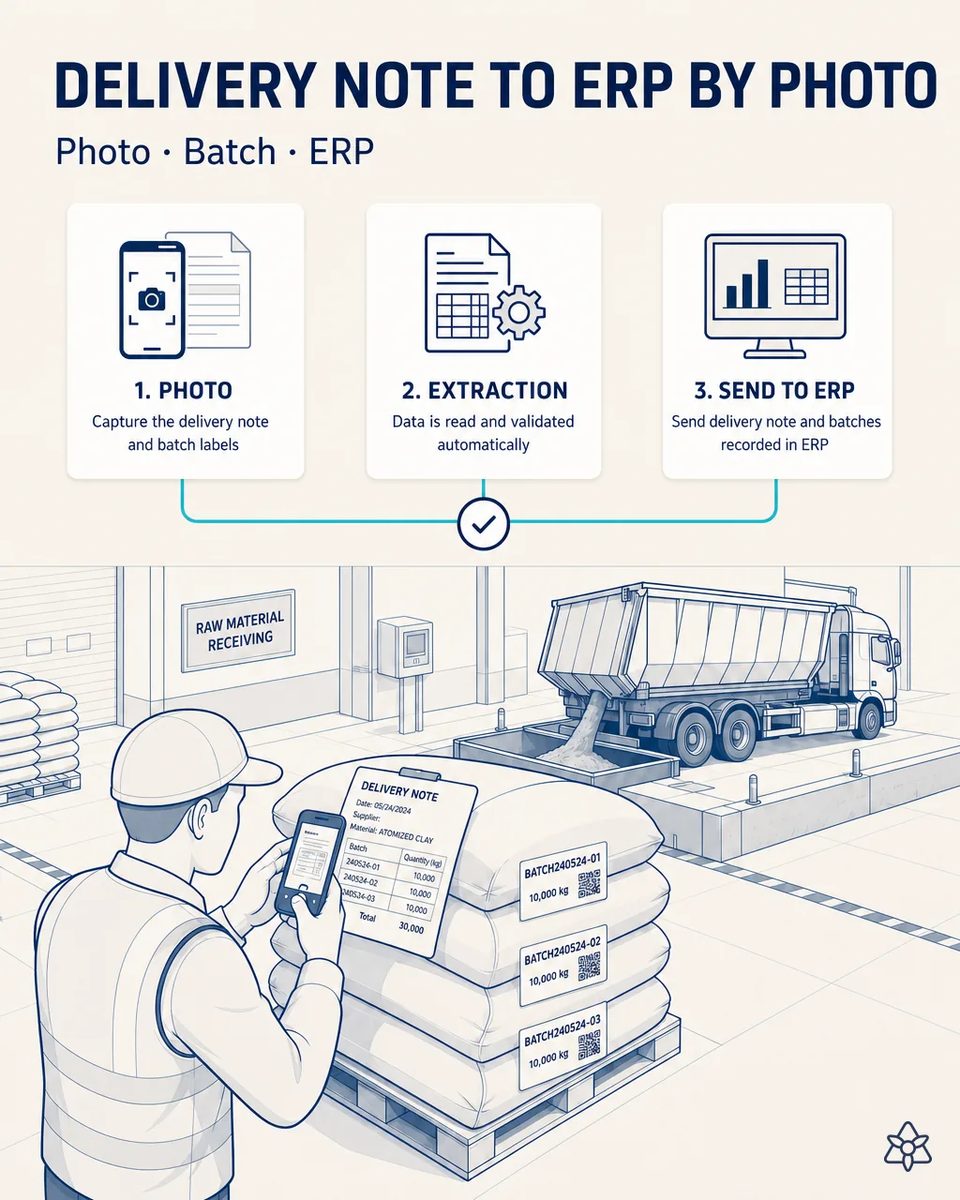
A truck arrives with bulk clay, feldspar or frits. Instead of typing the delivery note line by line into the ERP, the receiving lead photographs the delivery note and the batch labels. iLEAN Connect extracts everything in seconds and, after one validation tap, pushes it to the ERP.
The truck waits while the delivery note is typed line by line.
The carrier waits racking up demurrage while the receiving lead types. If they rush, batches get mistraced and surface weeks later when a line produces out of spec.
- Clay arrives in bulk, feldspar and sand by truck, frits and pigments in big bags or sacks. Each delivery has a note with several batches and quantities. Each supplier prints it differently. Some send the batch only on the bag label, others only on the note, and the receiving lead has to reconcile both by hand.
- The receiving lead types it line by line into the ERP while the carrier waits and demurrage adds up. On a busy morning, two or three trucks queue at the gate. Every minute is charged by the carrier and none of it adds value.
- When they rush, a batch is assigned to the wrong silo or the wrong material, and nobody notices at the time. The receipt looks correct in the ERP; only the physical batch is somewhere else.
- The error surfaces weeks later, when a line produces out of spec and the traceability points to a batch that was never in that silo. By then the batch is in the mill, the press and the kiln. Finding which tiles carry it takes days.
Connect in photo mode — the delivery note and the labels, read in seconds.
Connect photo mode. AI vision recognizes the delivery note's layout and the labels (GS1-128, QR, barcode, plain OCR). One-tap validation on an industrial tablet.
The receiving lead photographs the delivery note and the batch labels, checks a summary on the tablet and taps once. The carrier leaves in minutes and every batch is in the ERP with its silo or location from the start. Traceability from the finished tile back to the supplier stops having holes. And the receiving lead spends the morning checking material, not typing.
Receiving clay and frits today versus receiving by photo
| Aspect | Today | With iLEAN Connect |
|---|---|---|
| Truck time at the raw-material gate | Long, with demurrage | Minutes |
| Typing the delivery note | Line by line | One photo and one tap |
| Batch labels on big bags | Copied by hand | Read via GS1-128, QR, barcode or OCR |
| Batch assigned to the wrong silo | Found weeks later | Caught at the validation tap |
| Traceability from line back to supplier | Broken in places | Complete |
| Warehouse users in the ERP | One per person typing | Fewer named users |
Long carrier delay → minutes. Hidden batch errors → zero. Broken traceability → complete via photo and GS1.
Impact estimate — to be validated with your numbers.
The block below is an estimate to be validated against your plant's actual data. We put it forward so the committee has an order of magnitude; we refine it during the assessment.
- Estimated payback 3-8 months.
- CFO angle: a typical 50-70% reduction in receiving and warehouse-module ERP licenses.
- Carrier delay goes from long waits to minutes, and demurrage stops adding up at the gate. Carriers notice, and the plant stops being the slow stop on their route.
- Hidden batch errors drop to zero, and traceability from the line back to the supplier is complete via photo and GS1. When a line goes out of spec, the batch it was fed from is known in one query.
CFO angle — typical 50-70% reduction in receiving/warehouse-module ERP licenses. Estimated payback 3-8 months. *Estimate to validate*.
And the fair question from the production manager
“What if it reads a batch number wrong?” — reading a delivery note with a known layout and labels with a barcode or QR is an anchored task, where the best models drop below 1.5% error [1]. And the receiving lead sees the summary on the tablet before the tap: a batch that does not match the purchase order is flagged, not pushed. The same happens with a silo that does not accept that material.
[1] OpenAI paper "Why Language Models Hallucinate", 2025 — on the reliability of AI in anchored tasks.
What people ask about receiving clay, feldspar and frits by photo
Does it work with every raw-material supplier's delivery note?
Yes. The layout of each supplier's note is recognized, and a new supplier is added without asking them to change anything. The first deliveries of a new supplier are checked with extra care until the layout is learned.
Which label formats does it read on big bags?
GS1-128, QR codes, standard barcodes and plain printed text through OCR, including on big bags and sacks that have been handled and creased. When a label cannot be read, the system says so and asks for a second photo instead of guessing.
What about bulk clay with no labels?
Then the delivery note and the weighbridge ticket carry the batch, and the receiving lead assigns the silo on the tablet during the same tap. The weighbridge weight is checked against the quantity on the note.
Is the clay or frit delivery checked against the open purchase order?
Yes. Material, quantity and supplier are compared with the open order, and any mismatch is shown before validation. The receiving lead decides whether to accept, hold or reject before the truck leaves.
How are receiving licenses reduced?
People who log in only to type receipts stop needing a named license. It depends on your ERP contract, which is why it is framed as an estimate to validate. The calculation is done against last year's invoice, not against a list price.
More cases from this series
- The glaze printer, fully linked to the ERPHow iLEAN links the digital glaze printer to the ERP so the design recipe travels with no manual…
- The line lead's knowledge no longer dies at shift's endHow the line lead dictates incidents while walking between lines, hands-free.
- The kiln control panel, now connectedHow an external camera digitizes the firing curve of an isolated roller kiln, without touching its SCADA.
- The lab spreadsheet, connected to the ERP in real timeHow iLEAN automatically pushes the quality lab's spreadsheet to the ERP, with license savings.
- The supplier's alert, in seconds, not hoursHow iLEAN reads raw-material delay notices in real time and replans before the line actually stops.
- Nothing reaches the ERP without human verificationHow iLEAN checks every captured data point with a human before it reaches the ERP, in seconds.
Tell us how long a raw-material truck waits at your gate today.
We work on your plant's real data, not ours. Assessment with no commitment.
Request estimated ROI within 48h ‹ See all cases of porcelain tile See ceramics