The supplier's alert, in seconds, not hours
A feldspar or glaze-frit supplier emails a delay notice. It lands in the buyer's inbox, read only once a line is already scheduled to start with that input. With iLEAN Connect, the system reads the email at zero latency, cross-references active ERP lines, and alerts with the concrete action to take.
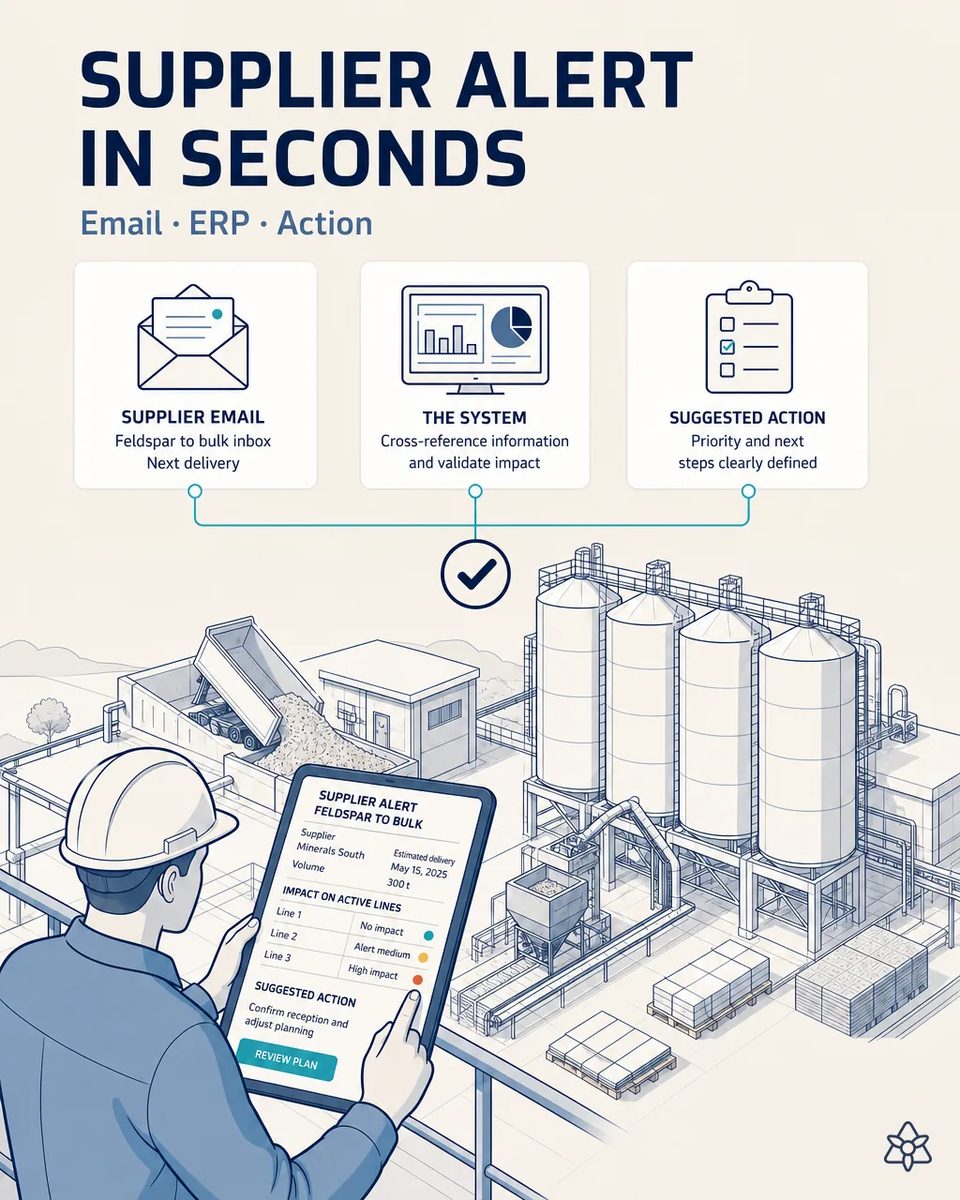
The delay notice is read when the line is already waiting for the material.
Critical supplier alerts arrive by email to people who can't watch the inbox in real time. By the time they're read, planning decisions are already broken — and on a multi-line continuous process, that break spreads.
- Clay, feldspar, sand and glaze frits arrive by bulk truck or big bag, and the suppliers warn of delays the way they always have: by email, to the buyer's personal inbox.
- The buyer is not watching the inbox in real time. The notice is read hours later, often when a line is already scheduled to start with that material and the mill or the glaze preparation is already committed. Nobody is at fault; the channel was simply never designed for urgency.
- Mill feed recipes and glaze preparation are planned days ahead. A frit delay discovered on the day of the startup leaves a glazing line without its glaze and a press without its next format.
- And in a continuous multi-line process the break does not stay local: the atomizer, the press, the glazing line and the kiln all lose their sequence at once, and the kiln cannot simply be paused. What was a supply problem becomes a production problem on six lines.
Connect in chaotic-sources mode — the supplier inbox, read 24/7 in silent copy.
Connect chaotic-sources mode — a mailbox in silent 24/7 copy. A language model extracts intent (supply delay) and entities (supplier, material, dates), cross-references the ERP, and returns the concrete action to the right role.
The supplier keeps writing to the same address and the buyer keeps reading the same inbox. What changes is that a silent copy is read the moment it lands, and the planner gets the affected line and the concrete action, not just a forwarded email. The decision is still theirs; it is simply made hours earlier. In a process that cannot stop cheaply, those hours are the difference between a sequence change and a stopped line.
The supplier email today versus the email read on arrival
| Aspect | Today | With iLEAN Connect |
|---|---|---|
| Time until the delay is known | Hours, when someone opens the inbox | Seconds |
| Material and quantity affected | Read and interpreted by hand | Extracted from the email text |
| Which line and startup it hits | Worked out in a meeting | Cross-referenced with the ERP |
| Glaze preparation for the next color | Discovered short of frit | Replanned in advance |
| Who receives the action | Whoever was copied | The role that has to decide |
| Supplier's way of writing | — | Unchanged, any format |
Hours of human latency → seconds. Replanning decisions based on the lines' real-time state, not on an email read hours later.
Impact estimate — to be validated with your numbers.
The block below is an estimate to be validated against your plant's actual data. We put it forward so the committee has an order of magnitude; we refine it during the assessment.
- Estimated payback 3-7 months, depending on how often supplier alerts arrive.
- Unplanned stops avoided when the cause is a notice that was read too late, not a material that truly could not be replaced.
- From hours of human latency to seconds between the supplier's email and the planner's decision. The planner on duty sees the alert with the affected line already named.
- Replanning based on the real state of the lines, not on an email read after the sequence has already broken.
Avoided unplanned stops from miscommunication, estimated payback 3-7 months depending on alert frequency. *Estimate to validate*.
And the fair question from the production manager
“Can it tell a delay notice from an order confirmation?” — classifying the intent of a supplier email and pulling out material, quantity and dates is an anchored task, where the best models drop below 1.5% error [1]. And nothing is replanned automatically: the suggested action goes to a planner, who confirms or discards it, and that decision is recorded. Over time, that record shows which suppliers and materials cause most replanning.
[1] OpenAI paper "Why Language Models Hallucinate", 2025 — on the reliability of AI in anchored tasks.
What people ask about reading raw-material supplier emails
Do clay and frit suppliers have to change how they write to us?
No. The model reads the email as it arrives, in free text or with an attachment, and in the supplier's own language. Nobody outside the plant has to do anything new. New suppliers are recognized from their first email.
Which raw materials does it recognize?
The ones in your ERP material master: clays, feldspars, sands, frits, pigments and inks. Supplier names and trade references are matched against that master. A material that does not appear in the master is flagged for purchasing to classify, not guessed.
Does it reschedule the press and glazing lines on its own?
No. It proposes the action and names the affected line and startup, and a planner decides. The final word on the sequence stays with a person. What the system saves is the hours between the email and the moment someone realizes it matters.
Does it read the buyer's private email?
Only the mailbox or the copy you decide to connect, usually a shared purchasing address. Nothing else is read or stored. Access is agreed with IT and can be withdrawn at any time.
What about supplier notices that arrive at night or on a weekend?
They are read the moment they arrive, and the alert reaches the planner on duty, which is exactly when a continuous process needs it most. The kiln does not stop on Saturday, and neither does the risk of a missing frit on Monday.
More cases from this series
- The glaze printer, fully linked to the ERPHow iLEAN links the digital glaze printer to the ERP so the design recipe travels with no manual…
- The line lead's knowledge no longer dies at shift's endHow the line lead dictates incidents while walking between lines, hands-free.
- The kiln control panel, now connectedHow an external camera digitizes the firing curve of an isolated roller kiln, without touching its SCADA.
- The lab spreadsheet, connected to the ERP in real timeHow iLEAN automatically pushes the quality lab's spreadsheet to the ERP, with license savings.
- The raw-material delivery note, straight to the ERP by photoHow one photo of the delivery note and batch labels pushes everything to the ERP, with no typing.
- Nothing reaches the ERP without human verificationHow iLEAN checks every captured data point with a human before it reaches the ERP, in seconds.
Tell us how your raw-material suppliers warn you of a delay today.
We work on your plant's real data, not ours. Assessment with no commitment.
Request estimated ROI within 48h ‹ See all cases of porcelain tile See ceramics