The lab spreadsheet, connected to the ERP in real time
The quality manager fills a spreadsheet every shift with hardness, water absorption, strength and caliber data, in a folder the ERP never sees. iLEAN Connect detects the spreadsheet, absorbs it in real time, and after validation pushes it to the ERP automatically.
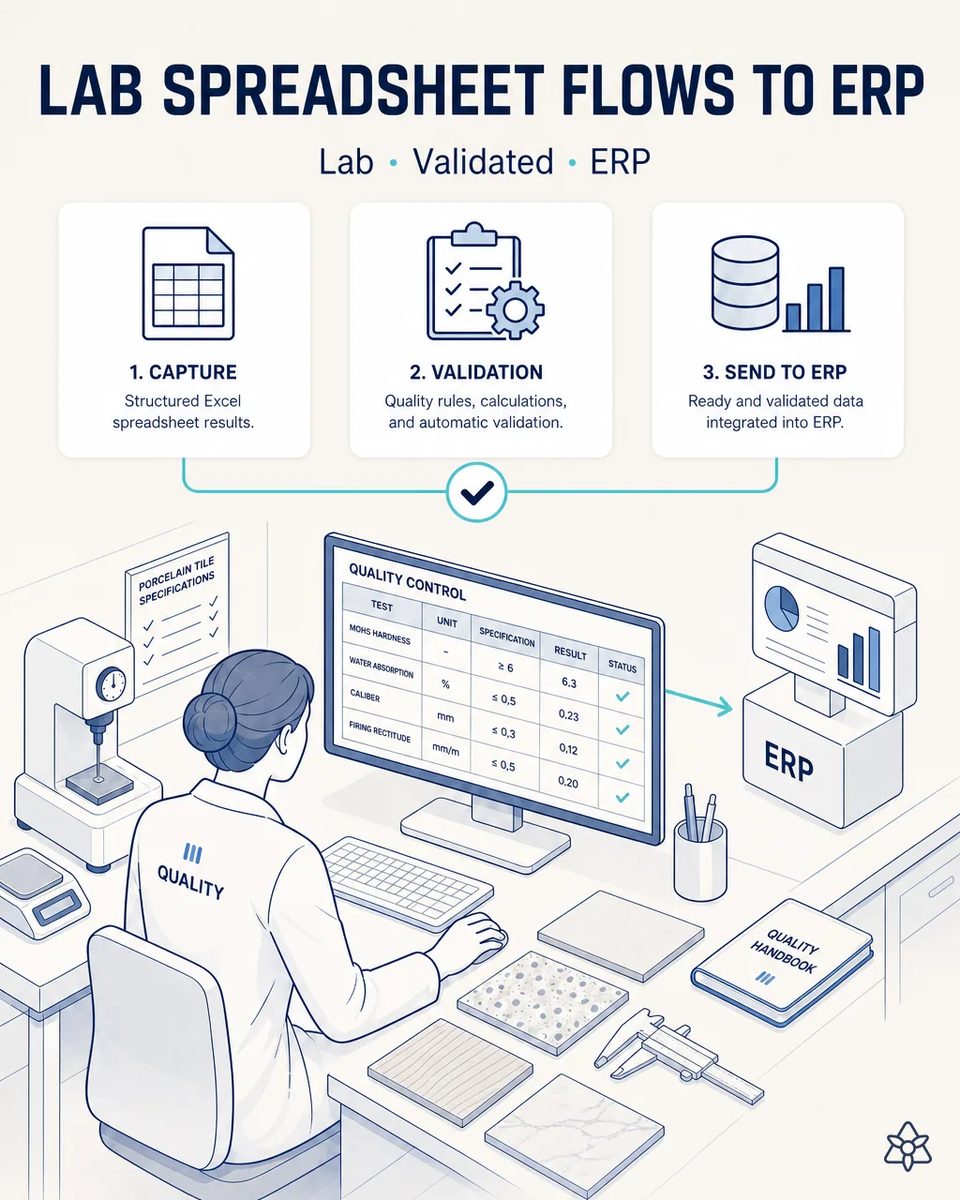
The lab results live in one spreadsheet and the official record in another world.
Two parallel worlds — the real spreadsheet (live data) and the official ERP (data transcribed weeks later by someone copy-pasting).
- Every shift the quality lab measures water absorption, breaking strength, surface hardness, caliber and rectitude and writes them in a spreadsheet on a shared folder. It is quick, flexible and the lab trusts it. The problem is not the spreadsheet; it is that nothing reads it except the person who filled it in.
- That spreadsheet is the real data. The ERP holds a version transcribed weeks later by someone copying and pasting cells, with whatever gaps the copy leaves. A decimal comma moved or a row pasted one line too low is enough to misstate a batch.
- Transcription errors show up at the worst moment: when a customer asks for the declaration of performance of a batch, or when a batch has to be reclassified to another quality class. The answer has to be rebuilt from the spreadsheet, under time pressure.
- Several people log into the ERP's quality module only to type results, and each of them is a named license paid every year. The license is not paid for analysis; it is paid for typing.
Connect in listen-inward mode — the folder is read, nobody copies cells.
Connect's "listen inward" mode — watches the shared folder, reads the exact delta when the file is saved, parses it with a grounded language model, validates on screen, pushes to the ERP via API.
The lab keeps its spreadsheet exactly as it is. When it is saved, iLEAN reads only what changed, a supervisor validates on screen, and the results reach the ERP via API. The licenses that existed only for typing stop being needed, and that is the line the CFO reads first. For the lab, the change is simpler: the result exists officially the moment it is saved.
Tile lab results on a shared drive versus results posted to the ERP
| Aspect | Today | With iLEAN Connect |
|---|---|---|
| Lag between lab result and ERP | Weeks | Zero |
| Hours per month copying cells | Several, every month | Zero |
| Water absorption per batch | In the spreadsheet only | In the ERP, validated |
| Declaration of performance data | Rebuilt by hand | Available by batch |
| The lab's own template | Untouchable, so it is retyped | Read as it is, even as it changes |
| Named users in the lab module | One per person typing | One, the supervisor who validates |
Weeks of lag → zero latency. Hours/month transcribing → zero.
Impact estimate — to be validated with your numbers.
The block below is an estimate to be validated against your plant's actual data. We put it forward so the committee has an order of magnitude; we refine it during the assessment.
- Estimated payback 4-9 months.
- CFO angle: a typical 50-80% reduction in quality and lab-module ERP licenses, from several named users to one, recurring every year.
- From weeks of lag to zero latency between the lab test and the official record.
- And the hours spent every month copying cells drop to zero, so the lab spends that time testing instead of typing. Customers asking for batch data get it the same day.
CFO angle — typical 50-80% reduction in quality/lab-module ERP licenses (from several user licenses to one). Estimated payback 4-9 months. *Estimate to validate*.
And the fair question from the production manager
“Our spreadsheet has merged cells and notes everywhere — will it hold up?” — that is the expected case: parsing does not rely on fixed positions, it interprets columns, units and margin notes as they are. It is an anchored task, where the best models drop below 1.5% error [1], and a supervisor validates on screen before anything is pushed to the ERP. A value outside the physical range of the test is flagged instead of posted.
[1] OpenAI paper "Why Language Models Hallucinate", 2025 — on the reliability of AI in anchored tasks.
What people ask about connecting the quality lab spreadsheet
Does the tile lab have to standardize its spreadsheet?
No. Asking the lab to change its template is the quickest way to make a project fail. iLEAN reads the one in use today, as it is. If the template evolves, the reading adapts without a project.
Which tile tests does it cover?
Whatever the spreadsheet holds: water absorption, breaking strength and modulus of rupture, surface hardness, caliber, rectitude, warpage and shade, among others. Results that come from a test bench report can also be read if they are saved to the same folder.
Can lab-module ERP licenses really be cut?
It depends on your ERP contract, which is why it is framed as an estimate to validate against last year's invoice. Anyone who logs in only to type results stops needing to. The supervisor who validates keeps their license; the rest stop logging in only to copy.
Does it read the whole lab file every time it is saved?
No, only the change since the last save. That keeps the push fast and avoids duplicating results already in the ERP. If a result is corrected later in the spreadsheet, the correction is detected and shown for validation again.
Does it help with tile batch reclassification?
Yes. When results are in the ERP by batch, deciding whether a batch moves to another quality class is a query, not a search through files. The same applies when a customer asks for the declaration of performance data of a specific batch.
More cases from this series
- The glaze printer, fully linked to the ERPHow iLEAN links the digital glaze printer to the ERP so the design recipe travels with no manual…
- The line lead's knowledge no longer dies at shift's endHow the line lead dictates incidents while walking between lines, hands-free.
- The kiln control panel, now connectedHow an external camera digitizes the firing curve of an isolated roller kiln, without touching its SCADA.
- The raw-material delivery note, straight to the ERP by photoHow one photo of the delivery note and batch labels pushes everything to the ERP, with no typing.
- The supplier's alert, in seconds, not hoursHow iLEAN reads raw-material delay notices in real time and replans before the line actually stops.
- Nothing reaches the ERP without human verificationHow iLEAN checks every captured data point with a human before it reaches the ERP, in seconds.
Tell us how many people log into your ERP only to type lab results.
We work on your plant's real data, not ours. Assessment with no commitment.
Request estimated ROI within 48h ‹ See all cases of porcelain tile See ceramics