The line lead's knowledge no longer dies at shift's end
The line lead spends the shift walking between interconnected lines with their hands busy. Nobody asks them anything because they can't type. With iLEAN Connect's earpiece mode, they dictate while walking and the system structures the incident and returns support in seconds.
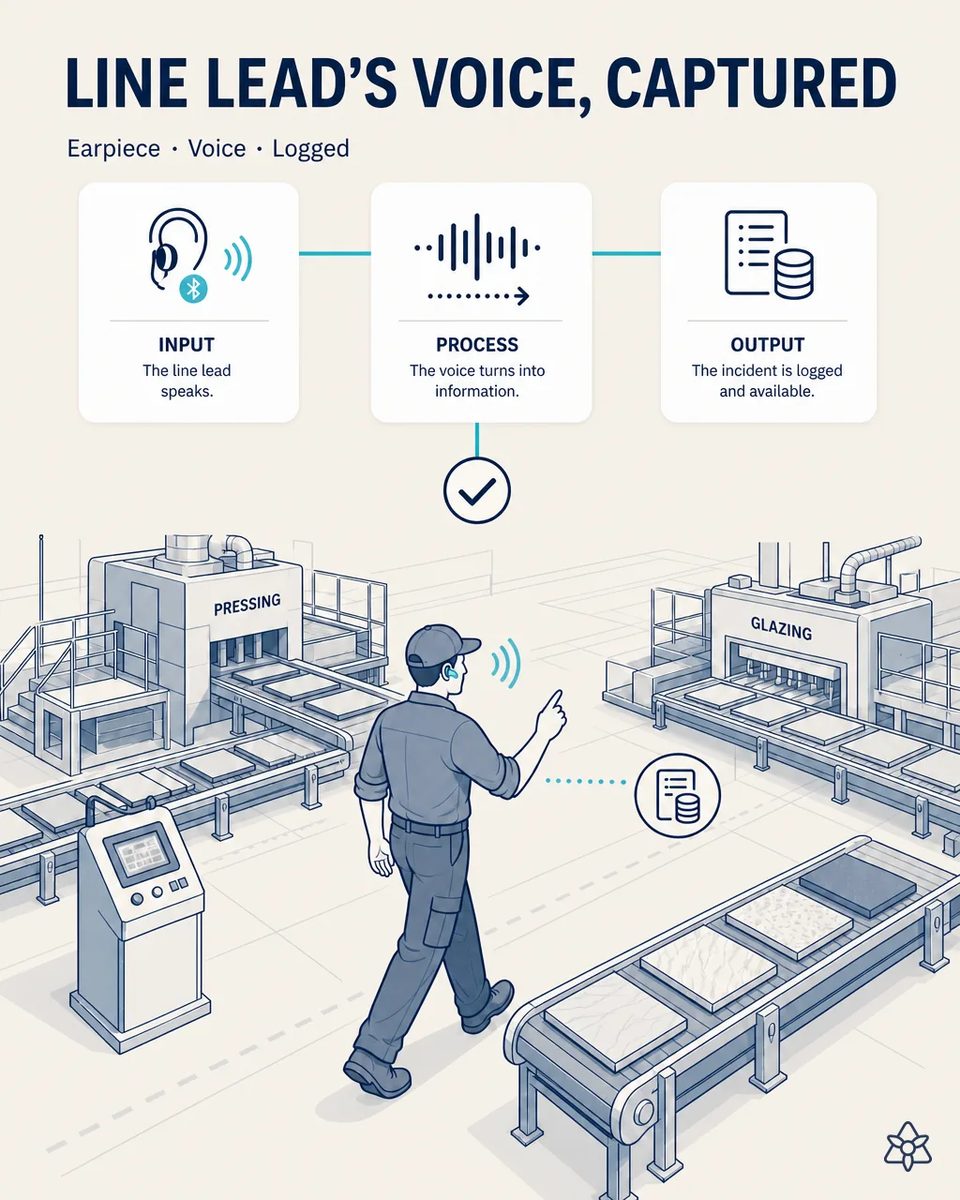
How the lines affect each other is only known by whoever walks between them.
Critical operational knowledge about how the lines behave relative to each other lives in the line lead's head and never enters the system in real time.
- The line lead spends the shift on foot: from the press to the dryer, from the glazing line to the kiln entry, with hands busy and no keyboard within reach.
- They are the person who knows that a pressure drift at press 2 shows up as edge chipping on the glazing line, or that a slow kiln entry backs up the boxes of fresh tiles waiting to be fired.
- That knowledge is passed on verbally at shift change, or in a few lines on the shift report. Most of it never enters any system, and nobody asks for it because nobody expects the line lead to stop and type.
- So continuous improvement works on the incidents that were written down, which are rarely the ones that explain how the lines interfere with each other. The rest leaves the plant at the end of every shift.
Connect in voice mode — a custom wake word, and the incident is dictated walking.
Connect voice mode. Custom wake-word. A language model structures the dictation as an incident linked to the active line/shift. Feedback by voice or push.
Nobody asks the line lead to stop and type. They say the wake word, describe what they see, and keep walking. The incident lands tied to the line and the shift, next to the live data of the other lines, and the line lead gets support back in seconds. Over a month, those dictations become the map of how the lines really interfere with each other.
The line lead's knowledge today versus knowledge captured by voice
| Aspect | Today | With iLEAN Connect |
|---|---|---|
| Incidents seen between lines | Remembered until shift change | Dictated on the spot |
| Link to line and shift | Reconstructed afterwards | Automatic from context |
| Press drift seen at glazing | A comment in the handover | A record tied to both lines |
| Feedback to the line lead | None | By voice or push in seconds |
| Recurring cross-line problems | Invisible in the reports | Searchable by line and cause |
| Line lead's hands and attention | Busy | Still on the line |
Knowledge dying at shift's end → entering the system in real time and cross-referenced with live data from the other lines.
Impact estimate — to be validated with your numbers.
The block below is an estimate to be validated against your plant's actual data. We put it forward so the committee has an order of magnitude; we refine it during the assessment.
- No standalone payback: we do not put a figure on it because its value is hard to monetize upfront, and we prefer to say so.
- It is an enabling piece: every real continuous-improvement project on a multi-line process depends on this information existing.
- Knowledge that died at shift's end enters the system in real time, cross-referenced with live data from the other lines.
- The value is best sized with your continuous-improvement manager, against the cross-line incidents you cannot explain today. The first weeks of dictations usually show which ones they are.
Hard to monetize upfront, but all real continuous improvement on a multi-line process depends on this information existing. *Estimate to validate* with the continuous-improvement manager.
And the fair question from the production manager
“Will it understand a dictated incident with kiln noise behind it?” — turning a short dictation into an incident with line, machine and symptom is an anchored task, because the lines, machines and defect names come from a closed list, and there the best models drop below 1.5% error [1]. And whatever the system understands is read back to the line lead by voice, so a wrong line or machine is corrected before it is stored. Nothing dictated reaches the ERP without passing the same human verification as the rest.
[1] OpenAI paper "Why Language Models Hallucinate", 2025 — on the reliability of AI in anchored tasks.
What people ask about the line lead's voice earpiece
Does the line lead have to learn voice commands?
Only the wake word. After that they speak naturally, as they would to a colleague on the radio, and the system structures the incident. There is no menu to navigate and no form to fill in.
Does it work with the noise of presses and the kiln?
The earpiece is chosen for industrial noise and the wake word is tuned on site. It is tested during commissioning on your own floor, next to the presses. If the dictation is not understood, the system asks again instead of guessing.
Is the line lead's voice recorded all shift?
No. Only what is said after the wake word is processed. The rest of the shift is not recorded or stored. This is usually agreed with the works council before deployment, and it is part of the configuration.
How does it know which line a dictated incident belongs to?
From what is said and from context: the lines active in that shift and the machine named in the dictation, both confirmed back to the line lead by voice. A correction takes one sentence and does not need the line lead to stop walking.
What does the line lead get back after dictating?
A short confirmation and, when relevant, support: a similar earlier incident, the last format change on that press or the current state of the kiln. That turns the earpiece into a tool the line lead wants to use, not one more reporting duty.
More cases from this series
- The glaze printer, fully linked to the ERPHow iLEAN links the digital glaze printer to the ERP so the design recipe travels with no manual…
- The kiln control panel, now connectedHow an external camera digitizes the firing curve of an isolated roller kiln, without touching its SCADA.
- The lab spreadsheet, connected to the ERP in real timeHow iLEAN automatically pushes the quality lab's spreadsheet to the ERP, with license savings.
- The raw-material delivery note, straight to the ERP by photoHow one photo of the delivery note and batch labels pushes everything to the ERP, with no typing.
- The supplier's alert, in seconds, not hoursHow iLEAN reads raw-material delay notices in real time and replans before the line actually stops.
- Nothing reaches the ERP without human verificationHow iLEAN checks every captured data point with a human before it reaches the ERP, in seconds.
Tell us how your line leads pass on what they see between lines today.
We work on your plant's real data, not ours. Assessment with no commitment.
Request estimated ROI within 48h ‹ See all cases of porcelain tile See ceramics