The kiln control panel, now connected
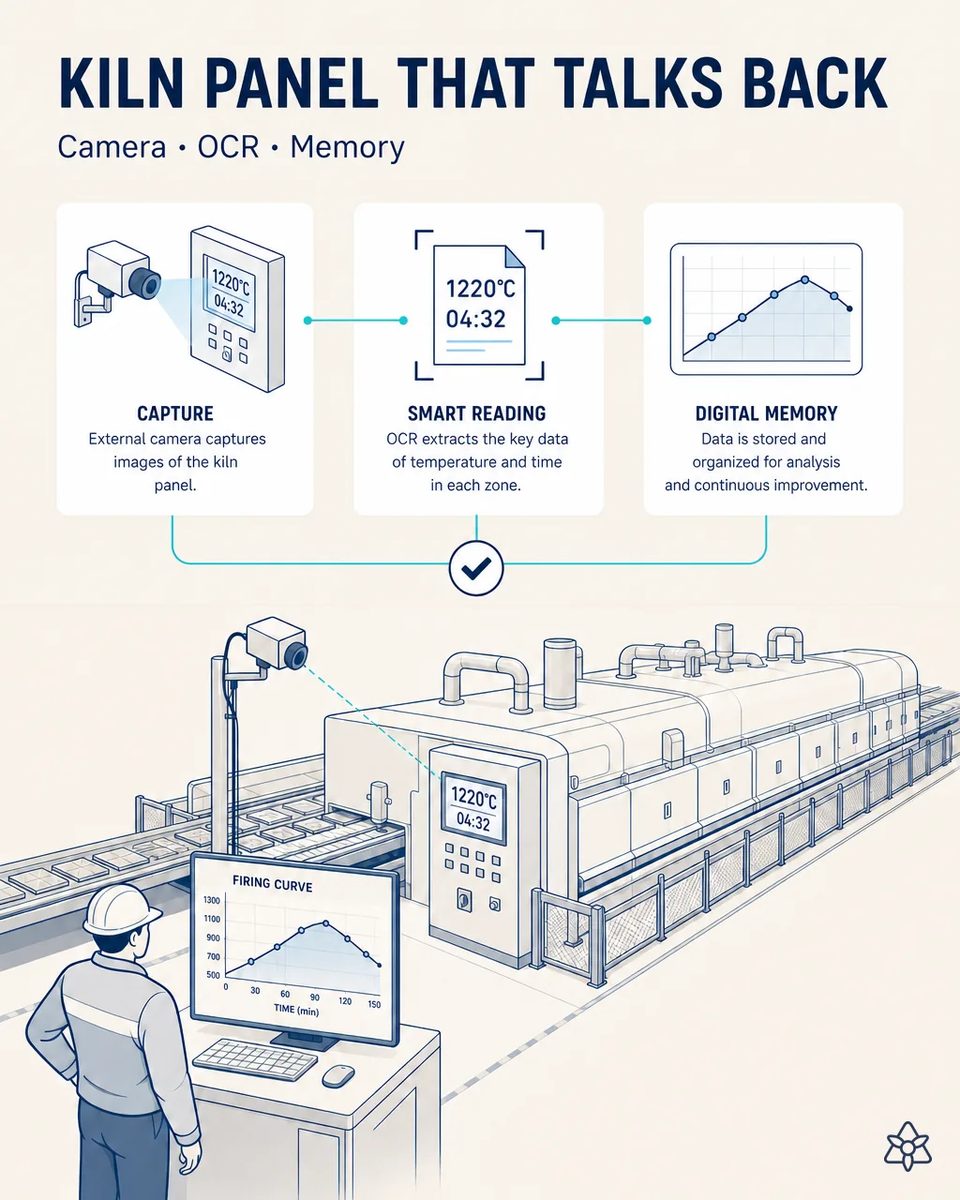
A porcelain tile plant's roller kiln is often over a decade old, runs on an isolated network, and its panel shows the temperature curve, roller speed and energy consumption — the most expensive data in the whole line. With iLEAN Connect, an external camera points at the panel: the kiln stays the same, but the plant now has the firing curve digitized in central memory, batch by batch.
The most expensive data in the plant lives on a screen nobody records.
The kiln is the thermal bottleneck and the most expensive asset across the interconnected lines. Its panel shows everything a continuous-improvement manager would need to correlate the firing curve with defects and energy use, but today nobody does because the panel's data isn't stored in a structured way.
- The roller kiln is the thermal bottleneck and the most expensive asset across the interconnected lines. Many run for more than a decade on an isolated network, by the kiln builder's decision, and nobody wants to touch them.
- Its panel shows everything that matters: temperature by zone, roller speed, firing cycle time and energy consumption. It is the richest data source in the plant and the least used. It changes every minute and is gone the next.
- Nobody stores it in a structured way. When a batch comes out with black core, warpage or shade drift, there is no curve to put next to the defect, only the memory of whoever was on shift.
- So the continuous-improvement manager cannot answer the question that decides the scrap: was it the paste, the glaze or the firing? And without that answer, replacing the kiln starts to look like the only option.
Connect in photo mode on the panel — read from outside, the kiln untouched.
Connect photo mode on the panel. Fixed industrial camera + OCR with a grounded language model interprets every frame, structures the temporal curve per batch, and cross-references it with the ERP (which batch was firing at that moment).
Nothing is installed in the kiln's control system, no port is opened and its builder's support is not affected. A camera reads what the panel already shows, and that is enough to give each batch its own firing curve. On the most expensive machine in the plant, solving it from outside is what makes the case approvable.
The kiln panel today versus the kiln panel being read
| Aspect | Today | With iLEAN Connect |
|---|---|---|
| Firing curve per batch | Visible on screen, then lost | Digitized and stored by batch |
| Roller speed and cycle time | Read by eye during rounds | Time series in central memory |
| Black core or warpage root cause | Argued, not proven | Curve next to the defect in minutes |
| Batch firing at a given minute | Guessed from the schedule | Cross-referenced with the ERP |
| The kiln's SCADA and network | — | Untouched, still isolated |
| Kiln replacement capex | On the investment plan | Postponable |
Zero curve-defect correlation → root-cause analysis per batch in minutes. Kiln replacement becomes postponable indefinitely.
Impact estimate — to be validated with your numbers.
The block below is an estimate to be validated against your plant's actual data. We put it forward so the committee has an order of magnitude; we refine it during the assessment.
- Estimated payback 5-10 months.
- Scrap reduction from correlating the firing curve with defects, a correlation that simply cannot be made today.
- Avoided capex: a kiln that can be read stops being a kiln that has to be replaced, and the replacement can be postponed indefinitely.
- Root-cause analysis per batch goes from impossible to minutes, and energy use per square meter becomes visible by format.
Estimated payback 5-10 months, avoided kiln-replacement CAPEX, scrap reduction from curve-defect correlation. *Estimate to validate*.
And the fair question from the production manager
“Can a camera reading a kiln panel be trusted for root cause?” — the screen is fixed, the fields sit in known positions and each zone has a physical temperature range, which makes it an anchored task where the best models drop below 1.5% error [1]. And any frame with a value outside the kiln's possible range is discarded instead of stored, so it never contaminates the curve that the analysis rests on. Each stored value keeps the frame it was read from, so anyone can check it later.
[1] OpenAI paper "Why Language Models Hallucinate", 2025 — on the reliability of AI in anchored tasks.
What people ask about reading the roller kiln panel
Does the kiln builder need to be involved?
No. Nothing is installed in the kiln's control system and its network stays isolated, so neither its configuration nor its support contract is affected. The camera is mounted on its own bracket in front of the panel, outside the kiln's electrical cabinet.
How often is the kiln panel read?
Often enough to rebuild the firing curve of every batch. The frequency is set at commissioning according to the firing cycle and the number of zones shown on the panel. A batch is rarely missed, because a firing cycle lasts far longer than the interval between readings.
How does it know which batch was in the kiln?
It cross-references the reading time with the ERP schedule and the transit time through the kiln, so each segment of the curve is assigned to the batch firing at that moment. That is what makes it possible to put a black core or a warpage claim next to the exact curve that fired it.
Does it also capture the kiln's energy consumption?
Yes, if the panel shows it. That allows energy per square meter to be compared by format and by firing curve, which is rarely possible on an older kiln. It is also the first data the plant needs before discussing burner tuning or a cycle change with the kiln builder.
What if the kiln screen has glare or labels in another language?
The camera position and lighting are adjusted on site, and the reading does not depend on the language of the labels, only on where each value sits on the screen. If the panel layout ever changes, the reading positions are updated, not the kiln.
More cases from this series
- The glaze printer, fully linked to the ERPHow iLEAN links the digital glaze printer to the ERP so the design recipe travels with no manual…
- The line lead's knowledge no longer dies at shift's endHow the line lead dictates incidents while walking between lines, hands-free.
- The lab spreadsheet, connected to the ERP in real timeHow iLEAN automatically pushes the quality lab's spreadsheet to the ERP, with license savings.
- The raw-material delivery note, straight to the ERP by photoHow one photo of the delivery note and batch labels pushes everything to the ERP, with no typing.
- The supplier's alert, in seconds, not hoursHow iLEAN reads raw-material delay notices in real time and replans before the line actually stops.
- Nothing reaches the ERP without human verificationHow iLEAN checks every captured data point with a human before it reaches the ERP, in seconds.
Tell us how old your roller kiln is and what its panel shows today.
We work on your plant's real data, not ours. Assessment with no commitment.
Request estimated ROI within 48h ‹ See all cases of porcelain tile See ceramics