The glaze printer, fully linked to the ERP
The digital printer that decorates every piece before firing is modern and has an API, but is isolated from the ERP: the recipe is selected manually. With iLEAN, the design recipe and batch travel automatically from the active line, with no manual selection.
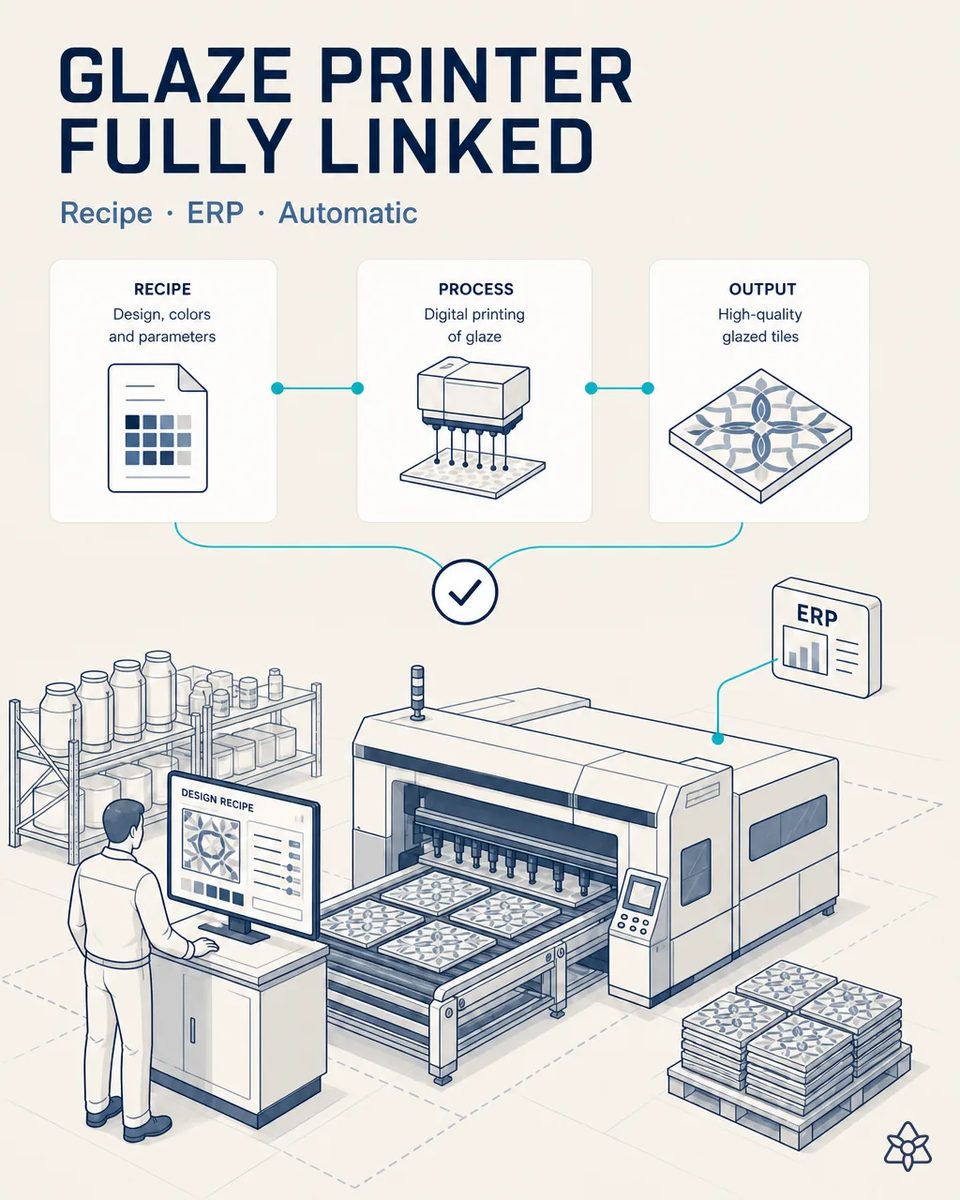
The last aesthetic decision before the kiln is a manual selection.
The digital printer is the last aesthetic decision before an irreversible process. A wrong recipe selection turns into a full-run scrap, undetected until the kiln exit.
- The digital inkjet printer that decorates every tile is modern and has an API, but it is isolated from the ERP: the operator picks the design recipe from a list. The ERP knows which design the order needs; the printer does not.
- A collection can have dozens of designs and graphic variations, with similar names and formats that differ by a few centimeters. Under the pressure of a startup, the wrong one is one click away. The printer accepts any recipe it has; it has no way of knowing which order is active.
- A wrong pick is not visible on the glazing line. The tile only shows its real color after firing, so the error is discovered at the kiln exit, when the whole run is already fired.
- At that point there is no rework: a full run of the wrong design or shade is scrap or a downgrade, and the kiln time spent on it is lost too. On a continuous line, the next run is already waiting behind it.
Connect between two modern systems — the ERP publishes the recipe to the printer.
Connect links two modern systems via API. When the ERP/MES flags a line startup with a specific format/design, it automatically publishes the matching recipe to the printer.
When the ERP or MES marks a line startup with a format and a design, the matching recipe and batch are published to the printer. The operator no longer chooses; they confirm what has already arrived. It is the shortest integration in the matrix and one of the fastest to pay back. Neither system is replaced; they simply start talking to each other.
Recipe selection today versus recipe published from the ERP
| Aspect | Today | With iLEAN Connect |
|---|---|---|
| How the design recipe is chosen | Picked from a list by the operator | Published from the active order |
| Batch on the printer | Typed or omitted | Travels with the recipe |
| Similar design names | A source of mistakes | Irrelevant: the code travels |
| When a wrong pick is found | At the kiln exit | Not made |
| Full-run scrap from recipe error | Several times a year | Zero of human origin |
| Inkjet printer software | — | Untouched, linked via its API |
Monthly recipe-selection errors (with associated scrap) → zero human-origin error.
Impact estimate — to be validated with your numbers.
The block below is an estimate to be validated against your plant's actual data. We put it forward so the committee has an order of magnitude; we refine it during the assessment.
- Estimated payback 3-6 months, one of the fastest in the matrix.
- It comes from the drastic reduction in the risk of scrapping a full fired run because of a wrong recipe.
- Monthly recipe-selection errors, with their associated scrap, drop to zero errors of human origin.
- And every fired run carries a trace of which recipe it was printed with and which order it came from. That trace closes a shade or design complaint in minutes.
Fast payback, 3-6 months, from the drastic reduction in full-run scrap risk. *Estimate to validate*.
And the fair question from the production manager
“And if the ERP order itself carries the wrong design?” — then the error would come from the order, not from the link, and that is why the printer shows the received recipe for the operator to confirm before printing. Matching an order's format and design code with the printer's recipe library is an anchored task, where the best models drop below 1.5% error [1], and here it is mostly a deterministic API lookup. If the code does not exist in the printer's library, nothing is loaded and the operator is warned.
[1] OpenAI paper "Why Language Models Hallucinate", 2025 — on the reliability of AI in anchored tasks.
What people ask about linking the inkjet printer to the ERP
Do we need to change the inkjet printer's software?
No. iLEAN uses the API the printer already has. Its software and its recipe library stay as they are. The printer supplier does not need to change anything on their side.
What if our glaze printer has no API?
Then the case changes: it is approached like the kiln panel, reading the screen from outside. Most modern inkjet printers do have one. It is checked in the first technical visit, before anything is promised.
Does it also send the ink and head settings?
It sends whatever the recipe in the printer's library includes. The design recipe is defined once, and the link makes sure the right one is loaded. Head and ink parameters stay under the control of the printer and its technicians.
Can the operator still override the design recipe?
Yes, with a reason that is recorded. What disappears is the silent manual pick with no trace. If overrides repeat on a design, that is a signal that the ERP master or the recipe library needs fixing.
Does it work with several inkjet printers on different lines?
Yes. Each printer receives the recipe of the order active on its own line, so a recipe cannot land on the wrong line. The link also records which printer printed which run, which helps when a shade complaint arrives.
More cases from this series
- The line lead's knowledge no longer dies at shift's endHow the line lead dictates incidents while walking between lines, hands-free.
- The kiln control panel, now connectedHow an external camera digitizes the firing curve of an isolated roller kiln, without touching its SCADA.
- The lab spreadsheet, connected to the ERP in real timeHow iLEAN automatically pushes the quality lab's spreadsheet to the ERP, with license savings.
- The raw-material delivery note, straight to the ERP by photoHow one photo of the delivery note and batch labels pushes everything to the ERP, with no typing.
- The supplier's alert, in seconds, not hoursHow iLEAN reads raw-material delay notices in real time and replans before the line actually stops.
- Nothing reaches the ERP without human verificationHow iLEAN checks every captured data point with a human before it reaches the ERP, in seconds.
Tell us how many design recipes your inkjet printers hold today.
We work on your plant's real data, not ours. Assessment with no commitment.
Request estimated ROI within 48h ‹ See all cases of porcelain tile See ceramics