Surface defects, caught before packaging
At kiln-exit speed, the human eye tires and lets through pieces with a crack, a glaze bubble or a shade variation. iLEAN Edge places a camera at the line exit, infers in milliseconds per piece, and rejects it before packaging.
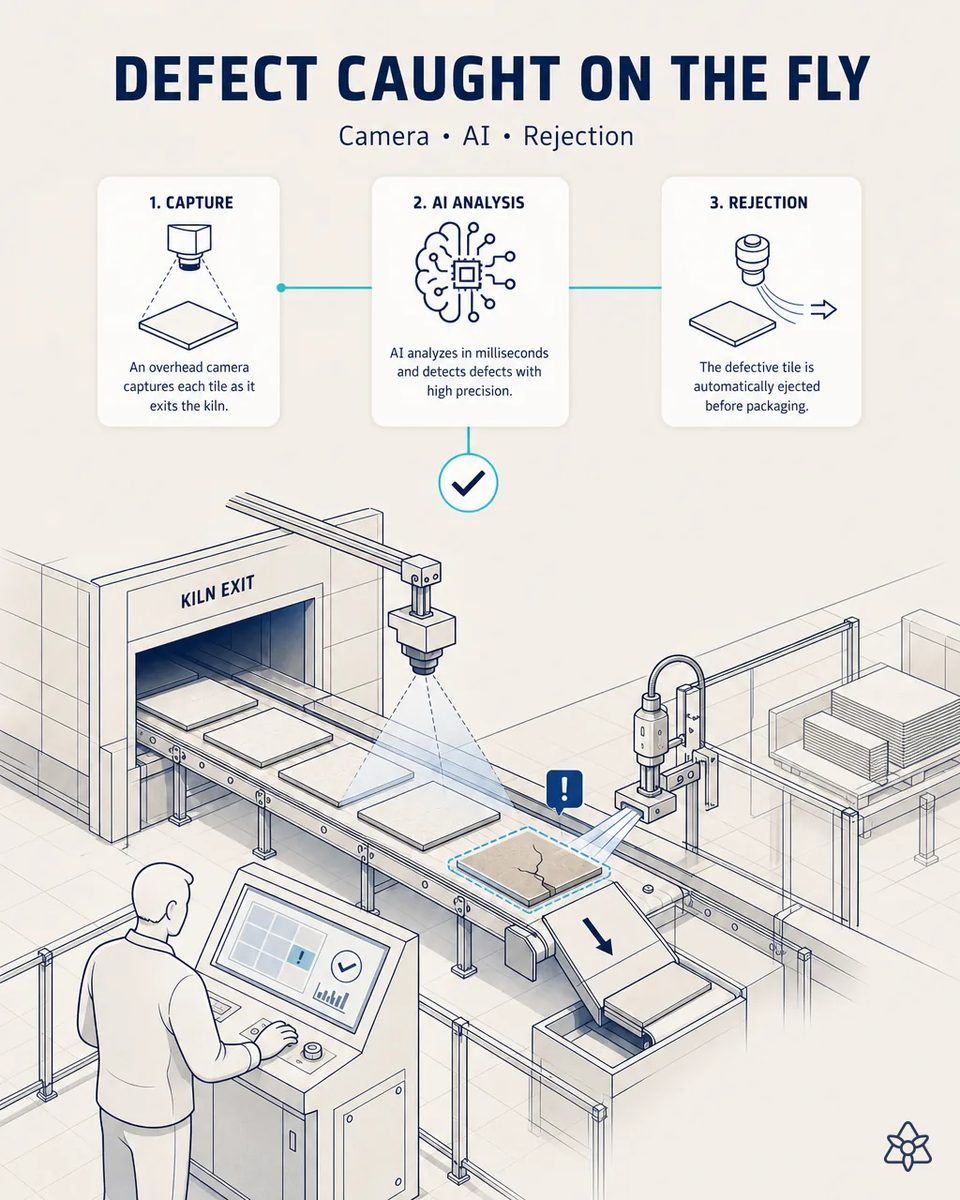
Human visual control at line speed is an inspection by sampling.
100% human visual control is impossible at real line speed. Sampling inspection leaves gaps that end up as full-pallet returns.
- At kiln-exit speed, thousands of square meters pass in front of the sorting line every shift. The human eye tires and lets through tiles with a hairline crack, a glaze bubble, a pinhole or a slight shade variation.
- 100% human visual control is not possible at real line speed. What actually exists is a sample, and the quality of that sample changes with the hour of the shift. Night shifts and long runs of the same design are where it drops most.
- The gaps in that sample end up as claims and full-pallet returns, because a single visible defect on a laid floor discredits the whole batch. The installer stops laying and the claim covers the whole lot, not one tile.
- And on large formats and rectified pieces, every tile that goes out defective costs more than on a small format, in freight, in claims and in reputation with the distributor. A distributor who receives one bad pallet looks at the next ten more carefully.
Edge — a local vision model at the kiln exit, every tile, in milliseconds.
Edge — local CNN vision, trained on the plant's actual format and collection, with no need to send images to the cloud.
The model is trained on your actual formats and collections, not on a generic catalog, and inference runs on the line. No image has to leave the plant for a tile to be classified before it reaches packaging. The sorting team stops looking at every tile and starts deciding on the doubtful ones. And the criterion no longer depends on who is on shift or how many hours they have been at it.
Kiln-exit inspection today versus inspection with Edge
| Aspect | Human inspection | With iLEAN Edge |
|---|---|---|
| Share of tiles inspected | A sample | 100% of the pieces |
| Hairline cracks and pinholes | Missed when the eye tires | Classified tile by tile |
| Glaze bubbles and shade variation | Depends on the shift | Constant criterion |
| Point where a defective tile is caught | At the customer | Before packaging |
| Tile images leaving the plant | — | None: local inference |
| Doubtful tiles at sorting | Pass or fail by intuition | Escalated to a person |
Partial sampling → 100% piece control. Visual-defect claims → drastic reduction.
Impact estimate — to be validated with your numbers.
The block below is an estimate to be validated against your plant's actual data. We put it forward so the committee has an order of magnitude; we refine it during the assessment.
- Estimated payback 5-12 months, depending on your current scrap ratio. The higher your claims today, the shorter it is likely to be.
- From partial sampling to control of 100% of the pieces at kiln exit.
- A drastic reduction in visual-defect claims and in returns of full pallets.
- And each rejection is stored with its image, which shows which defect is growing and on which format, before it becomes a claim. That data is also useful upstream, at the press and on the glazing line, to remove the cause.
Estimated payback 5-12 months depending on current scrap ratio, reduced claims and returns. *Estimate to validate*.
And the fair question from the production manager
“What if it rejects good tiles because of the design?” — on decorated porcelain the graphic itself can look like a defect, which is why the model is trained on good and bad pieces of your own collections. Classifying a known defect on a known design is an anchored task, where the best models drop below 1.5% error [1]. And borderline pieces are not simply rejected: they are escalated to a person, and every decision feeds back into training. The threshold for rejecting is agreed with quality, not imposed by the model.
[1] OpenAI paper "Why Language Models Hallucinate", 2025 — on the reliability of AI in anchored tasks.
What people ask about kiln-exit vision inspection
Can it tell a marble vein from a crack?
Yes, because it is trained on your actual designs. A vein that belongs to the graphic and a crack that does not have different patterns once the model has seen enough of both. That is why training starts from your own reject history and not from a generic defect catalog.
Does it keep up with the speed of the kiln-exit line?
Yes. Inference is local and takes milliseconds per piece, independent of the plant network and the cloud. A line stop for the network does not stop the inspection.
Does it replace the sorting operators?
No. It takes the repetitive part off them and escalates the doubtful pieces, which is where a person adds most value. The team moves from looking at every tile to deciding on the few that matter.
What happens when a new tile collection is launched?
The model is extended with pieces of the new design before production starts, so the first run is already covered. Pieces from the pre-series or the design samples are usually enough to start.
Does it measure shade or only surface defects?
The case covers cracks, glaze bubbles and shade variation as visual defects. Classifying shade into commercial tones can be added later on the same camera. What matters first is that no defective piece reaches the pallet.
More cases from this series
- The glaze printer, fully linked to the ERPHow iLEAN links the digital glaze printer to the ERP so the design recipe travels with no manual…
- The line lead's knowledge no longer dies at shift's endHow the line lead dictates incidents while walking between lines, hands-free.
- The kiln control panel, now connectedHow an external camera digitizes the firing curve of an isolated roller kiln, without touching its SCADA.
- The lab spreadsheet, connected to the ERP in real timeHow iLEAN automatically pushes the quality lab's spreadsheet to the ERP, with license savings.
- The raw-material delivery note, straight to the ERP by photoHow one photo of the delivery note and batch labels pushes everything to the ERP, with no typing.
- The supplier's alert, in seconds, not hoursHow iLEAN reads raw-material delay notices in real time and replans before the line actually stops.
Tell us what share of your claims come from visual defects today.
We work on your plant's real data, not ours. Assessment with no commitment.
Request estimated ROI within 48h ‹ See all cases of porcelain tile See ceramics