Format change without paper on the pressing line
Every format change on a porcelain tile pressing line starts with a printed work order and a hand-filled mold-adjustment sheet. Both documents define the batch, but today they disappear into a folder until someone collects them at the end of the shift. With iLEAN Connect, the operator takes two photos and the batch already exists in the central system at zero latency, with no change to their routine.
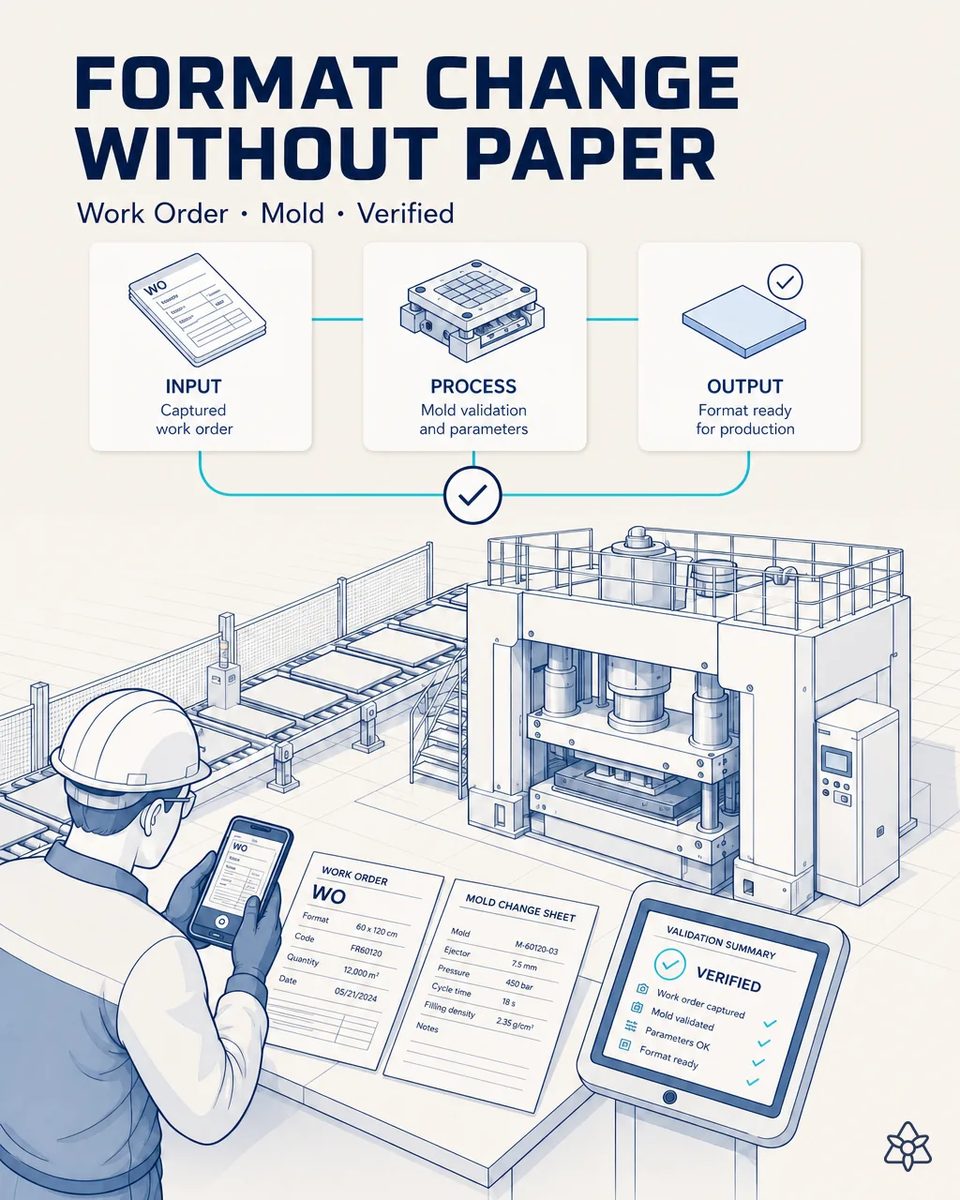
The press setting that explains a caliber problem sits in a folder.
The shift's work order is printed from ERP data, and any mold or pressure adjustment gets noted by hand. The format-change sheet stays on paper for 4-8 hours before digitization. If a caliber issue shows up later at the kiln, nobody can quickly correlate it to the actual press setting.
- The shift's work order prints from the ERP with format, collection and target square meters. Everything that happens afterwards at the press — die set, ejector height, specific pressure, fill density — is written by hand on the mold-change sheet.
- That sheet stays on paper for 4-8 hours, until someone collects the folder at the end of the shift and types it, if they type it at all. Over a weekend the gap is longer, and the press keeps running. During that gap the batch exists physically but not in any system anyone can query.
- When a caliber or flatness problem appears at the kiln exit or at sorting, the question is always the same: what pressure and which spray-dried powder batch was the press running at that moment?
- Answering it means going down to the line, finding the right folder and reading a handwritten figure. By the time it is done, the next two batches have already been pressed with the same setting, and the problem has moved downstream to glazing and firing. Every hour the setting stays wrong is more tiles that will be downgraded at sorting.
Connect in photo mode — two photos at the press, and the batch exists.
Connect photo mode. A grounded language model extracts structured fields (format, caliber, thickness, paste batch, pressure) from the photos and stores them in iLEAN's central memory the instant they're taken. Zero habit change for the press operator.
The press operator keeps filling in the same sheet with the same pen. The only new gesture is two photos, and from that second the format change is a record you can search by batch, not a sheet you have to go and find. That is why it is usually the first case a tile plant approves: it asks the floor for almost nothing.
Format change on paper versus format change captured at the press
| Aspect | Today, on paper | With iLEAN Connect |
|---|---|---|
| Mold-change sheet in the system | 4-8 h later, typed by hand | At the moment of the photo |
| Specific pressure and fill density | Handwritten, rarely transcribed | Structured fields per batch |
| Spray-dried powder batch on the press | Inferred afterwards | Linked to the format change |
| Caliber deviation found at sorting | Hunt for the folder | One lookup by batch |
| Reconstructing a past format change | Hours of searching | Instant web query |
| Press operator's routine | — | Unchanged: two photos |
4-8h latency → zero latency. Manually reconstructing a past format change → instant web lookup by batch.
Impact estimate — to be validated with your numbers.
The block below is an estimate to be validated against your plant's actual data. We put it forward so the committee has an order of magnitude; we refine it during the assessment.
- Estimated payback 4-9 months, depending on the number of format changes per month.
- The production lead's transcription time is recovered every shift, and it stops being the bottleneck for knowing what the press did.
- From 4-8 hours of latency down to zero: the format change exists in the system before the first tile reaches the dryer.
- And reconstructing a past change goes from an afternoon in the archive to an instant lookup by batch, which is what a caliber claim actually needs. The answer to the customer stops depending on who remembers the shift.
Estimated payback 4-9 months depending on monthly format changes, recovering the production lead's transcription time. *Estimate to validate*.
And the fair question from the production manager
“What if it misreads the pressure on a handwritten sheet?” — reading fields from a document whose layout never changes is an anchored task, where the best models drop below 1.5% error [1]. And there is a second net: specific pressure and fill density have a physical range for each press and format, so a value outside it is flagged for the operator to confirm before it is stored.
[1] OpenAI paper "Why Language Models Hallucinate", 2025 — on the reliability of AI in anchored tasks.
What people ask about capturing the press format change
Do we have to redesign the mold-change sheet for the presses?
No. The sheet is read as it is today, including the handwritten notes in the margins, which are usually where the real adjustment is written. Changing the template would only add friction on the floor.
Which fields come out of the work order and mold sheet photos?
Format, caliber, thickness, paste or spray-dried powder batch and pressure, plus any adjustment noted by hand. The exact list of fields is agreed with your production lead at commissioning.
Does it work if each press uses a slightly different sheet?
Yes. Each press can keep its own version; the model learns the layout of each one and tags the capture with the press it came from, so nothing gets mixed between presses.
Does the press format change need an ERP connection from the start?
No. The batch lives first in iLEAN's central memory and the push to the ERP is connected later, once the value is visible on the floor and the data has been checked for a few weeks. That order also lets quality see the captured fields before anyone touches the ERP.
Can a caliber problem at sorting be traced back to the press?
That is the main use: from the sorting batch you go straight to the format change, the pressure and the powder batch that produced it, in one query instead of a walk to the archive.
More cases from this series
- The glaze printer, fully linked to the ERPHow iLEAN links the digital glaze printer to the ERP so the design recipe travels with no manual…
- The line lead's knowledge no longer dies at shift's endHow the line lead dictates incidents while walking between lines, hands-free.
- The kiln control panel, now connectedHow an external camera digitizes the firing curve of an isolated roller kiln, without touching its SCADA.
- The lab spreadsheet, connected to the ERP in real timeHow iLEAN automatically pushes the quality lab's spreadsheet to the ERP, with license savings.
- The raw-material delivery note, straight to the ERP by photoHow one photo of the delivery note and batch labels pushes everything to the ERP, with no typing.
- The supplier's alert, in seconds, not hoursHow iLEAN reads raw-material delay notices in real time and replans before the line actually stops.
Tell us how long a format change takes to exist in your system today.
We work on your plant's real data, not ours. Assessment with no commitment.
Request estimated ROI within 48h ‹ See all cases of porcelain tile See ceramics