JIDOKA AI applied to mold, color and material changeovers
An interiors plant lives in changeover: mold, color, material, revision. Every changeover means the best part of an hour of downtime and, at the same time, it is the exact moment when the expensive mistakes slip in. With iLEAN Edge, fixed cameras at each critical point compare the current state against the reference state, and the line does not start until they all read conforming and the lead signs on what they can see.
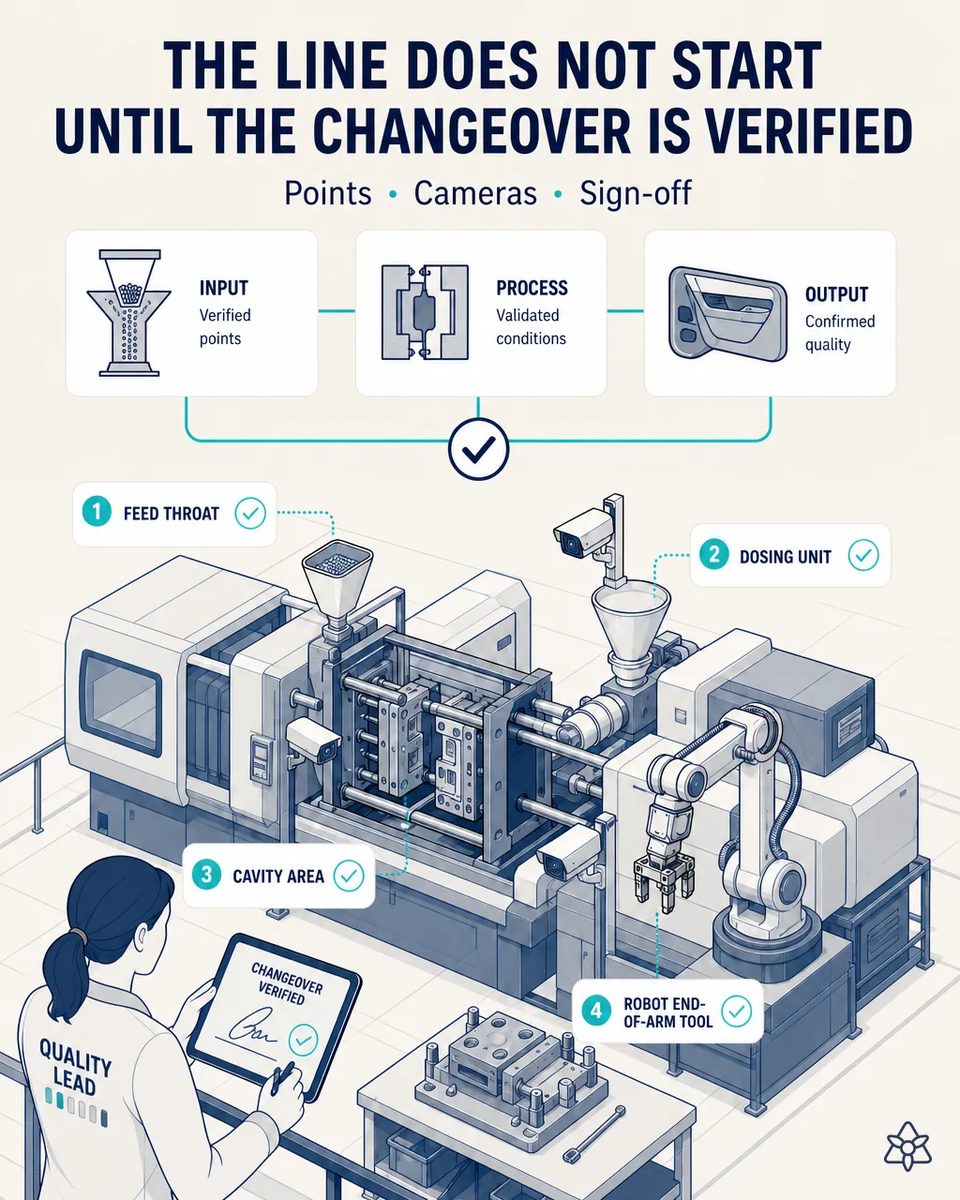
The five changeover mistakes all produce parts that look fine.
The five classic changeover mistakes are always the same: previous material not fully purged, wrong masterbatch, a cavity left blocked off from the last shift, the robot end-of-arm tool from the other mold, and the previous packaging container with its old label still on. Any one of the five produces parts that look fine. The pre-start check exists — there is a checklist — but it gets signed from memory, because whoever signs it has forty minutes of downtime weighing on them and the pressure to start. It is a problem of time, not of willingness. And the consequence does not show at the changeover: it shows in the first hundred parts if you are lucky, and at the customer if you are not. Material contamination and starting up on the previous setup are among the most expensive and least documented causes of non-quality in this sub-sector.
- Previous resin not fully purged, wrong masterbatch, a cavity still blocked off from the last shift, the robot end-of-arm tool from the other mold, and the previous packaging container with its old label still on.
- The pre-start checklist exists. It gets signed from memory, because whoever signs it has forty minutes of press downtime weighing on them and the pressure to start.
- The consequence does not show at the changeover: it shows in the first hundred parts if you are lucky, and at the OEM if you are not.
- Material contamination and starting up on the previous setup are among the most expensive and least documented causes of non-quality in interiors molding.
Edge plus JIDOKA AI — the line does not start until every point reads conforming and the lead signs.
Edge plus JIDOKA AI. Fixed industrial cameras at each critical changeover point, with models trained to recognize "ready versus not ready" at each one: resin color at the feed throat, octabin label, visible mold number, free cavities, correct robot tool, packaging container and label. Start-up stays blocked until every camera reads conforming and the lead signs on visual evidence. And SMED AI sequences and overlaps the changeover tasks so verification falls into dead time: the goal is a changeover just as short or shorter, but with evidence.
The camera does not decide alone: it compares each point against its reference state for that mold and color, and it is the lead who signs on what they can see. SMED AI sequences and overlaps the tasks so the verification falls into dead time: the goal is a changeover just as short or shorter, but with evidence. The signature at the end is the same one as today; what changes is what stands behind it.
Today's changeover versus the verified changeover
| Aspect | Today | With iLEAN Edge |
|---|---|---|
| Resin color at the feed throat | Assumed purged | Read against the reference |
| Octabin and masterbatch label | Glanced at | Verified before start-up |
| Blocked cavity from last shift | Found in the first parts | Detected before the first shot |
| Robot end-of-arm tool | Right one, usually | Confirmed by camera |
| Packaging container and label | Old label still on | Verified before the first part is packed |
| Changeover time | Best part of an hour | Just as short or shorter, with SMED AI |
from a blind signature at the end of a long changeover to a signature backed by point-by-point evidence · from finding contamination in the first parts or at the customer to being unable to start with it · from a changeover lengthened by verification to one just as short or shorter, thanks to SMED AI.
Impact estimate — to be validated with your numbers.
The block below is an estimate to be validated against your plant's actual data. We put it forward so the committee has an order of magnitude; we refine it during the assessment.
- Estimated payback 5-10 months, depending on changeover frequency.
- The first contaminated lot after a changeover, eliminated.
- Machine minutes recovered per changeover on a large-tonnage press, multiplied by the number of mold and color changeovers per week.
- And a signature backed by point-by-point evidence instead of a blind signature at the end of a long changeover.
elimination of the first contaminated lot after a changeover, plus machine minutes recovered per changeover multiplied by the number of changeovers per week. Estimated payback 5-10 months depending on changeover frequency. *Estimate to be validated.*
And the fair question from the production manager
"What if the camera blocks the press for no reason?" — that is the right objection, because the changeover sits on the shift's critical path. Each point is checked against the reference state of that specific mold and color, and in doubt the system does not block silently: it escalates to the lead, who signs on the evidence. Reading a mold number or an octabin label is an anchored task where the best models drop below 1.5% error [1]; the press stops on a verifiable discrepancy, not on model uncertainty.
[1] OpenAI paper "Why Language Models Hallucinate", 2025 — on the reliability of AI in anchored tasks.
What people ask about verifying the changeover
Which points are verified?
The ones behind the classic mistakes: resin color at the feed throat, octabin and masterbatch label, visible mold number, free cavities, correct robot end-of-arm tool, packaging container and label. They are defined with your tooling team at commissioning, and the reference state is stored per mold and per color.
Does it make the changeover longer?
No, and that is the design goal. SMED AI sequences and overlaps the tasks so verification falls into dead time. The reference is a changeover just as short or shorter, with evidence, because the check takes seconds and the waiting it replaces took minutes.
Does it catch a color change that was not fully purged?
Yes: the resin color at the feed throat is one of the trained states, and it is the most treacherous, because a partial purge produces parts that look fine and fail later.
Can it be overridden when in a hurry?
An exception can be defined with a lead's signature and it is recorded as such. What cannot happen is starting up with no trace of who decided to skip the check, which is the situation the OEM finds when it investigates a contaminated lot.
Is it worth it with few changeovers?
The case scales with changeovers per week. With daily mold and color changes on large-tonnage presses, the recovered minutes and the contaminated lot avoided make the number.
More cases from this series
- Audit evidence, generated at the moment it is producedPhotos, curves, test results and signatures tied to the serial number and organized by standard. From…
- Four verification rings against the customer line stopFour verification rings between the delivery schedule and the dock. If they do not match, the shipment…
- Receiving resin, skins and components, solved with a photoDelivery notes and container labels read by vision, cross-checked against the order and pushed to the…
- Shift knowledge stops dying at handoverA headset and voice capture for whoever walks the shift with both hands busy. The issue structures…
- Lab data stops being retyped by handCMM, color, adhesion and test reports entering the ERP quality module after sign-off. Up to 80% fewer…
- Integrating what you already have: laser marker and weld cellPart number, revision and cavity travel from the ERP to the marker with no keying, and the weld curve is…
Tell us how many changeovers you run a week and how long each one takes.
We work on your plant's real data, not ours. Assessment with no commitment.
Request estimated ROI within 48h ‹ See all cases of plastic interiors See automotive