The AI proposes, the person signs: early human verification
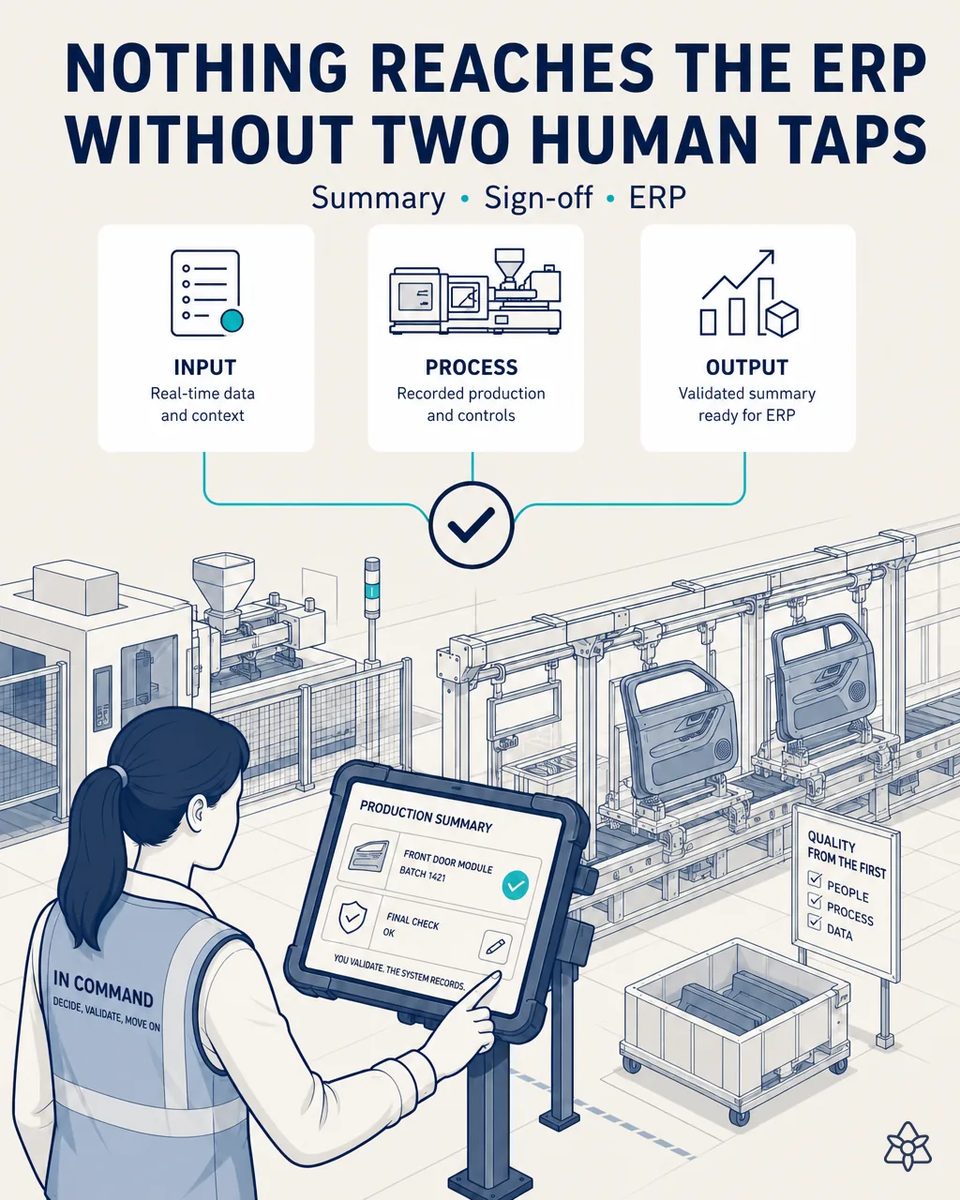
What separates iLEAN from an autonomous AI agent that writes data without a signature is this: nothing the system captures reaches the central system without a human having seen it first. In an interiors plant that means an industrial tablet at the press and at every assembly station, with a two-second visual summary and two taps: confirm or correct.
Either the data is not captured, or it is captured unsigned.
In a certified automotive environment, the fear of AI writing into the ERP on its own is not a cultural prejudice: it is a regulatory issue. The quality and traceability master is auditable evidence and cannot be contaminated with data nobody has signed. But the operator does not want to type either, and rightly so. Every field you ask someone to enter at the machine is a field that will end up filled in badly, late, or from memory at the end of the shift. Without a fast human gate the outcome is always one of two: either the data is not captured, or it is captured unsigned. That deadlock is, in practice, the main brake on shop floor digitization. It is not technological: it is about trust and about time.
- In a plant certified to IATF 16949 the fear of AI writing into the ERP is not a prejudice: the quality and traceability master is auditable evidence and cannot hold data nobody has signed.
- But the operator does not want to type either, and rightly so: every field asked for at the press is a field filled in badly, late or from memory at the end of the shift.
- Without a fast human gate the outcome is always one of two: data not captured, or data captured with no one behind it.
- That deadlock is the real brake on shop floor digitization in this sub-sector. It is not technological: it is about trust and about seconds.
Connect in early human verification mode — the AI proposes, the person signs.
Connect in early human verification mode. Everything the system captures by any route — the photo of the start-up sheet, the panel read by the camera, the parsed email, the voice note, the lab report — appears on the tablet as a visual summary designed to be validated in two seconds, not to enter data. The operator confirms with a tick or corrects with a pencil. Only then does the data cross into the master. Whoever validates is recorded with a timestamp, and that signature becomes part of the evidence the auditor will ask for later.
It is the piece that guarantees the master is not contaminated and that every datum has a name behind it. Without it, in a certified environment, the other eleven cases do not get approved: nobody signs off on AI writing into the system a PPAP or a customer audit depends on. The gate costs two seconds and buys the trust the rest of the matrix runs on.
Today's data entry versus the signed summary
| Aspect | Today | With iLEAN |
|---|---|---|
| When the data enters | Hours later, or never | Seconds, at the press |
| Who appears as the author | Whoever types it | Whoever looked at the part |
| Operator's effort | Walk to a terminal, fill fields | Two taps: confirm or correct |
| What the signature proves | That a box was ticked | Which summary they saw, and when |
| Writing to the quality master | Unsigned or delayed | Only after human confirmation |
| Training needed | A procedure per field | None |
from "either unvalidated data contaminating the ERP or data never captured out of mistrust" to data captured and signed within seconds · from a paper signature you have to go and find to a traceable signature tied to the lot and serial number · validation latency: seconds, with no training.
Impact estimate — to be validated with your numbers.
The block below is an estimate to be validated against your plant's actual data. We put it forward so the committee has an order of magnitude; we refine it during the assessment.
- No standalone payback: this is the enabling piece of the whole matrix, and it is strategic value rather than a direct business case.
- Without early human verification, in a certified environment the other eleven pieces do not get approved.
- Validation latency drops to seconds, with no training and no walk to a terminal, at the press and at every assembly station down to the functional test.
- And every signature is a timestamped record tied to the lot and serial number: the evidence the IATF 16949 auditor or the OEM process auditor will ask for later.
enabling piece for the whole matrix. Without early human verification, in a certified environment the other eleven pieces do not get approved. *Strategic value rather than a direct business case.*
And the fair question from the production manager
"If a person signs in the end, what is the AI saving?" — the work is not in deciding, it is in assembling. Today somebody would have to go to a terminal, find the order and type the values. Here the start-up sheet, the panel read, the lab result or the voice note arrive already structured, which is an anchored task where the best models drop below 1.5% error [1], and the operator only confirms or corrects. Every correction is stored: the system learns where its extraction fails at that station.
[1] OpenAI paper "Why Language Models Hallucinate", 2025 — on the reliability of AI in anchored tasks.
What people ask about early human verification
Can the AI ever write to the ERP on its own?
No, and it is not a setting: it is the architecture. Data crosses into the master only after a human confirmation on the tablet, with the name and timestamp recorded.
How long does it take the operator?
About two seconds. The summary is designed to be read at a glance, not to enter data: part number, lot, the extracted values, and two buttons: a check to confirm, a pencil to correct.
Where do the tablets go?
At each press and at every assembly station, including the airbag module station and end-of-line functional test. The summary follows the operator who saw the part, so the signature belongs to the person who can actually vouch for it.
What gets recorded for the auditor?
Which summary was shown, who confirmed it, when, and what they corrected. That is the trace a customer process audit or an IATF 16949 auditor asks for, and it exists for every datum, not only for the ones somebody remembered to sign.
Is it mandatory before deploying the other cases?
In practice yes. It is what makes the photo of the start-up sheet, the panel camera or the lab feed approvable, because it is what keeps the master clean. It is usually the first piece quality asks to see working.
More cases from this series
- Audit evidence, generated at the moment it is producedPhotos, curves, test results and signatures tied to the serial number and organized by standard. From…
- Four verification rings against the customer line stopFour verification rings between the delivery schedule and the dock. If they do not match, the shipment…
- Receiving resin, skins and components, solved with a photoDelivery notes and container labels read by vision, cross-checked against the order and pushed to the…
- Shift knowledge stops dying at handoverA headset and voice capture for whoever walks the shift with both hands busy. The issue structures…
- Lab data stops being retyped by handCMM, color, adhesion and test reports entering the ERP quality module after sign-off. Up to 80% fewer…
- Integrating what you already have: laser marker and weld cellPart number, revision and cavity travel from the ERP to the marker with no keying, and the weld curve is…
Tell us whether your team would let an AI write into the ERP — with this piece, the question changes.
We work on your plant's real data, not ours. Assessment with no commitment.
Request estimated ROI within 48h ‹ See all cases of plastic interiors See automotive