The alerts that break the sequence do not arrive over EDI
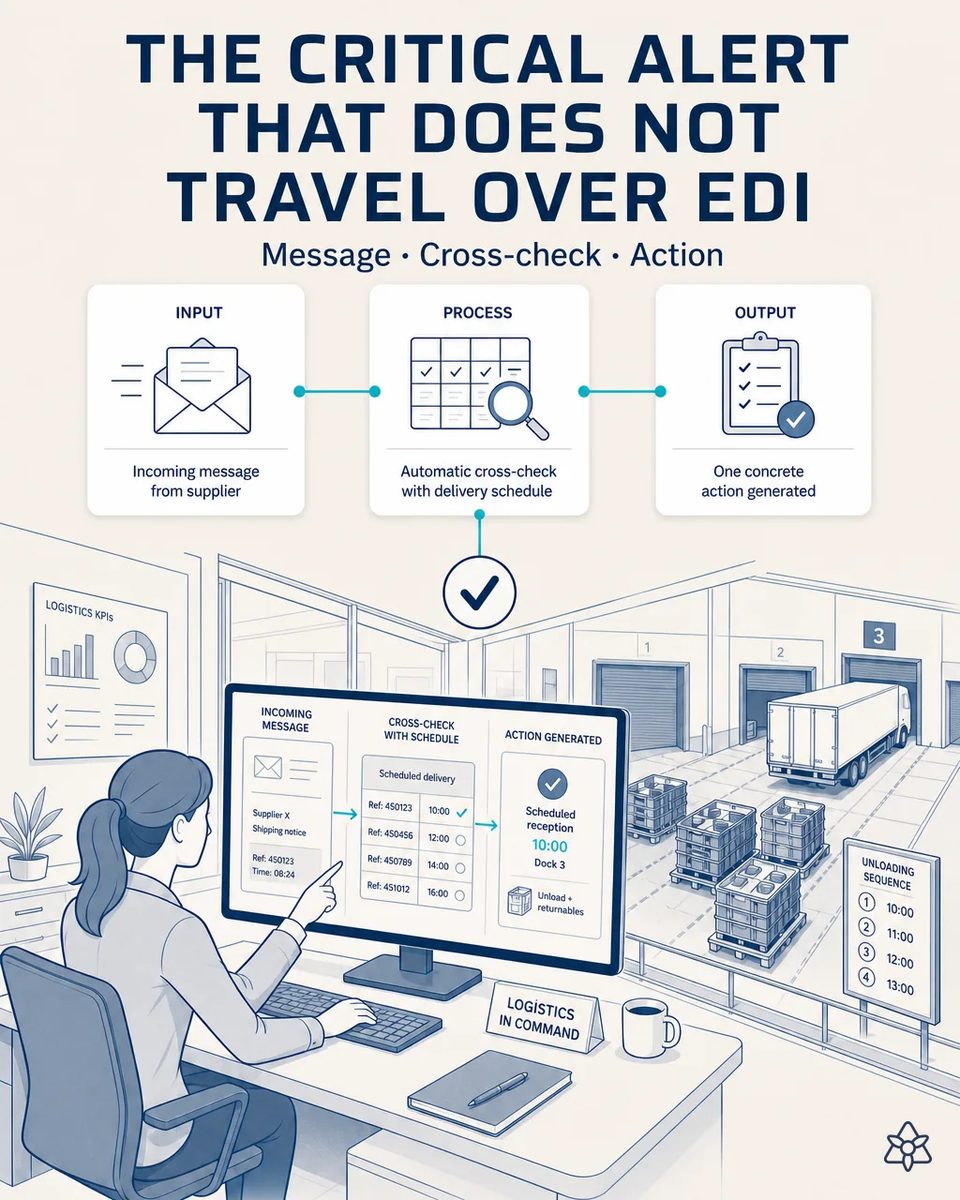
Delivery schedules and sequence calls arrive over EDI and they work. The problem is everything else: the customer planner pulling the start forward by email, the carrier messaging about a delay, the supplier reporting a shortfall, the customer announcing a containment. With iLEAN Connect the system sits on silent copy twenty-four hours a day, cross-checks the alert against the live plan and returns the concrete action to the right role.
In sequenced supply there is no buffer for the email nobody read.
In sequenced supply there is no stock buffer to absorb a surprise. And surprises almost never travel through the formal channel: they travel by email and messaging, into one specific person's inbox — someone who is on the shop floor, in a meeting or on holiday. By the time the alert is read, the staging sequence is already launched. Undoing it costs more than doing it right would have: containers have to be restaged, labels reprinted and, if you are lucky, special freight arranged. Two or three hours of human latency can be the difference between delivering and not delivering. And then comes the uncomfortable part: when the customer asks why nobody reacted, there is no record of what was known and when. The email was in an inbox, and that is not traceability.
- The sequence call and the delivery schedule arrive over EDI and they work. What breaks the day arrives by email or messaging: the OEM planner pulling the start forward, the carrier warning of a delay, the skin supplier reporting a shortfall, the customer announcing a containment.
- It lands in one person's inbox — somebody who is on the floor, in a meeting or on vacation — and competes with a hundred other messages.
- By the time it is read, the staging sequence is already launched: containers have to be restaged, labels reprinted and, with luck, special freight arranged.
- And when the OEM asks why nobody reacted, there is no record of what was known and when. An email in an inbox is not traceability.
Connect in chaotic-sources mode — silent copy, twenty-four hours a day.
Connect in chaotic-sources mode. A dedicated mailbox and messaging number, permanently copied in, without asking anyone to change channel. The moment a message arrives, the system extracts intent (schedule pull-forward, transport delay, revision change, containment notice) and entities (part number, program, quantity, route, supplier) and cross-checks them against live ERP and EDI schedule data. What reaches the right role is not "you have an email": it is the concrete action, with its stock and route implications. The decision stays human; the work of gathering the information does not.
Finding out sooner is not enough: you need to know which containers, which route and which stock are affected, and who has to move. That is what comes back, to the role that must act, while the decision stays human. In a JIS window of a few hours, the difference between reading the message now and reading it after the meeting is the difference between delivering and not delivering.
Today's alert versus the cross-checked alert
| Aspect | Today, in the inbox | With iLEAN Connect |
|---|---|---|
| When it is read | When its recipient opens the email | In minute one, 24/7 |
| Pull-forward of the start | Discovered with containers already staged | Cross-checked against the live sequence |
| Carrier delay | Nobody knew the truck was late | Route and window implications returned |
| Revision change | Found at the OEM goods-in | Flagged before the container is built |
| Special freight | The usual way out | The exception |
| What was known and when | Nothing to show | A traceable record |
from 2-3 hours of human latency to seconds · from replanning on three-hour-old information to replanning on current data · from "nobody knew the truck was late" to a traceable record of what was known and when.
Impact estimate — to be validated with your numbers.
The block below is an estimate to be validated against your plant's actual data. We put it forward so the committee has an order of magnitude; we refine it during the assessment.
- Estimated payback 3-7 months, depending on how often critical alerts arrive outside EDI.
- OEM line stops caused by information that existed but was not read, avoided.
- Urgent special freight you stop paying for, because the pull-forward is known before the staging sequence is launched rather than after the containers are built.
- And replanning on current data instead of on information that is three hours old, with a traceable record of what was known and when.
avoidance of customer line stops caused by missing information and of urgent special freight; estimated payback 3-7 months depending on how often critical alerts arrive outside EDI. *Estimate to be validated.*
And the fair question from the production manager
"Are you going to read my team's email?" — no. iLEAN sits in copy on a dedicated mailbox and a company messaging number: it only sees what the OEM, the carrier and suppliers send to those operational channels. On extraction, classifying the intent of an alert — pull-forward, delay, revision change, containment — is an anchored task where the best models drop below 1.5% error [1], and the action is executed by a person.
[1] OpenAI paper "Why Language Models Hallucinate", 2025 — on the reliability of AI in anchored tasks.
What people ask about reading sequence alerts
Does it replace EDI?
No. EDI carries the delivery schedule and the sequence call, which is its job. This case covers what arrives by hand and breaks the plan: the pull-forward, the delay, the shortfall and the containment notice. Both channels end up cross-checked against the same live plan.
How does it know which containers are affected?
By cross-checking the part number, program and quantity in the message against the live ERP order and the EDI schedule. That is the difference between an alert and an action: not one more email, but these three containers for that program are now due two hours earlier.
Does it tell a containment notice from a routine message?
Yes, and it is the point: a containment on an instrument panel part number is flagged top priority because its cost grows by the hour, while a minor schedule adjustment interrupts nobody.
Does it work with messages in another language?
It is designed for that. An OEM planner writing in one language and a carrier in another is the normal case in sequenced supply, and intent extraction does not depend on the language.
Who receives the action?
The role that must act, not the inbox it landed in: logistics for a pull-forward, quality for a containment, purchasing for a supplier shortfall. The record of who received what, and when, is kept for the day the OEM asks why the container was not on the truck.
More cases from this series
- Audit evidence, generated at the moment it is producedPhotos, curves, test results and signatures tied to the serial number and organized by standard. From…
- Four verification rings against the customer line stopFour verification rings between the delivery schedule and the dock. If they do not match, the shipment…
- Receiving resin, skins and components, solved with a photoDelivery notes and container labels read by vision, cross-checked against the order and pushed to the…
- Shift knowledge stops dying at handoverA headset and voice capture for whoever walks the shift with both hands busy. The issue structures…
- Lab data stops being retyped by handCMM, color, adhesion and test reports entering the ERP quality module after sign-off. Up to 80% fewer…
- Integrating what you already have: laser marker and weld cellPart number, revision and cavity travel from the ERP to the marker with no keying, and the weld curve is…
Tell us how many times a month a late-read email breaks your sequence.
We work on your plant's real data, not ours. Assessment with no commitment.
Request estimated ROI within 48h ‹ See all cases of plastic interiors See automotive