Zero PPM to customer
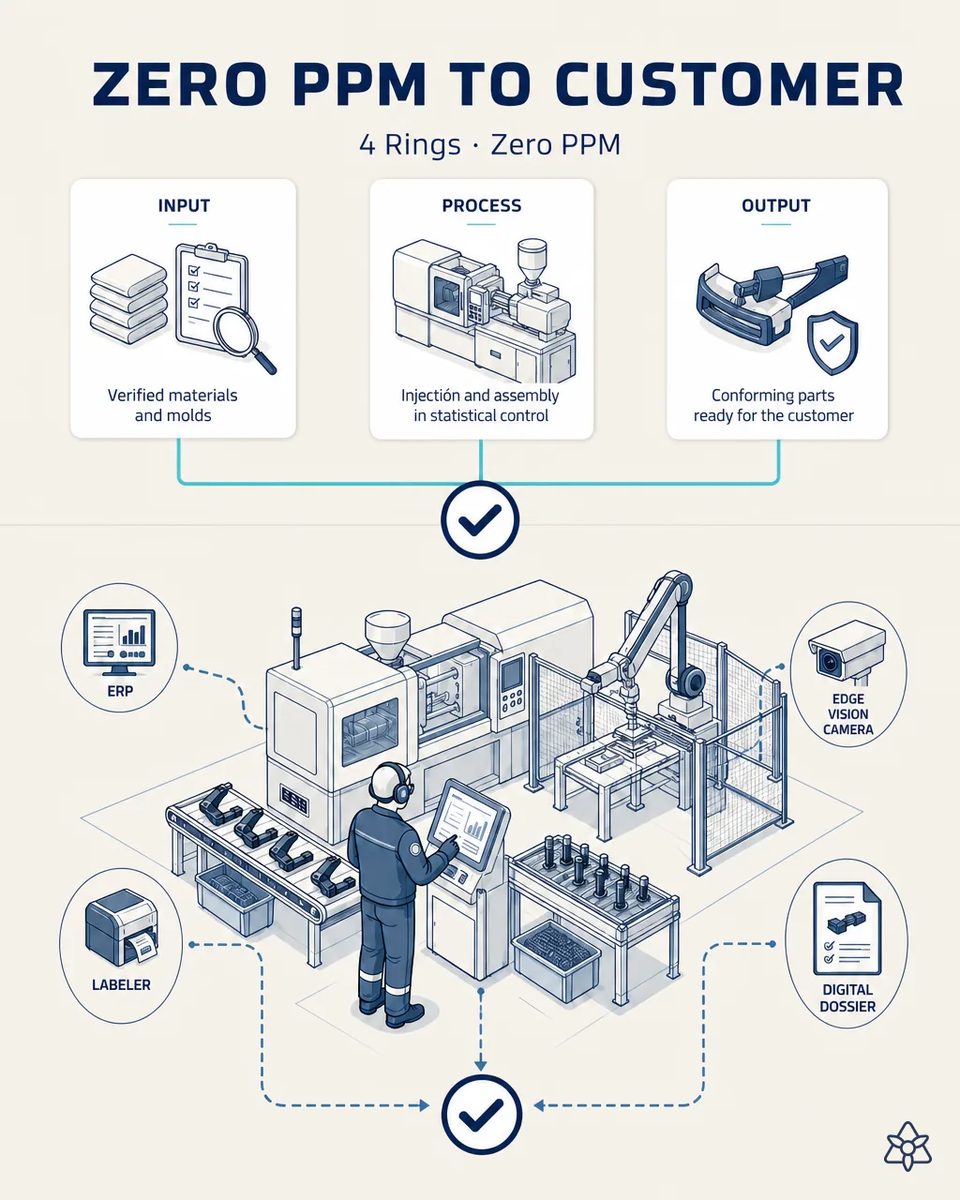
The capital pain of any Tier 1/2/3 automotive plastic injection plant is the same: zero defect PPM reaching the customer. The iLEAN flagship system coordinates the ERP, labeler, Edge vision and evidence dossier in rings that cross-check each other; if anything doesn't match, the line stops before the box leaves the plant.
One escape at the customer costs more than the whole matrix.
A defect or broken traceability reaching the automotive customer is the sub-sector's biggest reputational and contractual risk. Every incident costs anywhere from direct containment expense to the risk of losing future volume with that OEM.
- For a Tier 1, 2 or 3 molder the capital pain is a single number: defect PPM reaching the customer.
- A defect or a broken lot link that gets through is the sub-sector's biggest contractual and reputational risk, and it rarely comes from one failure.
- It comes from a chain: a mold started with the previous parameters, a label typed in a hurry, a cavity drifting toward flash, and a lot released because everything looked fine separately.
- The bill runs from direct containment cost — sorting, special freight, penalties, an external inspector at the customer's plant — to the volume that quietly goes elsewhere on the next award.
Agents coordinates four rings that check each other — everything above, orchestrated.
Ring 1 (ERP) defines mold, parameters, lot and part number. Ring 2 (labeler) prints exactly what the ERP publishes, no manual entry. Ring 3 (Edge) validates the first article and catches defects part by part. If anything doesn't match, JIDOKA AI stops the line while SMED AI speeds up the mold change. Ring 4 (evidence pack) certifies everything matched.
No ring on its own solves it: each one already exists in some form and parts still escape. The strength is the cross-check, because what gives a chain away is four independent sources ceasing to agree with each other. When they disagree, JIDOKA AI holds the line and SMED AI compresses the mold change that follows, so the stop costs minutes instead of a shift.
The four rings, and what each one holds
| Ring | What it holds | What it stops |
|---|---|---|
| 1 · ERP | Mold, parameters, lot and part number | A run started on the wrong setup |
| 2 · Labeler | Exactly what the ERP published | A box identified as something it is not |
| 3 · Edge vision | First article plus every part | The defect that ships in the box |
| 4 · Dossier | Signed evidence per lot | A release nobody can prove |
| When two rings disagree | JIDOKA AI holds the line | The box leaving before anyone checks |
| Mold change on the critical path | SMED AI compresses it | Rigor being traded for minutes |
risk of containment or partial recall at the customer → zero, with discrepancies caught inside the plant, not at the customer.
Impact estimate — to be validated with your numbers.
The block below is an estimate to be validated against your plant's actual data. We put it forward so the committee has an order of magnitude; we refine it during the assessment.
- Estimated payback 6-12 months, measured against the first incident avoided rather than against a productivity line.
- Protection against a containment or lost volume with the customer, which is the cost that never appears in the scrap report.
- Discrepancies caught inside the plant instead of at the customer's receiving dock, which is the entire difference in PPM.
- Protection of a multi-year commercial relationship — worth sizing with your quality lead and plant management, not in a spreadsheet.
protection against containment or lost volume with the customer, protection of the multi-year commercial relationship. Estimated payback 6-12 months against the first incident avoided. Estimate to validate with the quality lead and plant management.
And the fair question from the production manager
"Do we have to deploy all twelve cases to get any of this?" — no, and framing it that way is how a plant never starts. The rings are built in layers and each case pays on its own from the first month: with lot startup and the labeler you already hold ring 1 and ring 2, which is where most of the broken traceability lives. The model reliability question is the same one as everywhere else in this matrix, and on anchored tasks the best models drop below 1.5% error [1].
[1] OpenAI paper "Why Language Models Hallucinate", 2025 — on the reliability of AI in anchored tasks.
What people ask about the complete system
Where do you start in a plant with mixed presses?
With the ring that needs no machine intervention, which is ERP and labeler. The presses over ten years old join later through the panel camera, so their age never becomes the reason the first layer does not get built.
How long does the line stay down when a ring disagrees?
As long as it takes a person to look at the discrepancy, which is normally seconds: the system shows what each ring says and where they diverge. It is a hold with an explanation, not a generic stop.
Is zero PPM realistic or a slogan?
It is the target your customer already writes into the contract, so the question is not whether to aim at it. What this system changes is where the discrepancy is caught: inside your plant, before the box ships, instead of on their line.
Why is a chain of small failures not caught by the controls we already have?
Because each control is designed to judge one thing on its own. A cavity drifting toward flash passes its control, a label typed in a hurry passes its own, and the box that carries both is the one that becomes a containment. Four rings that have to agree with each other are what make the combination visible.
How do we show a customer that this is running?
With the dossier. The evidence per lot is the same artifact they would ask for in an audit, and handing it over is usually what turns the conversation about PPM into a conversation about the next program.
More cases from this series
- Supervisor's voice, liveWith a headset and Connect voice mode, the floor supervisor logs incidents without ever stopping to type.
- The press panel that talksAn external camera reads an old, unnetworked injection press panel; its process parameters get digitized…
- Two-tap validationNothing iLEAN captures reaches the central system without a human confirming it first, in seconds, from…
- Paperless lot startupThe operator photographs the process sheet and traveler card at press startup; the lot exists in the…
- Resin delivery in secondsOne photo of the delivery note and CoA; iLEAN digitizes and traces the lot before it enters the…
- Resin drying straight to ERPiLEAN watches the resin drying control folder, validates the data, and posts it to the ERP. Up to 80%…
Tell us what your last containment at a customer cost you.
We work on your plant's real data, not ours. Assessment with no commitment.
Request estimated ROI within 48h ‹ See all cases of automotive plastic injection See automotive