Two-tap validation
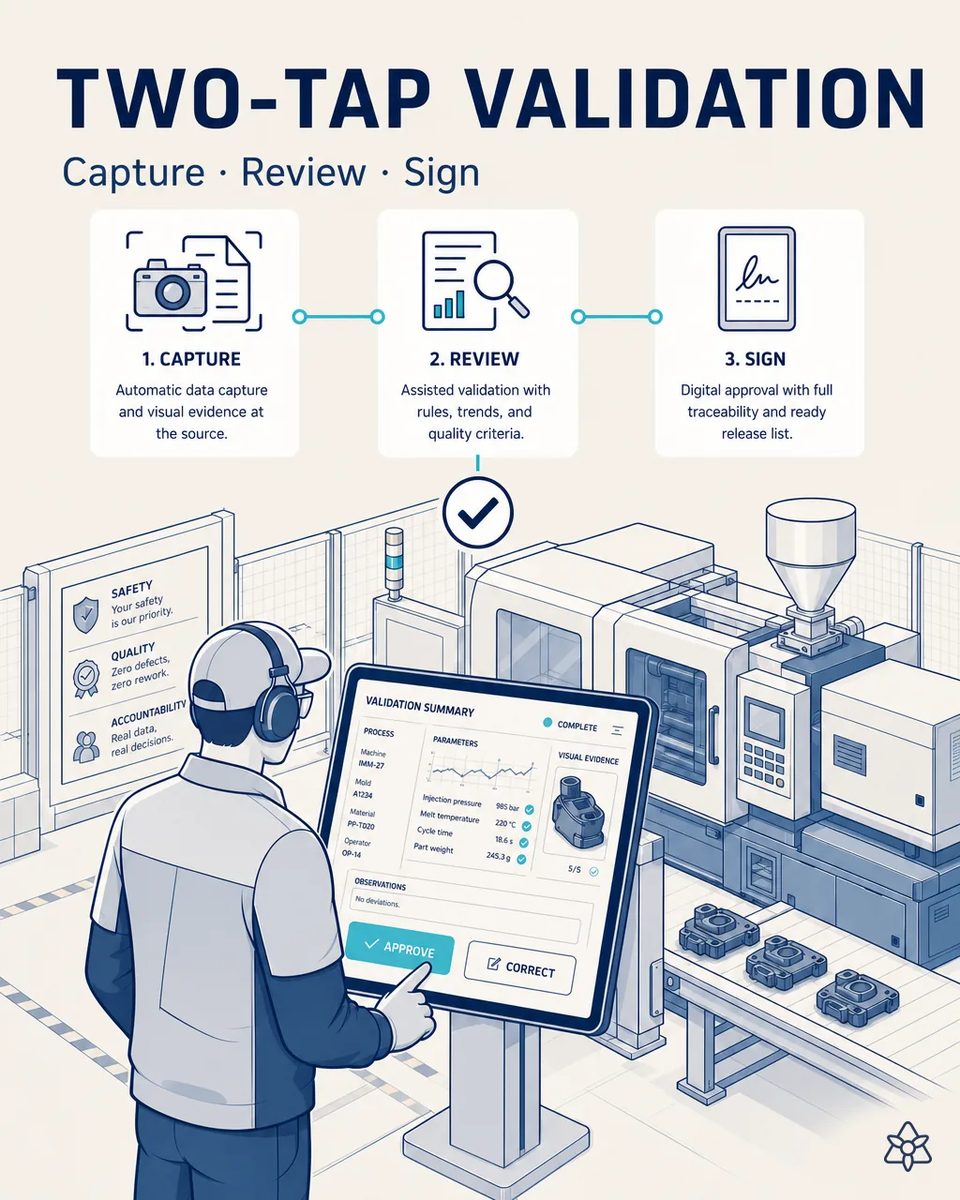
What sets iLEAN apart from an autonomous AI agent that enters data unsigned is this: nothing it captures reaches the central system without a human having seen it first. At every cell, an industrial tablet shows a two-second visual summary; the supervisor confirms with two taps.
In an audited plant, an unsigned data point is worse than no data point.
The fear that AI will "enter data on its own and someone will have to clean up the ERP/MES master" is the main cultural brake on digitization in an IATF-audited environment, where a mis-traced data point has audit consequences.
- The fear is specific and reasonable: that AI starts writing into the ERP on its own and somebody spends months cleaning the master afterwards.
- In an IATF-audited plant a mis-traced data point is not an annoyance, it is a finding, and findings are what put a certificate and a customer approval at risk.
- So the plant swings between two bad options: not capturing the data at all, or capturing it with nobody's name attached to it. Both end the same way, with a quality lead who will not sign.
- That is the real cultural brake on digitizing a molding shop, and no amount of model accuracy removes it by itself.
Connect in early human verification mode — the AI proposes, a person signs.
Connect early human verification mode. Every capture — a photographed process sheet, a headset-dictated incident, a resin-delay email — goes to the tablet with a visual summary before crossing to the master. One tap confirms, another corrects.
This is what separates iLEAN from an autonomous agent that writes unsigned data. Every capture from the other eleven cases stops here first — a photographed process sheet, a dictated incident, a resin delay — and the plant decides what crosses. It costs two seconds and it is the reason the rest gets approved.
Data entry today versus the signed summary
| Aspect | Today | With iLEAN Connect |
|---|---|---|
| Path into the master | Typed by whoever has a seat | Proposed by iLEAN, confirmed by a person |
| Time spent per capture | Minutes of typing | Two seconds and two taps |
| A wrong value | Cleaned out of the master weeks later | Caught before it crosses |
| What the record shows | Who typed it, if anyone recalls | Who confirmed, when, on which screen |
| The team's trust in the AI | The main brake on the project | Nothing moves without a signature |
| A correction made at the tablet | Lost | Fed back so the capture improves |
unvalidated data contaminating the ERP/MES, or data not captured out of distrust → data captured and validated in seconds, clean master.
Impact estimate — to be validated with your numbers.
The block below is an estimate to be validated against your plant's actual data. We put it forward so the committee has an order of magnitude; we refine it during the assessment.
- No standalone payback: this is the enabling piece of the whole matrix, and the brief frames it as strategic value rather than a direct business case.
- Without it, none of the other eleven get signed off with confidence in an IATF-audited environment — that is the entire argument.
- A clean master, which is what an audit and a customer approval are actually looking at.
- Data that gets captured instead of being skipped out of distrust, which is the hidden cost nobody puts a number on.
enabling piece of the whole iLEAN matrix — without it, none of the other eleven pieces get signed off with confidence in an IATF-audited environment. Strategic value, not directly monetizable.
And the fair question from the production manager
"Two taps per capture, times every cell and every shift — does that add up to a job?" — it does not, because the summary is built to be read in two seconds and the supervisor only ever confirms or corrects. And it is the cheap half of the insurance: extraction is an anchored task where the best models drop below 1.5% error [1], and this step is there for the remainder, which is exactly the one an auditor would find.
[1] OpenAI paper "Why Language Models Hallucinate", 2025 — on the reliability of AI in anchored tasks.
What people ask about the two taps at the cell
What happens if nobody validates for a whole shift?
The captures queue up and nothing crosses into the master. They are not lost and they are not posted either: the pending list is visible per cell, and an item that ages past its limit escalates to the shift supervisor and then to the plant manager. A backlog is a problem you can see, which is more than the paper version offers.
Does every single capture have to be confirmed?
Every one that writes to the master, yes. What can be tuned is who confirms what: a delivery note goes to receiving, a startup sheet to the line supervisor, a dictated incident to whoever dictated it.
Does it work on the phone the supervisor already carries?
It does, and many plants start that way to avoid buying hardware before the case has proven itself. The fixed tablet at the cell comes later, when the volume of captures makes walking over to a screen the slower option.
How does it hold up when the auditor asks who entered a value?
That is precisely what it is for: every value carries the person who confirmed it, the timestamp and the summary they saw. It is a stronger trail than manual entry, which only records the ERP user.
Does it slow down the other eleven cases?
It adds seconds and removes months. Without this piece the other cases either do not get approved or get approved with reservations, which is slower than any tablet.
More cases from this series
- Supervisor's voice, liveWith a headset and Connect voice mode, the floor supervisor logs incidents without ever stopping to type.
- The press panel that talksAn external camera reads an old, unnetworked injection press panel; its process parameters get digitized…
- Paperless lot startupThe operator photographs the process sheet and traveler card at press startup; the lot exists in the…
- Resin delivery in secondsOne photo of the delivery note and CoA; iLEAN digitizes and traces the lot before it enters the…
- Resin drying straight to ERPiLEAN watches the resin drying control folder, validates the data, and posts it to the ERP. Up to 80%…
- Resin alert in real timeiLEAN reads the resin supplier's email in zero seconds, cross-references active orders, and suggests the…
Tell us what it would take for your quality lead to let software write into the master.
We work on your plant's real data, not ours. Assessment with no commitment.
Request estimated ROI within 48h ‹ See all cases of automotive plastic injection See automotive