Resin alert in real time
A resin supplier delay email lands in the materials manager's inbox, read hours later, once production orders are already scheduled with that material. With iLEAN Connect, the system reads the email in zero seconds, cross-references active ERP orders, and alerts with the concrete action: what to reshuffle and what to reschedule.
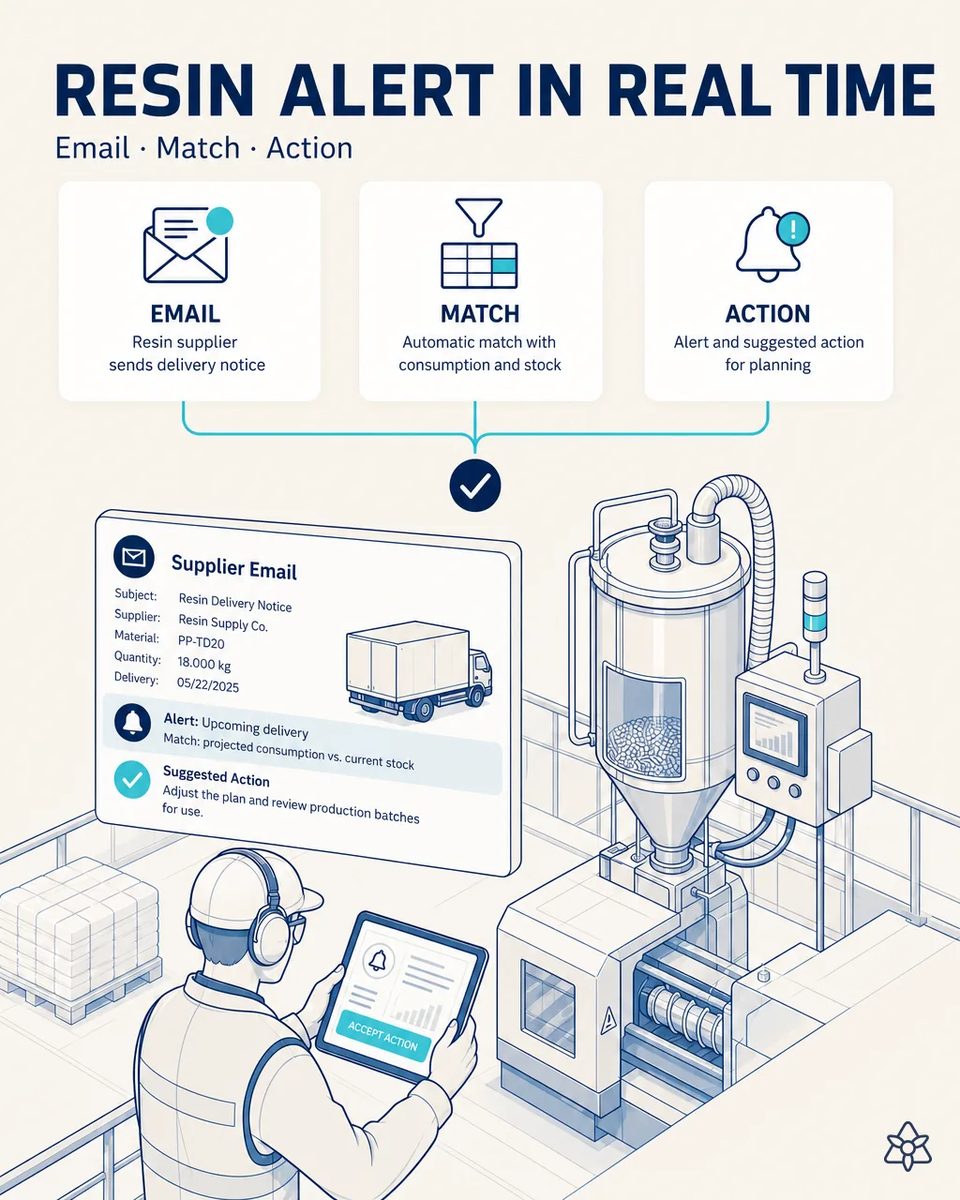
The email that decides the week arrives at one person's inbox.
With a highly export-driven operation and imported raw material, critical supplier alerts land by email with specific people who can't monitor the inbox in real time. The typical result is an idle press waiting on resin, or an improvised plan change without full visibility into which other orders are affected.
- The purchase order is formal and lives in the ERP. What actually changes the week is an email: a shipment held at origin, a two-week delay, a grade substituted for another that nobody has validated on that mold.
- It lands at a named address, in free text, competing with a hundred other messages, and it gets read when that person opens their mail.
- With imported raw material the notice period is everything: caught the day before it is a plan change, caught the same day it is a press standing still with the mold mounted.
- And the plan change gets improvised, because nobody has in front of them the full list of open orders that run on that resin.
Connect in chaotic-sources mode — a mailbox silently copied, around the clock.
Connect chaotic-sources mode — a mailbox silently copied 24/7. A language model extracts intent (supply delay), entities (supplier, material, dates) and cross-references them with the ERP. It returns the concrete action to the right role, not just "you got an email."
Finding out sooner is only half of it. What turns the alert into a decision is the cross-check: which open orders run on that grade, how many days of pellets are left, and which job can take the press in the meantime. And it reaches the role that has to act, not the inbox the supplier happened to write to.
Today's supply notice versus the cross-checked notice
| Aspect | Today | With iLEAN Connect |
|---|---|---|
| When the delay is read | When the recipient opens their mail | Seconds after it lands |
| Orders running on that grade | Worked out one by one | Listed with the alert |
| The press affected | Idle with the mold mounted | Reloaded with another job in time |
| Who finds out | Whoever it was addressed to | Materials, planning and the floor at once |
| A shipment held in customs | A surprise at the dock | Days of warning |
| The replan | Improvised | Proposed, with the affected orders on screen |
hours of human latency → seconds. Replanning based on current data, not on what was read hours later.
Impact estimate — to be validated with your numbers.
The block below is an estimate to be validated against your plant's actual data. We put it forward so the committee has an order of magnitude; we refine it during the assessment.
- Estimated payback 3-7 months, depending on how often critical supply alerts actually arrive.
- Unplanned press downtime for missing raw material, which is the most expensive idle hour in a molding shop because the mold is already mounted and the crew is already there.
- Fewer emergency grade substitutions decided on the spot, which are the ones that later show up as process problems.
- Replanning done on today's data instead of on an email read three hours ago.
avoided unplanned press downtime from missing raw material, estimated payback 3-7 months depending on how often critical alerts occur. Estimate to validate.
And the fair question from the production manager
"Is iLEAN going to read the whole purchasing team's mail?" — no. It sits in copy on one operational mailbox agreed with you, the one suppliers already write to, and sees nothing else. On top of that, classifying the intent of a supply notice is an anchored task where the best models drop below 1.5% error [1], and the replan is always proposed to a person, never executed.
[1] OpenAI paper "Why Language Models Hallucinate", 2025 — on the reliability of AI in anchored tasks.
What people ask about reading supplier alerts
Which mailbox does it watch?
One you designate, typically the shared purchasing or materials address suppliers already write to. Personal inboxes are out of scope by design, and that is what makes the case acceptable to the team rather than something they quietly work around.
Does it understand a date given as a week number?
Yes, and it is more common than it looks with international suppliers. Week numbers, local date formats and vague phrasing like end of next week are all normalized against the plant calendar, which is what makes the delay comparable with the dates in the ERP instead of something a person has to translate in their head.
Does it know how much of that resin is left?
When it is cross-checked with the ERP, yes: stock on hand plus the projected consumption of the open orders is what turns a vague delay into a specific number of days of cover. That number is the difference between an alert somebody files and an alert somebody acts on the same morning.
Does it act on its own?
No. It proposes: which orders are affected, which one to bring forward, which press to reload with another mold. The person decides, and the decision is recorded with its reason, which is what lets you look back later and see why that week was reshuffled.
Does it cover masterbatch and additives too?
Yes, and those often matter more, because a masterbatch delay stops a job just as dead as a base resin delay while getting a fraction of the attention in the inbox. The same applies to the reinforced grades a single customer specifies, where there is no second source to fall back on.
More cases from this series
- Supervisor's voice, liveWith a headset and Connect voice mode, the floor supervisor logs incidents without ever stopping to type.
- The press panel that talksAn external camera reads an old, unnetworked injection press panel; its process parameters get digitized…
- Two-tap validationNothing iLEAN captures reaches the central system without a human confirming it first, in seconds, from…
- Paperless lot startupThe operator photographs the process sheet and traveler card at press startup; the lot exists in the…
- Resin delivery in secondsOne photo of the delivery note and CoA; iLEAN digitizes and traces the lot before it enters the…
- Resin drying straight to ERPiLEAN watches the resin drying control folder, validates the data, and posts it to the ERP. Up to 80%…
Tell us how many press hours you lost last year waiting on resin.
We work on your plant's real data, not ours. Assessment with no commitment.
Request estimated ROI within 48h ‹ See all cases of automotive plastic injection See automotive