Resin drying straight to ERP
Drying hygroscopic resin before molding is a critical quality step. The process manager logs every batch in a spreadsheet the ERP never sees. iLEAN Connect detects the spreadsheet, absorbs each cell as it's written, and posts it to the ERP automatically after validation.
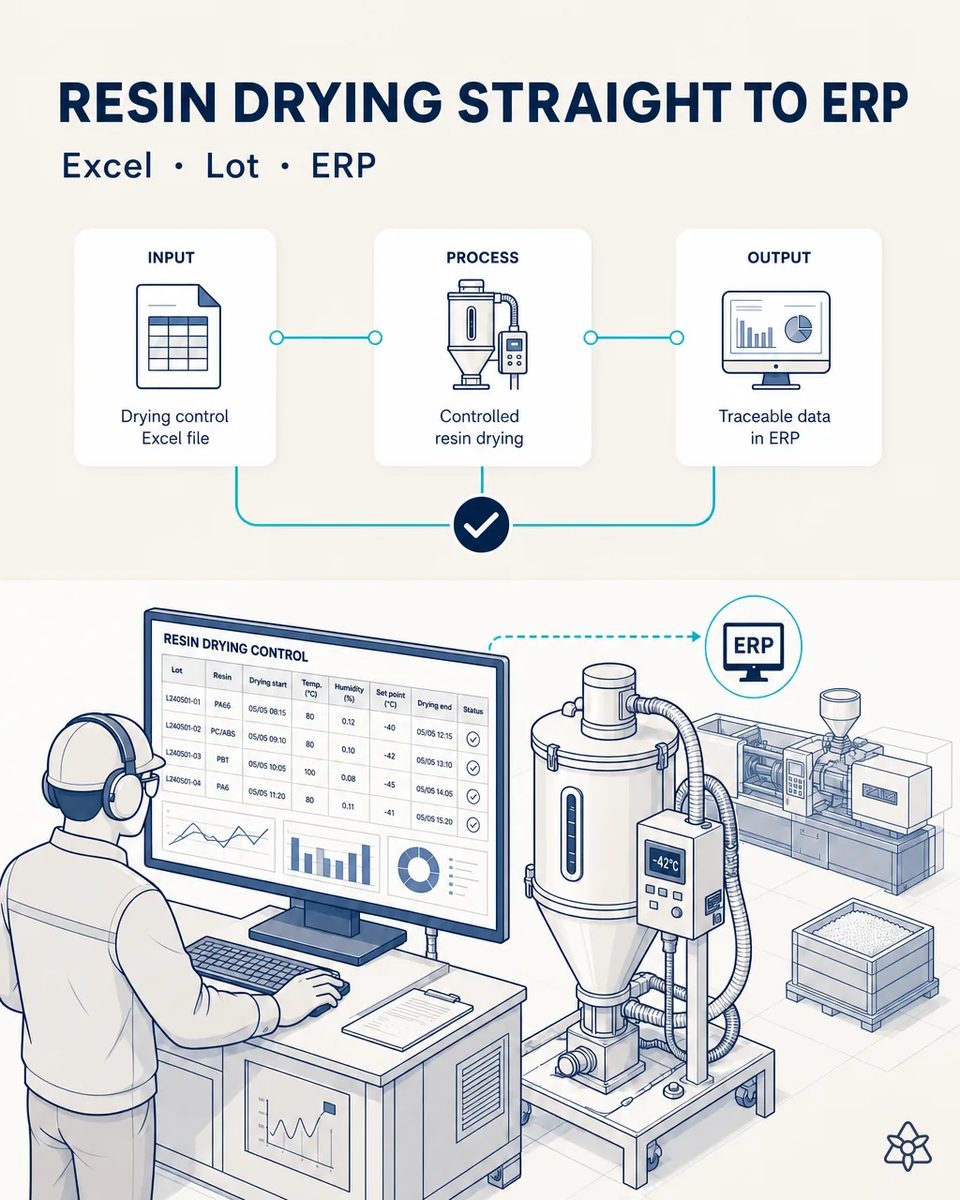
Drying decides the part, and it is recorded where nothing can see it.
Two parallel worlds — the real spreadsheet, where the live drying data lives, and the official ERP, missing that data or receiving it late, by hand, from someone dedicated to copy-pasting.
- Hygroscopic resin that reaches the screw with residual moisture above spec comes out of the mold with surface streaks, bubbles and mechanical properties below what the drawing promises the customer.
- So the plant controls it properly: desiccant dryer, dew point, hopper temperature and hours per batch, all logged batch by batch by the process manager — in a spreadsheet.
- The ERP never sees that spreadsheet. It gets copied across late, by hand, by somebody whose day includes copy-pasting cells.
- The result is a broken chain exactly where it matters most: the part that failed cannot be tied back to the drying batch that produced it.
Connect listening inward — it watches the folder, not the person.
Connect "listen inward" mode — watches the shared folder (not the person), reads the delta when the file is saved, parses it with a grounded model, validates on screen, posts to the ERP via API.
Nobody is asked to abandon their spreadsheet, which is why this case survives contact with the floor. The file keeps being the working tool; iLEAN reads the delta each time it is saved, parses it with a grounded model, shows it for validation and posts it to the ERP through its own interface. The ERP stops being a place data arrives at two days late.
The drying record today versus the connected record
| Aspect | Today | With iLEAN Connect |
|---|---|---|
| The drying log | A spreadsheet the ERP never sees | Read cell by cell as it is saved |
| Dew point and residual moisture | Written down, then filed | Tied to the batch that was molded |
| Dryer-to-part chain | Broken | Complete, dryer by dryer |
| A part that failed for moisture | Nothing to look back at | The drying curve of that exact batch |
| Who needs an ERP seat | Everyone who logs drying data | Only the manager who validates |
| Quality and process licenses | One per person entering data | 50-80% fewer |
drying data disconnected from the production lot → full drying-moisture-to-part traceability. Manual transcription → zero.
Impact estimate — to be validated with your numbers.
The block below is an estimate to be validated against your plant's actual data. We put it forward so the committee has an order of magnitude; we refine it during the assessment.
- Estimated payback 4-9 months, before counting the license saving.
- A typical reduction of 50-80% in quality and process seats, because only the validating manager needs to log in.
- Manual transcription of the drying record down to zero, and with it the errors it introduces.
- Full traceability from dew point and drying hours to the part number that was molded, which is what a customer asks for when a part fails on properties.
— *CFO angle*: if several process and quality people log into the ERP today just to enter drying data, that's several licenses; with Connect, only the validating manager needs one. Typical reduction of 50-80% in quality/process module licenses. Estimated payback 4-9 months. Estimate to validate.
And the fair question from the production manager
"Our spreadsheet is a mess of merged cells and notes in the margin — can it read that?" — it can, because reading a sheet with a stable layout is an anchored task, where the best models drop below 1.5% error [1]. And the delta is not posted blind: it goes to the tablet as a summary and the process manager confirms it, so a note in the margin becomes a flag rather than a bad number in the ERP.
[1] OpenAI paper "Why Language Models Hallucinate", 2025 — on the reliability of AI in anchored tasks.
What people ask about connecting the drying record
Does the process manager have to give up their spreadsheet?
No, and that is the whole design. The file stays exactly as it is, in the same shared folder, with the same columns and the same habits. iLEAN reads it when it is saved; the manager never changes tool and never has to learn a screen.
What if two people have the file open at once?
It reads the saved version, so simultaneous editing is not a problem in itself. Conflicting saves are flagged for the manager instead of one silently overwriting the other, which is more than the shared folder does today.
Can it read the dryer controller as well, or only the sheet?
Both are possible. Plants usually start with the sheet because it is immediate and costs nothing, then add the dryer controller once the value is proven, since the controller reports dew point continuously instead of at the two or three spot checks a shift that anyone has time to write down.
Where does the license saving actually come from?
From who has to log in. Today several process and quality people hold a paid seat for the sole purpose of entering drying data; with this case they keep writing in the spreadsheet they already use and a single manager validates what crosses. The seats that disappear are the ones nobody was using for anything else.
Does it flag a batch molded below the drying spec?
Yes, and it is the function with the most value: the deviation appears while the lot is still on the press, not two months later when a customer returns parts with surface streaks and asks for the drying records of that week.
More cases from this series
- Supervisor's voice, liveWith a headset and Connect voice mode, the floor supervisor logs incidents without ever stopping to type.
- The press panel that talksAn external camera reads an old, unnetworked injection press panel; its process parameters get digitized…
- Two-tap validationNothing iLEAN captures reaches the central system without a human confirming it first, in seconds, from…
- Paperless lot startupThe operator photographs the process sheet and traveler card at press startup; the lot exists in the…
- Resin delivery in secondsOne photo of the delivery note and CoA; iLEAN digitizes and traces the lot before it enters the…
- Resin alert in real timeiLEAN reads the resin supplier's email in zero seconds, cross-references active orders, and suggests the…
Bring your ERP renewal quote and we will count the seats your drying record no longer needs.
We work on your plant's real data, not ours. Assessment with no commitment.
Request estimated ROI within 48h ‹ See all cases of automotive plastic injection See automotive