The press panel that talks
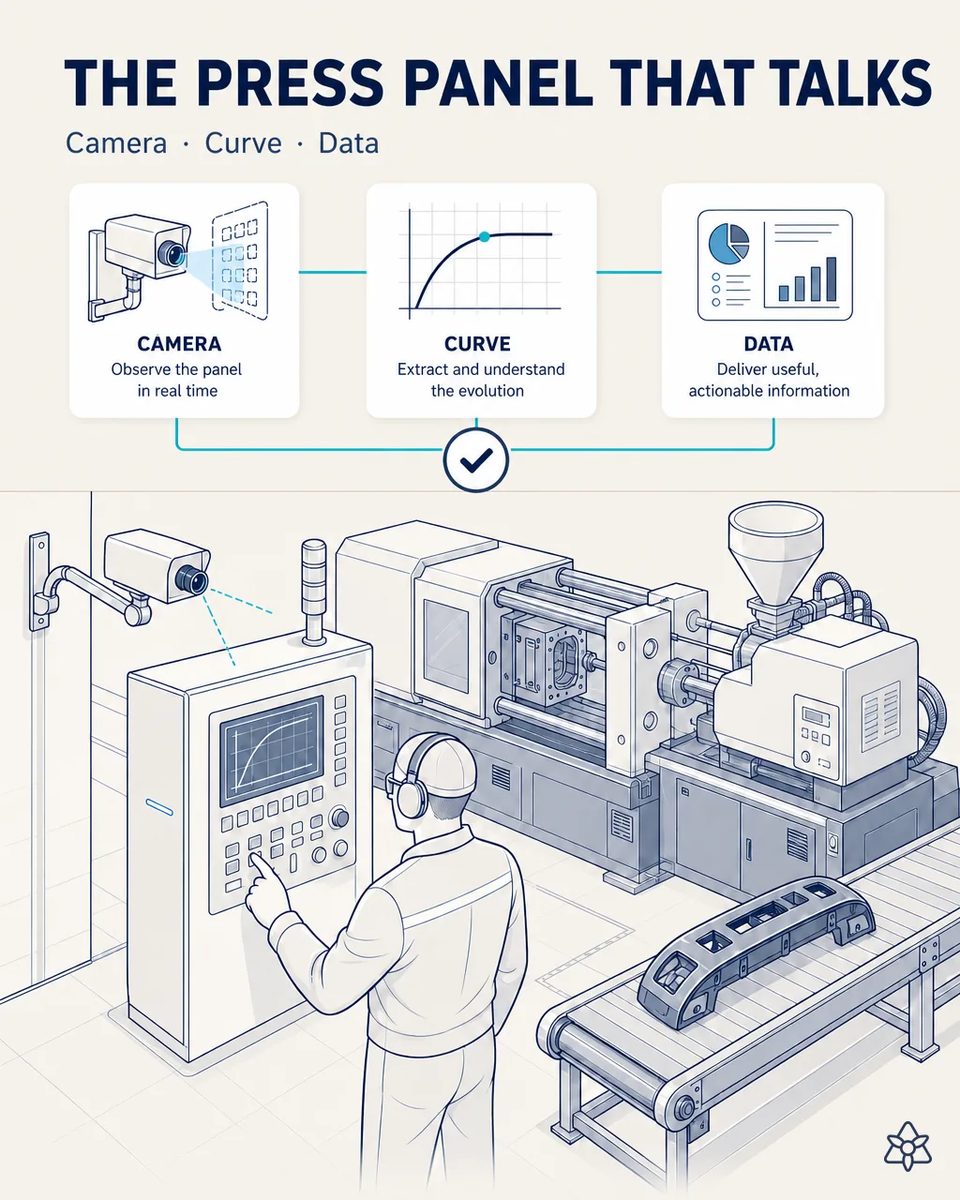
Across a fleet of dozens of injection presses, several have been on the floor for more than a decade: proprietary panel, no network, no MES connection — yet they still mold critical parts every day. With iLEAN Connect, an external camera pointed at the panel is enough: the machine stays the same, but the plant now has its process curve digitized lot by lot, without touching the original controller.
In a mixed fleet, the blind presses are not the least important ones.
Those legacy presses still mold critical parts, but their process data dies on the panel screen. When a customer complaint comes in about a part from that mold, there's no way to correlate the actual cycle with the defect. Replacing the press costs hundreds of thousands of dollars and weeks of downtime — a hard investment to justify just for the data.
- Several presses on the floor have been molding for more than a decade: proprietary controller, no network port anybody will open, no path to a manufacturing system.
- They are not parked on easy work — they hold molds for parts that ship every week to a demanding customer.
- Their process data lives and dies on the panel screen: the machine that drifts most is the one that reports nothing.
- So when a complaint arrives on a part from that mold, there is no actual cycle to compare against the defect, and the answer to the customer is built on what the setter remembers.
Connect in photo-over-panel mode — the fix comes from outside the machine.
Connect photo mode over the panel. Fixed industrial camera. OCR with a grounded language model interprets every frame, structures the process curve by lot, and cross-references it with the active order in the ERP.
Nothing is installed on the controller, no port is opened and no software is revalidated. A fixed industrial camera reads the panel frame by frame, OCR structures the values and they are matched to the order the ERP says is running on that press. On a machine the plant cannot afford to have down, that is the difference between a case that gets approved and a project maintenance vetoes on day one.
A press with no data versus a press with its curve stored
| Aspect | Today | With iLEAN Connect |
|---|---|---|
| Process curve of that press | Dies on the panel screen | Stored lot by lot |
| A complaint on that mold | No process to compare against | Root cause in minutes |
| Cycle time actually achieved | What the quote assumed | Measured, per lot and customer |
| The original controller | Proprietary and off the network | Untouched, nothing installed |
| Replacing the press | Hundreds of thousands plus weeks down | Deferrable indefinitely |
| Presses over ten years old | A blind spot in the fleet | The same data as the new ones |
zero process-to-complaint correlation → root-cause analysis by lot in minutes. Press replacement indefinitely deferrable.
Impact estimate — to be validated with your numbers.
The block below is an estimate to be validated against your plant's actual data. We put it forward so the committee has an order of magnitude; we refine it during the assessment.
- Estimated payback 5-10 months, mostly from scrap avoided once process and defect can finally be correlated.
- Machine-replacement capex pushed out of the plan instead of being justified just to get data.
- The oldest presses stop being an argument in the morning meeting and become a number.
- Real cycle time per lot, which is what tells you whether a job was quoted on the right press.
estimated payback 5-10 months, avoided machine-replacement CAPEX, scrap reduction from process-defect correlation. Estimate to validate.
And the fair question from the production manager
"Does a camera reading a panel hold up in front of a customer?" — here the task is anchored: a fixed screen, fields always in the same place and physical ranges known in advance, and on that the best models drop below 1.5% error [1]. Any frame whose value falls outside the possible range for that press is discarded instead of stored, which is what would otherwise wreck the series in an 8D.
[1] OpenAI paper "Why Language Models Hallucinate", 2025 — on the reliability of AI in anchored tasks.
What people ask about putting a camera on the panel
Does anything get installed on the press controller?
Nothing. The camera sits outside on its own bracket and sees the panel exactly the way the setter does. The machine's software, its warranty and its validation are untouched, and the press does not stop for the installation — the bracket goes up while it is running.
Which parameters can it pull off the panel?
Whatever the panel shows: melt and mold temperature, injection and holding pressure, cycle and cooling time, shot size, alarm codes. If the setter can read it, it can be structured.
Does it work on presses from different makers with different panels?
Yes, and that is normal in a mixed fleet where machines were bought a decade apart. Each panel is set up once with its own field map; after that every press feeds the same history in the same shape, which is what lets you compare two of them molding the same part.
Can the cycle time it measures be used for costing?
It is one of the first things plants do with it. The measured cycle per lot, not the theoretical one from the quotation, is what tells you whether a part is being sold at the right price on that press. On a job repeated every month the gap between the two adds up quickly.
Where does the camera go when the panel sits behind the guard?
It is solved at commissioning with the bracket and the lens: what matters is a stable, unobstructed view of the screen, not how close the camera sits. Panels behind a guard, at an angle or in poor light are the normal case, not the exception.
More cases from this series
- Supervisor's voice, liveWith a headset and Connect voice mode, the floor supervisor logs incidents without ever stopping to type.
- Two-tap validationNothing iLEAN captures reaches the central system without a human confirming it first, in seconds, from…
- Paperless lot startupThe operator photographs the process sheet and traveler card at press startup; the lot exists in the…
- Resin delivery in secondsOne photo of the delivery note and CoA; iLEAN digitizes and traces the lot before it enters the…
- Resin drying straight to ERPiLEAN watches the resin drying control folder, validates the data, and posts it to the ERP. Up to 80%…
- Resin alert in real timeiLEAN reads the resin supplier's email in zero seconds, cross-references active orders, and suggests the…
Tell us the tonnage and the age of the presses you cannot get data out of.
We work on your plant's real data, not ours. Assessment with no commitment.
Request estimated ROI within 48h ‹ See all cases of automotive plastic injection See automotive