Paperless lot startup
In an automotive plastic injection plant, every press startup requires a process sheet with approved parameters and a traveler card that identifies the lot along the line. Both are still paper captured late. With iLEAN Connect, the operator photographs both documents at startup and the lot already exists in the central system in zero seconds, with no change to their routine.
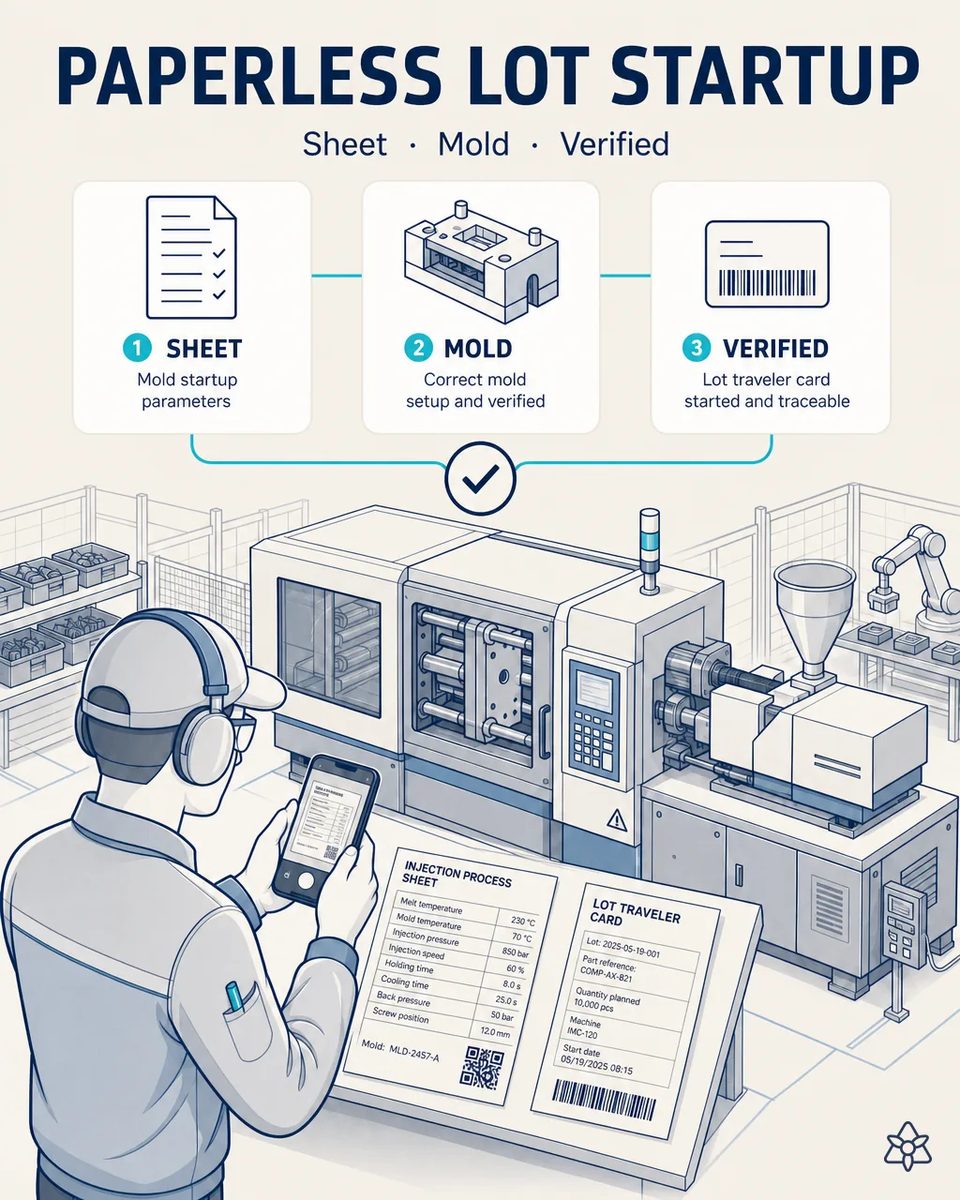
The two papers that open a lot are the last ones to reach a screen.
The process sheet defines whether the mold started with approved (PPAP) parameters; the traveler card is the only physical proof of the lot as it crosses injection, assembly and packaging. Today both can go hours without being digitized. If there's a deviation, it surfaces too late — when the auditor asks for traceability or the customer reports a defect, reconstructing what happened means searching scattered paper.
- The process sheet says whether that mold started with the parameters approved in PPAP: melt temperature, injection pressure, holding time, cooling time, screw position.
- The traveler card is the only physical proof of the lot as it crosses injection, assembly and packaging, and it travels with the tote, not with the system. If it gets wet, torn or left behind, the lot loses its identity.
- Between the press starting and somebody typing those values, hours go by, and over a weekend considerably more.
- During that window the lot is physically running and digitally does not exist, which is exactly when a customer complaint or an auditor asks about it.
Connect in photo mode — two photos at startup, nothing else changes.
Connect photo mode. The operator takes two phone photos at startup. A grounded language model extracts mold, cycle parameters, lot, shift and operator, and saves them to iLEAN's central memory in zero seconds. Zero habit change: the operator keeps filling out the same paper they already know.
This is the shortest of the twelve to deploy and the one that meets least resistance on the floor, because it asks nothing new of the operator: the same paper they already fill in, plus a photo. A grounded model pulls out mold, cycle parameters, lot, shift and operator, and the lot is open in the central system before the press finishes its first full cycle. That is usually why it is the first one signed off.
Lot startup on paper versus lot startup captured
| Aspect | Today | With iLEAN Connect |
|---|---|---|
| When the lot exists digitally | Hours after the first shot | Second zero |
| Check against approved PPAP parameters | Nobody does it at startup | Automatic, at startup |
| Traveler card | A card in a tote | A card and its digital twin |
| Finding a lot from three months ago | Search the paper archive | A query from any screen |
| Deviation written by hand at startup | Lost unless typed | Extracted and tied to the lot |
| What the operator does differently | — | One photo of each document |
hours of latency until someone transcribes → zero seconds. Lot found by searching a physical card → instant web query from any screen.
Impact estimate — to be validated with your numbers.
The block below is an estimate to be validated against your plant's actual data. We put it forward so the committee has an order of magnitude; we refine it during the assessment.
- Estimated payback 4-9 months, depending on how many lot startups a day the plant runs.
- Transcription time given back to the line supervisor, who is the one doing it today.
- From hours of latency — more over a weekend — to zero seconds.
- A lot found by query instead of by hunting for a card that may already have left with the tote.
estimated payback 4-9 months depending on daily startup volume, recovered transcription time for the line supervisor. Estimate to validate.
And the fair question from the production manager
"What if it reads a cooling time wrong off the sheet?" — pulling fields out of a document with a fixed layout is an anchored task, where the best models drop below 1.5% error [1]. And there is a second net: the values land on the cell tablet as a summary and the supervisor confirms or corrects them before anything crosses into the central system.
[1] OpenAI paper "Why Language Models Hallucinate", 2025 — on the reliability of AI in anchored tasks.
What people ask about capturing lot startup
Does it tell us whether the lot started with approved parameters?
That is the point of photographing the process sheet and not just the traveler card. The captured values are compared against the ones approved for that mold, and a deviation is flagged at startup rather than weeks later. It is also the question an auditor asks first, and today it is answered from memory.
What happens on a press that runs two or three lots a shift?
It scales better than the paper does: each startup is two photos and each lot closes on its own. The more lot changes a press sees, the more the case pays.
Is a phone enough or do we need industrial hardware?
A phone is enough to start, and that is deliberate — the case has to prove itself before anyone buys equipment. Cells that end up capturing constantly usually get a fixed device later, mounted where the operator already stands. The photo quality of any recent phone is well beyond what reading a printed sheet needs.
Does the traveler card stay on the floor?
Yes. Nothing physical is taken away, because the card is what packaging and shipping work with. What changes is that it stops being the only copy.
What about lots that started before we deployed this?
They stay as they are, on paper, and they are still traceable the way they always were. The digital history builds forward from the first captured startup; loading old lots is possible but rarely worth the effort, because what a customer complaint usually concerns is production from the last few weeks.
More cases from this series
- Supervisor's voice, liveWith a headset and Connect voice mode, the floor supervisor logs incidents without ever stopping to type.
- The press panel that talksAn external camera reads an old, unnetworked injection press panel; its process parameters get digitized…
- Two-tap validationNothing iLEAN captures reaches the central system without a human confirming it first, in seconds, from…
- Resin delivery in secondsOne photo of the delivery note and CoA; iLEAN digitizes and traces the lot before it enters the…
- Resin drying straight to ERPiLEAN watches the resin drying control folder, validates the data, and posts it to the ERP. Up to 80%…
- Resin alert in real timeiLEAN reads the resin supplier's email in zero seconds, cross-references active orders, and suggests the…
Tell us how many lot startups your presses run in a week.
We work on your plant's real data, not ours. Assessment with no commitment.
Request estimated ROI within 48h ‹ See all cases of automotive plastic injection See automotive