Defects caught on the fly
At the cycle-time pace of an automotive injection press, the human eye tires and lets through parts with flash, sink marks or short shots. iLEAN Edge places a camera above the cell; a trained CNN infers in milliseconds per part and pulls it before packaging.
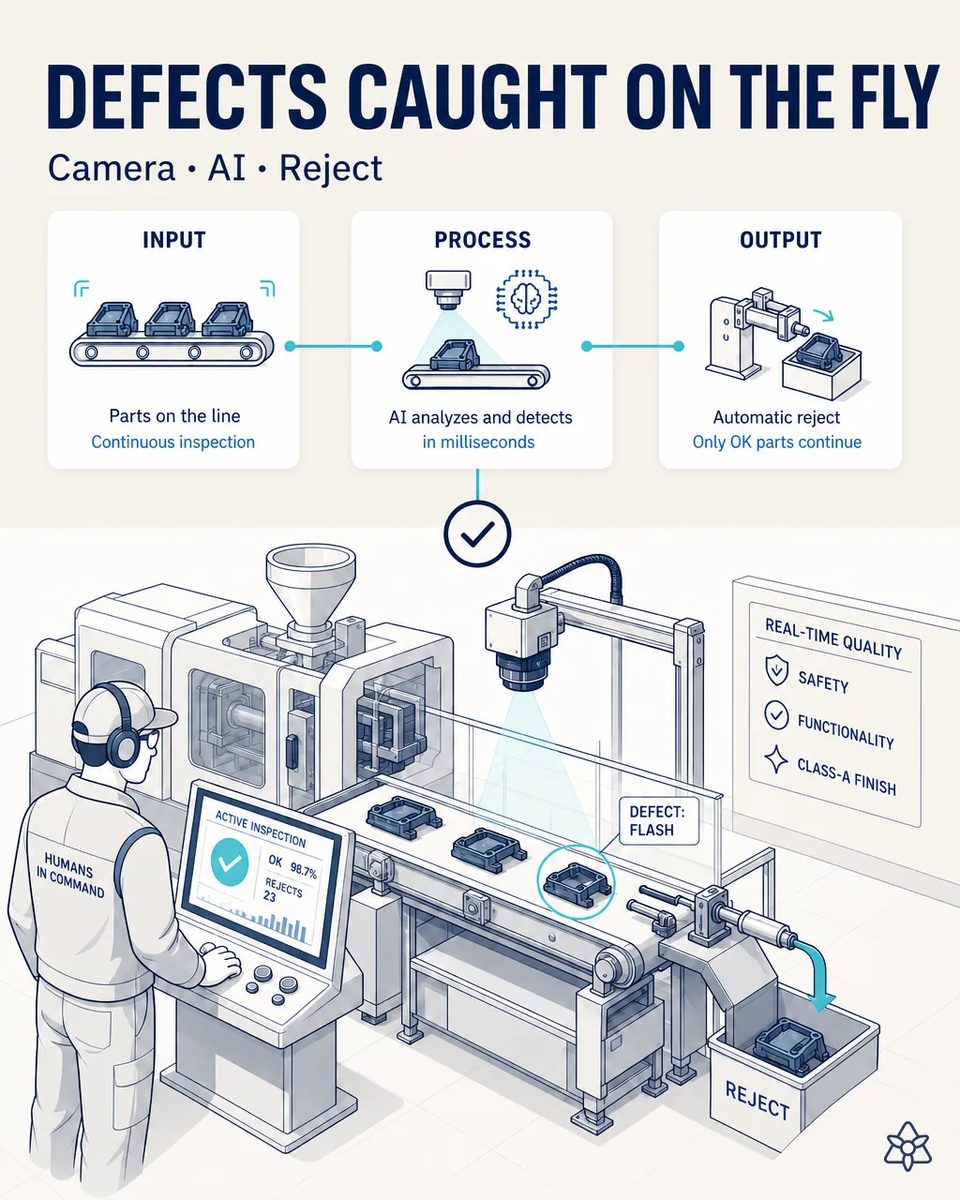
At cycle speed, the eye is the weakest control in the plant.
100% human visual inspection is impossible at real cycle-time speed, and sampling leaves gaps exactly on the intermittent defects. On a visible Class-A or functional part, that defect reaches the customer: returns, quality claims, risk of losing preferred-supplier status.
- An injection press does not wait: parts come out at the cycle the process needs, and the inspector is the same person at hour eight of a night shift as at hour one.
- 100% visual inspection is impossible at that pace, so the plant samples — and sampling leaves gaps exactly where the intermittent defect lives.
- Flash from a worn parting line, a sink mark from a holding-time drift or a short shot on one cavity can all come and go within a lot.
- On a Class A or a functional part, that defect reaches the customer: returns, a quality claim, and the preferred-supplier status that decides the next award.
Edge — a local CNN over the cell, inference in milliseconds, images never leave the plant.
Edge — local CNN vision, no images sent to the cloud. Model trained on good and bad examples of the customer's specific component.
The model is trained on good and bad examples of your specific part, under that cell's lighting, not on a generic defect catalog. Nothing is sent to the cloud: inference happens on the unit at the cell, which is what keeps it inside the cycle and inside your customer's confidentiality clause. That is the difference between a demo and something the quality lead is willing to put between the press and the box.
Sampling inspection versus Edge vision on molded parts
| Aspect | Today | With iLEAN Edge |
|---|---|---|
| Parts inspected | A 1-5% sample | Every part, every cavity |
| Flash on a worn parting line | Noticed when a customer complains | Flagged on the first parts |
| Short shot on one cavity | Slips through between samples | Pulled before packaging |
| The defective part | Boxed with the good ones | Diverted at the reject gate |
| Criterion at hour eight of the night shift | The same eyes, more tired | The criterion does not tire |
| Visual-defect PPM at the customer | The number argued over monthly | Driven down and traceable |
1-5% sampling → 100% part inspection. Customer visual-defect claims → drastic reduction.
Impact estimate — to be validated with your numbers.
The block below is an estimate to be validated against your plant's actual data. We put it forward so the committee has an order of magnitude; we refine it during the assessment.
- Estimated payback 5-12 months, depending on your current scrap and claim ratio.
- From a 1-5% sample to 100% of parts inspected, which is the only way an intermittent defect stops being invisible.
- A drastic reduction in visual-defect claims, and with them the containment costs that follow each one.
- Defect attribution per cavity, which turns a scrap number into a specific mold maintenance job.
estimated payback 5-12 months depending on the current scrap/claim ratio. Estimate to validate.
And the fair question from the production manager
"What if it rejects good parts?" — the false positive is the real risk of any vision system, and it is handled by training on good and bad parts of your own references, with that cell's lighting. Borderline parts are not scrapped: they are routed to a person to decide, and every decision feeds back into the model. This is not an anchored extraction task like the Connect cases, where the best models drop below 1.5% error [1]; here the criterion is yours and it is learned from your parts.
[1] OpenAI paper "Why Language Models Hallucinate", 2025 — on the reliability of AI in anchored tasks.
What people ask about inspecting molded parts with Edge
Does it slow the cycle down?
No. Inference runs on a local unit in milliseconds per part, well inside the take-out window. The press keeps its cycle and the camera works to that cycle, not the other way around — which is the condition production always puts on anything installed at the cell.
Can it tell flash from the normal gate witness mark?
That distinction is the first thing it is trained on, and it is why a generic model is useless here: what counts as acceptable at the gate is specific to your part, your mold and your customer's drawing. The same applies to the ejector pin marks that are normal on a non-visible face.
How many parts does it need for a new mold?
Fewer than people fear, because a molded-part defect catalog is short and repetitive: flash, sink marks, short shots, burn marks. What matters is that they are real parts from that mold, including the bad ones, which is the part plants have to get used to — today those go straight into the regrind bin.
Do the part images leave the plant?
No. Inference is local and the images stay on site. Only the verdict and its metadata travel, which is usually the condition a customer's IT department puts on any camera on the floor.
Does it tell us which cavity produced the defect?
Yes, when the take-out position identifies the cavity, and that is where most of the value is: it turns a rising scrap rate into a named cavity to repair at the next mold service.
More cases from this series
- Supervisor's voice, liveWith a headset and Connect voice mode, the floor supervisor logs incidents without ever stopping to type.
- The press panel that talksAn external camera reads an old, unnetworked injection press panel; its process parameters get digitized…
- Two-tap validationNothing iLEAN captures reaches the central system without a human confirming it first, in seconds, from…
- Paperless lot startupThe operator photographs the process sheet and traveler card at press startup; the lot exists in the…
- Resin delivery in secondsOne photo of the delivery note and CoA; iLEAN digitizes and traces the lot before it enters the…
- Resin drying straight to ERPiLEAN watches the resin drying control folder, validates the data, and posts it to the ERP. Up to 80%…
Tell us which visual defect reaches your customer most often.
We work on your plant's real data, not ours. Assessment with no commitment.
Request estimated ROI within 48h ‹ See all cases of automotive plastic injection See automotive