Lot labels, zero typing
The traceability label on every box carries part number, lot and date. It's printed by a modern labeler with an available API, but isolated from the ERP: every lot change means manual entry. With iLEAN, the labeler is bidirectionally stitched to the ERP: the data travels automatically from the active order.
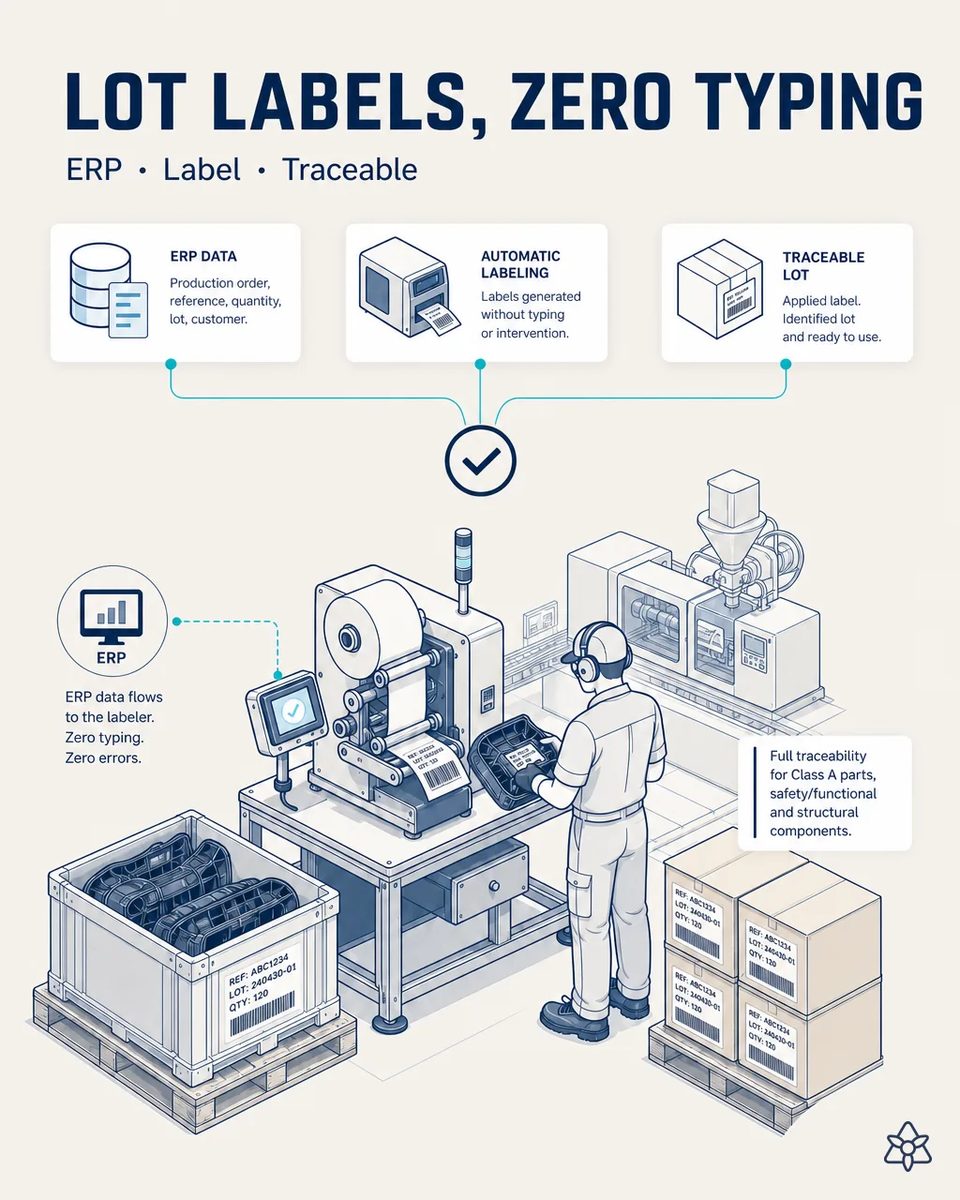
The last piece of information before the box ships is typed by hand.
The traceability label is the last piece of physical information before the box ships to the customer. One mistyped digit can mislabel an entire lot, and it surfaces at IATF audit — or worse, at the customer.
- The traceability label carries part number, lot and date. It is the last thing the plant controls before the box leaves the dock and becomes the customer's problem to interpret.
- The labeler is modern and has an API sitting unused, while the ERP holds exactly the data the label needs.
- Between the two there is a person typing, and every lot change on every press is one more chance to get a digit wrong, usually at the worst moment of the shift.
- One wrong digit mislabels a whole lot, and it surfaces in an IATF audit as a traceability finding — or, worse, at the customer, where it becomes containment.
Connect stitches two modern systems through their own interfaces.
Connect stitches two modern systems together via API. When the ERP marks an order as started, it automatically publishes part number, lot and date to the labeler. A lot change becomes one tap in the ERP, not manual entry on the labeler.
Neither machine is replaced and neither is reprogrammed: each one already exposes what it needs to. When the ERP marks an order as started, part number, lot and date are published to the labeler automatically, and the lot change becomes one tap in the ERP instead of a keyboard at the press. It is the shortest payback of the twelve because there is no hardware to buy.
The isolated labeler versus the stitched labeler
| Aspect | Today | With iLEAN Connect |
|---|---|---|
| Where the label data comes from | Typed at the labeler | Published by the active ERP order |
| A lot change | Retyped, under time pressure | One tap in the ERP |
| A mistyped digit | A whole lot mislabeled | Impossible: nothing is typed |
| What comes back from the labeler | Nothing | Labels printed, confirmed per lot |
| Count on the label versus count in the ERP | Reconciled by hand | Matched automatically |
| A labeling finding at audit | A standing risk | Removed at source |
monthly typing errors (some with an associated audit finding) → zero human-origin labeling errors.
Impact estimate — to be validated with your numbers.
The block below is an estimate to be validated against your plant's actual data. We put it forward so the committee has an order of magnitude; we refine it during the assessment.
- Estimated payback 3-6 months, the fastest of the twelve because there is no equipment to buy.
- Labeling errors of human origin down to zero, which is the category that produces audit findings.
- A drastic cut in traceability non-conformity risk, both at IATF audit and at the customer.
- Reconciliation between what was printed and what the ERP says was produced, done automatically instead of at month end.
estimated payback 3-6 months, drastic reduction in traceability non-conformity risk at IATF audit or customer level. Estimate to validate.
And the fair question from the production manager
"And if the connection drops mid-lot, do we stop printing?" — no. The labeler keeps printing the last order it received and iLEAN flags the gap; nothing is invented and nothing is guessed. Publishing structured fields between two systems is an anchored task where the best models drop below 1.5% error [1], and here there is not even free text to interpret: it is the ERP's own data traveling untouched.
[1] OpenAI paper "Why Language Models Hallucinate", 2025 — on the reliability of AI in anchored tasks.
What people ask about stitching the labeler to the ERP
Our labeler has an API we have never used — is that enough?
That is the usual situation and yes, it is enough. What is missing is not capability but the stitch between the two systems, which is exactly what this case is. Most plants discover they already paid for the interface when they bought the machine.
What if the ERP order and the labels already printed disagree?
The discrepancy is raised immediately, with the exact count of labels printed under the previous order so you know how many boxes to pull. It is the difference between catching it at the press with a pallet to relabel and catching it at the customer's receiving dock with a containment to open.
Does it cover the pallet label as well as the box label?
Yes, and they are handled as what they are: the pallet label aggregates the boxes it carries, so a pallet cannot end up claiming a quantity its boxes do not add up to. That mismatch is one of the most common reasons a shipment is rejected at the customer's dock.
What if a customer requires their own label layout?
That is normal for a molder serving several customers, each with their own label standard. The layout stays whatever that customer specified, down to the barcode symbology; what changes is where the data filling it comes from.
How long does it take to get running?
It is the shortest of the twelve. With the ERP and labeler interfaces documented, it is a matter of days, and the first lot printed straight from the order is the whole demonstration — there is nothing to train and no habit to change on the floor.
More cases from this series
- Supervisor's voice, liveWith a headset and Connect voice mode, the floor supervisor logs incidents without ever stopping to type.
- The press panel that talksAn external camera reads an old, unnetworked injection press panel; its process parameters get digitized…
- Two-tap validationNothing iLEAN captures reaches the central system without a human confirming it first, in seconds, from…
- Paperless lot startupThe operator photographs the process sheet and traveler card at press startup; the lot exists in the…
- Resin delivery in secondsOne photo of the delivery note and CoA; iLEAN digitizes and traces the lot before it enters the…
- Resin drying straight to ERPiLEAN watches the resin drying control folder, validates the data, and posts it to the ERP. Up to 80%…
Tell us how many labels a day you print and how many are typed by hand.
We work on your plant's real data, not ours. Assessment with no commitment.
Request estimated ROI within 48h ‹ See all cases of automotive plastic injection See automotive