The reflow oven stays the same — but now it talks
In a plant that grows by projects, two machine generations coexist: the new lines publish data over a standard protocol, and the veteran equipment — reflow oven, heat staking press, photometric bench — has proprietary panels with no network. Right there sits the data with the most influence on solder reliability. With iLEAN Connect, a fixed external camera reads the panel without touching the machine, without opening its network and without voiding its warranty.
Between one verification and the next, nobody sees the oven's drift.
The reflow thermal profile is the variable with the most influence on solder reliability, and solder reliability is what decides whether a panel fails in the vehicle years later. Today the profile is verified periodically with a profiler and noted in a log:
- Drift between verifications is invisible — the profiler says how the oven was that day at that hour. What happened between that measurement and the next, nobody records.
- The same goes for other veteran, critical equipment — if the heat staking press drifts in force or time, the fixation ends up loose and the defect is invisible to visual inspection; if the photometric measurement bench does not export its readings, the backlighting characterization lives only on paper.
- And the classic answer is disproportionate — replacing the equipment costs hundreds of thousands of euros and a stoppage no launch plan admits. Besides, the machine works fine: the only thing it lacks is telling what it does.
So the plant lives with a black box exactly on the variable that most determines whether the product will fail years from now, in an end customer's car.
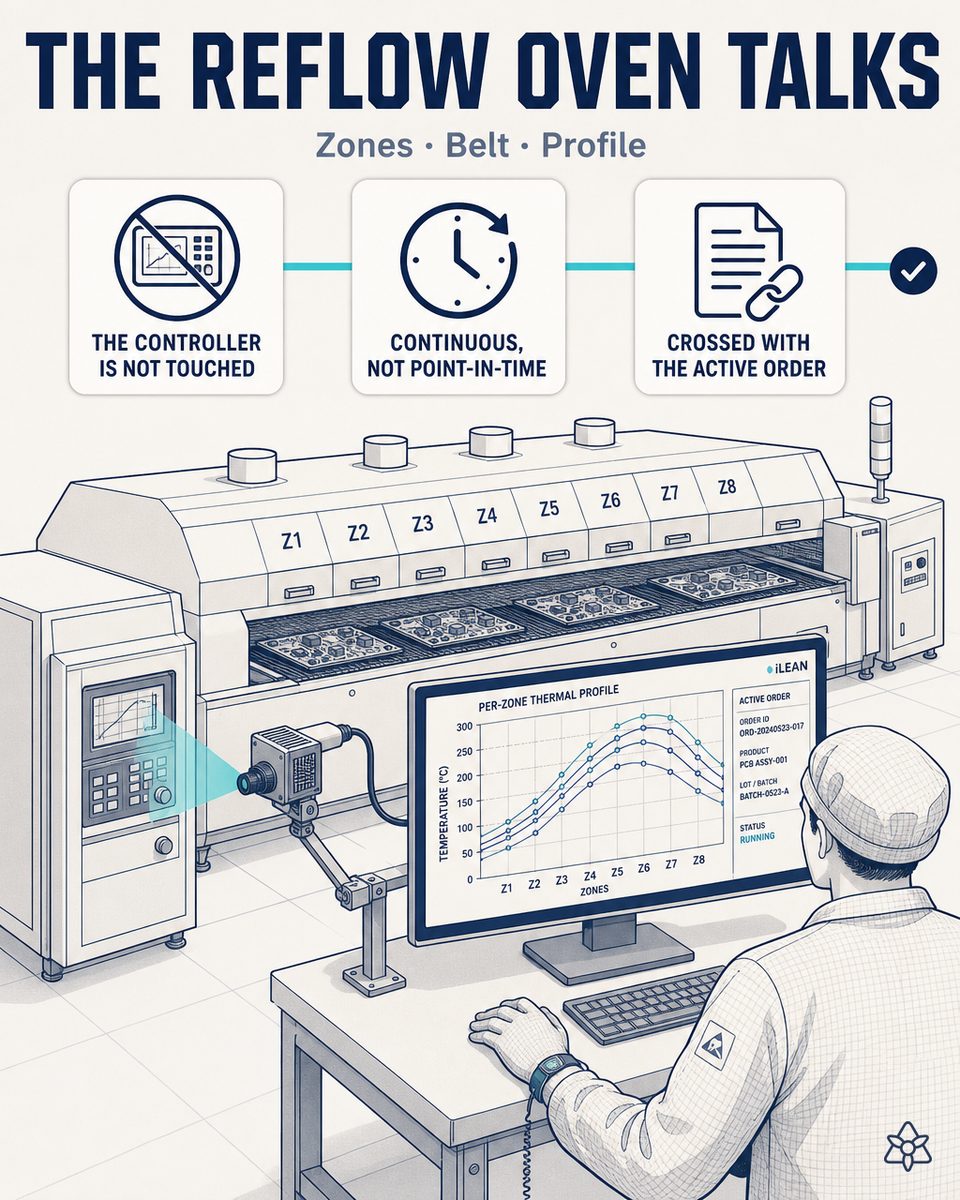
Connect in photo mode on the panel — the machine is not touched.
The missing information is already on the screen. What does not exist is the path from that glass to the system. Connect solves it by looking: the equipment's PLC is not touched, its network is not opened and its original configuration is not altered.
A fixed industrial camera aimed at the screen, capturing every few seconds. Optical reading interpreted by an anchored model that structures per-zone temperature, belt speed, active alarm and counter, cross-referenced with the active order to know which reference was in the oven at that moment.
How Connect operates on the reflow oven panel:
- Without touching the PLC or opening the network — a mount is installed in front of the screen and that is where the intervention ends. The equipment's warranty stays intact and the installation is done without stopping the line.
- Continuous capture, not point-in-time — every few seconds, versus the profiler that measures on one specific day. That is what turns a periodic verification into a continuous record.
- Anchored to that panel — per-zone temperature, belt speed, active alarm and counter, read at known positions.
- Cross-referenced with the active order — which reference was in the oven at that moment. Without that cross-reference the series is a chart; with it, it is traceability per reference and per batch.
- The same pattern works for the other veteran equipment — the heat staking press and the photometric measurement bench are digitized the same way, with no new project.
Oven as a black box vs. curve digitized with Connect
| Aspect | Proprietary panel with no network | With iLEAN Connect on the panel |
|---|---|---|
| Panel data | Dies on the screen | Time series per reference and batch |
| Thermal profile | Verified periodically with a profiler | Recorded continuously |
| Drift between verifications | Invisible | Detectable before the defect |
| Root cause analysis | Without process data | With the real curve of that shift |
| Intervention on the equipment | Opening the network and compromising the warranty | None — external camera |
| Replacement CAPEX | Hundreds of thousands of euros and a stoppage | Deferrable |
Impact estimate for your plant — to be validated with your own numbers.
The block below is an estimate to be validated against your plant's actual data. We put it forward so the committee has an order of magnitude; we refine it during the assessment.
- Electronic panel plant with a reflow oven, a heat staking press and a photometric bench with proprietary panels and no network.
- Connect pilot on the oven panel: external mount, model anchoring and cross-reference with the active order. First value expected within a few weeks.
- Indicative payback between 5 and 10 months, plus the deferral of the equipment replacement CAPEX. Estimate to be validated.
- The underlying lever is that the reflow profile is the variable with the most influence on solder reliability, and that reliability decides whether a panel fails in the vehicle years later — when the cost is no longer that of a board.
- And a cheap expansion path: the same setup digitizes the heat staking press and the photometric bench, without opening a project per machine.
And the fair question from the maintenance manager
"What if the camera misreads a temperature and we make a decision on false data?" — hallucination is a problem of free generation, not of anchored tasks. Reading a numeric value at a known position on a known panel is where the best models brought the error below 1.5% [1]. On top of that, the reading is redundant over time — every few seconds — so a discordant reading is discarded against its neighbors instead of propagating into the curve.
[1] OpenAI paper "Why Language Models Hallucinate", 2025 — on the reliability of AI in anchored tasks.
What people ask about digitizing the reflow oven without touching it
Is the PLC touched or the equipment's network opened?
No. A fixed industrial camera aimed at the screen is mounted and that is where the intervention ends: the PLC is not touched, its network is not opened and its original configuration is not altered. The equipment's warranty stays intact, and the installation happens without stopping the line — which in a plant with a launch plan is a non-negotiable condition. It is also what makes the case viable against the alternative: replacing the equipment costs hundreds of thousands of euros and a stoppage no launch admits.
What does it add over the profiler we already use?
Continuity. The profiler says how the oven was that day at that hour, and it is an excellent measurement — but a point-in-time one. What happens between one verification and the next, nobody records, so a progressive drift is only discovered at the next measurement or, worse, in the product. The camera does not replace the profiler: it adds the continuous record that is missing today, so drift is seen while it happens and not weeks later. They are two complementary things, not alternatives.
Why is the reflow profile so critical?
Because it is the variable with the most influence on solder reliability, and that reliability is what decides whether a panel fails in the vehicle years later. A slightly deviated profile does not produce a visible defect on the line: it produces a solder joint that ages worse. The cost does not show up in the plant, it shows up in warranty and in the customer relationship. That is why recording the real curve per reference and per batch is not a documentary exercise: it is the only way to correlate a field failure with the conditions under which it was manufactured.
Does it work for the heat staking press or the photometric bench?
Yes, and it is the most profitable expansion path. The pattern is identical — external camera, model anchored to the specific panel, time series cross-referenced with the order — and both machines have the same problem. If the heat staking press drifts in force or time, the fixation ends up loose and the defect is invisible to visual inspection; if the photometric measurement bench does not export its readings, the backlighting characterization lives only on paper. Digitizing them does not demand a new project per machine: the same setup is replicated.
What if someone changes the screen on the panel?
Connect detects it as a layout deviation and stops structuring that reading automatically until the model is re-anchored to the new arrangement — a documented configuration adjustment, not an intervention on the machine. In the meantime it invents no data: the capture is flagged for review and the previous history remains intact and traceable per reference. On proprietary panels without firmware changes it is infrequent, but the system is designed to fail loudly instead of failing silently.
More cases from this series
- Evidence is not reconstructed: it is generated at the moment of the factEvery critical change leaves its dossier with photos, signatures and measurements, organized by…
- Your product’s genealogy starts at the receiving dockDelivery note, reel labels, certificates and moisture data captured by photo and fed into the ERP. From…
- The laboratory’s measurements, in the ERP in minutes and with fewer licensesLuminance, chromaticity and force-travel: iLEAN reads the laboratory’s Excel on save and feeds it into…
- So an engineering change never catches you producing the previous revisionCustomer email and portal read on arrival: iLEAN cross-checks the notice against active orders and…
- The line startup file, available at second zeroSetup sheet, reflow profile and first article captured with a photo: the startup file exists at second…
- Recording what the person walking the plant knows — without them stoppingEarpiece and voice mode: the process engineer dictates while walking and iLEAN structures the incident…
Which critical machine in your plant is not giving data today?
We work on your plant's real data, not ours. We show you the reading working on your own panel. Assessment with no commitment.
See how we would apply it in your plant ‹ See all 12 electronic panel cases See automotive