The line startup file, available at second zero
In an electronic panel plant, every reference startup generates a small paper file: the setup sheet with which reels go in which position, the record of the verified reflow profile and the first-article sheet the technician and the inspector sign before running at rate. That file is the proof that the startup was done right, and it is what an auditor will ask for months later. With iLEAN Connect, two or three photos at startup are enough.
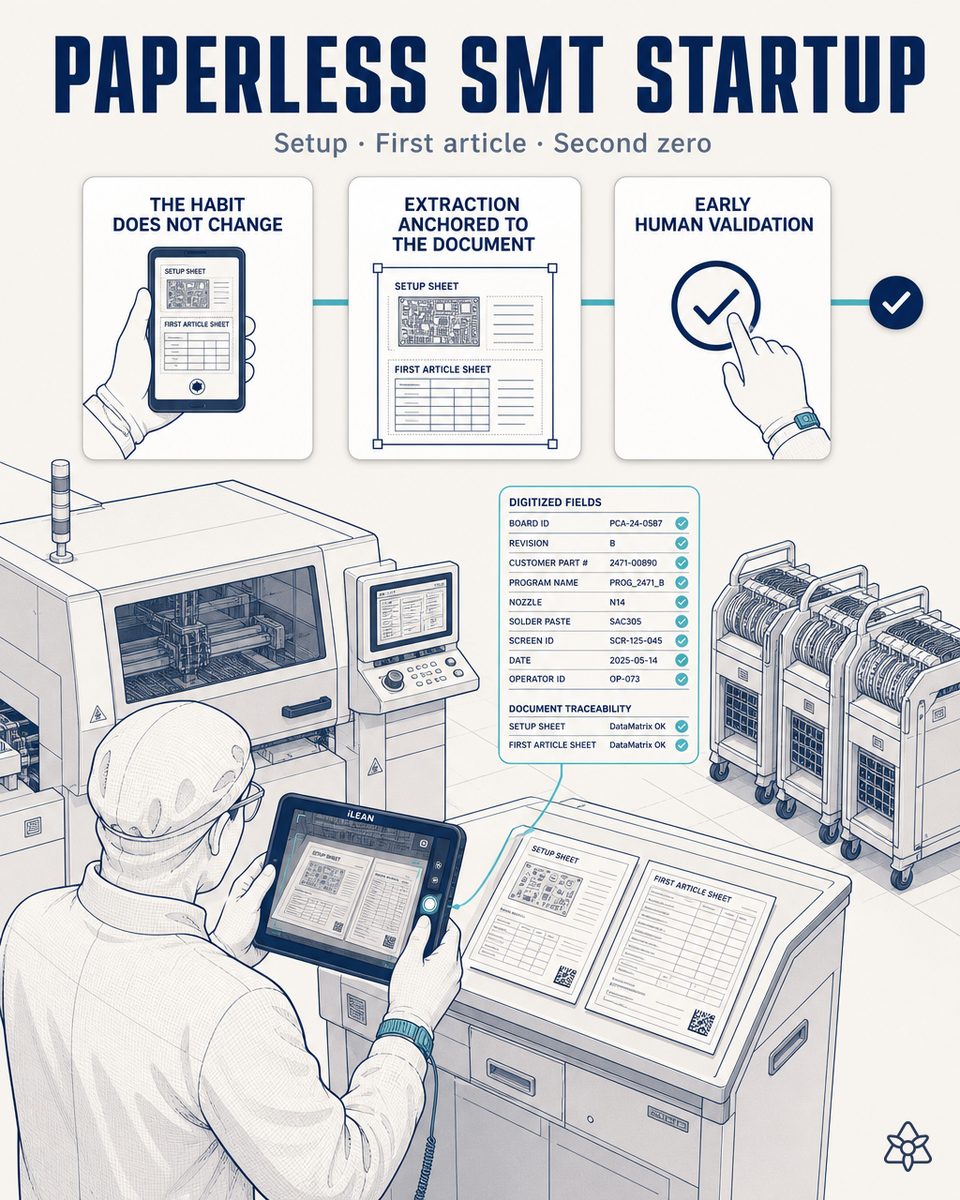
The paper does not get lost. The problem is that it is not searchable.
A plant that industrializes projects continuously starts references many times per shift. The setup paper is filled in by hand because it is faster than the system, and then it gets archived:
- When a defect shows up three weeks later and someone asks under exactly which conditions that batch started — which stencil, which feeder positions, which reel batches, what the first article gave and who signed it — the information exists in some filing cabinet, but retrieving and correlating it is archaeology.
- And with several startups per shift, that is a lot of knowledge out of reach — not lost, but inaccessible in practice, which for decision-making purposes is the same thing.
- There is a second, less visible cost — the process team's time spent transcribing and archiving, which is time not spent industrializing the next project.
In a plant that grows by projects, that second cost weighs more than it seems: the bottleneck is not the line, it is the team that sets it up.
Connect in photo mode — without changing the technician's habit.
The technician fills in the setup sheet and the first-article sheet exactly as today. The only thing added is two or three photos at startup, with the phone or the industrial tablet.
An anchored model recognizes the document's structure and extracts reference, engineering revision, loaded program, stencil number, feeder positions, hand-written reel batch, first-article result and signer. The file stays in central memory tied to the active order.
How Connect photo operates at line startup:
- The habit does not change — same sheet, same pen, same moment. There is no training to give and no new workstation in front of a screen.
- Extraction anchored to the real document — including the hand-written reel batches, which are precisely the ones that never reach any system and the ones needed when a component has to be traced.
- Early human validation — the summary is presented on the tablet and it is two taps: confirm or correct. Nothing crosses without a person seeing it.
- Tied to the active order — the file is not left loose: it is associated with the reference and the batch being manufactured.
- Searchable along four axes — reference, shift, stencil or reel batch. Exactly the four you get asked about when a defect appears.
Paper startup file vs. file digitized with Connect
| Aspect | Setup sheet and first article on paper | With iLEAN Connect photo |
|---|---|---|
| Availability of the file | At the end of the shift, or when archived | At second zero |
| Lookup for an auditor | Manual reconstruction in the filing cabinet | Instant |
| Hand-written reel batches | Stay on the paper | Captured and searchable |
| Defect ↔ startup-conditions correlation | Archaeology | Query by reference, stencil or batch |
| Process team's time | Transcribing and archiving | Recovered for industrializing |
| Technician's habit | The same sheet — plus a transcription | The same sheet — plus two or three photos |
Impact estimate for your plant — to be validated with your own numbers.
The block below is an estimate to be validated against your plant's actual data. We put it forward so the committee has an order of magnitude; we refine it during the assessment.
- Electronic panel plant that industrializes projects continuously, with several reference startups per shift and a paper startup file.
- Connect photo pilot on line startup — with the phone or the tablet already in the plant, without changing the work standard. First value expected within a few weeks.
- Indicative payback between 4 and 9 months depending on the number of startups per shift. Estimate to be validated with the plant's real data.
- The return that weighs most in a plant growing by projects is not the archive: it is the process team's time, which today transcribes and archives instead of industrializing the next project.
- And it is the enabler of the rest of the matrix: without the startup in the system from second zero, the reflow oven curve and the cosmetic defect have nothing to correlate against.
And the fair question from the quality manager
"What if the model misreads a hand-written reel batch?" — hallucination is a problem of free generation, not of anchored tasks. Here the AI recontextualizes what is already written against the plant's real sheet: the best models brought the error below 1.5% [1]. And the summary passes through the validation tablet before crossing into the system: a doubtful field gets flagged and a person confirms it with one tap.
[1] OpenAI paper "Why Language Models Hallucinate", 2025 — on the reliability of AI in anchored tasks.
What people ask about digitizing SMT line startup
Does the setup sheet have to change?
No. The technician fills it in exactly as today, with the same format and at the same moment, because paper is used precisely for being faster than the system at that point of the startup. The model anchors to the real structure of that sheet instead of asking anyone to redo it. The only thing added is two or three photos, so there is no training to give and no resistance to overcome — which is where most shop-floor digitizations fail.
Why does it matter so much that the file is searchable?
Because the real problem is not that the paper gets lost: it usually does not. The problem is that it cannot be queried. When a defect appears three weeks later and you need to know under which conditions that batch started — which stencil, which feeder positions, which reel batches, what the first article gave and who signed — the information exists in a filing cabinet but retrieving and correlating it is archaeology. In a plant with several startups per shift, that is hundreds of files out of practical reach.
What exactly gets extracted from the photos?
Reference, engineering revision, loaded program, stencil number, feeder positions, hand-written reel batch, first-article result and signer. The field that adds most value is usually the reel batch: it is information written by hand in the margin that never reaches the system, but it is exactly what is needed the day a component has to be traced back to its source reel. And the signer, because a startup file without knowing who validated the first article is incomplete for an auditor.
How is it queried afterwards?
Along the four axes people actually ask about: reference, shift, stencil or reel batch. That is the difference between a digital archive and a useful file — a scanned PDF would be as unqueryable as the paper. With the fields structured and tied to the active order, questions like "which other references used this stencil this week?" or "which batches shipped with this reel?" resolve in seconds instead of demanding folders be opened.
How long until it delivers value?
A pilot on one line can deliver value within a few weeks: anchor the model to the plant's own sheets and start accumulating startups. The first deliverable is simple and very useful: being able to answer, for a specific batch, with which stencil, which feeder positions and which reel batches it started, without touching a piece of paper. From there, every week of history makes the correlation with defects more solid — and it is the base the reflow oven curve and Edge inspection later rest on.
More cases from this series
- Evidence is not reconstructed: it is generated at the moment of the factEvery critical change leaves its dossier with photos, signatures and measurements, organized by…
- Your product’s genealogy starts at the receiving dockDelivery note, reel labels, certificates and moisture data captured by photo and fed into the ERP. From…
- The laboratory’s measurements, in the ERP in minutes and with fewer licensesLuminance, chromaticity and force-travel: iLEAN reads the laboratory’s Excel on save and feeds it into…
- So an engineering change never catches you producing the previous revisionCustomer email and portal read on arrival: iLEAN cross-checks the notice against active orders and…
- Recording what the person walking the plant knows — without them stoppingEarpiece and voice mode: the process engineer dictates while walking and iLEAN structures the incident…
- The reflow oven stays the same — but now it talksAn external camera reads the reflow oven panel and digitizes the thermal curve per reference, without…
How many reference startups do you run per shift?
We work on your plant's real data, not ours. We show you the reading working on your own setup sheet. Assessment with no commitment.
Calculate the return with an iLEAN consultant ‹ See all 12 electronic panel cases See automotive