The laboratory’s measurements, in the ERP in minutes and with fewer licenses
In an interface electronics plant the laboratory is the arbiter of almost everything the customer values: the luminance and color of the backlit symbol, the switch's force-travel curve, the behavior in thermal cycling and in life testing. All of that is collected in spreadsheets in a shared folder, because the sheet is fast and the ERP is not. With iLEAN Connect, the file is read on save, validated and fed into the ERP automatically.
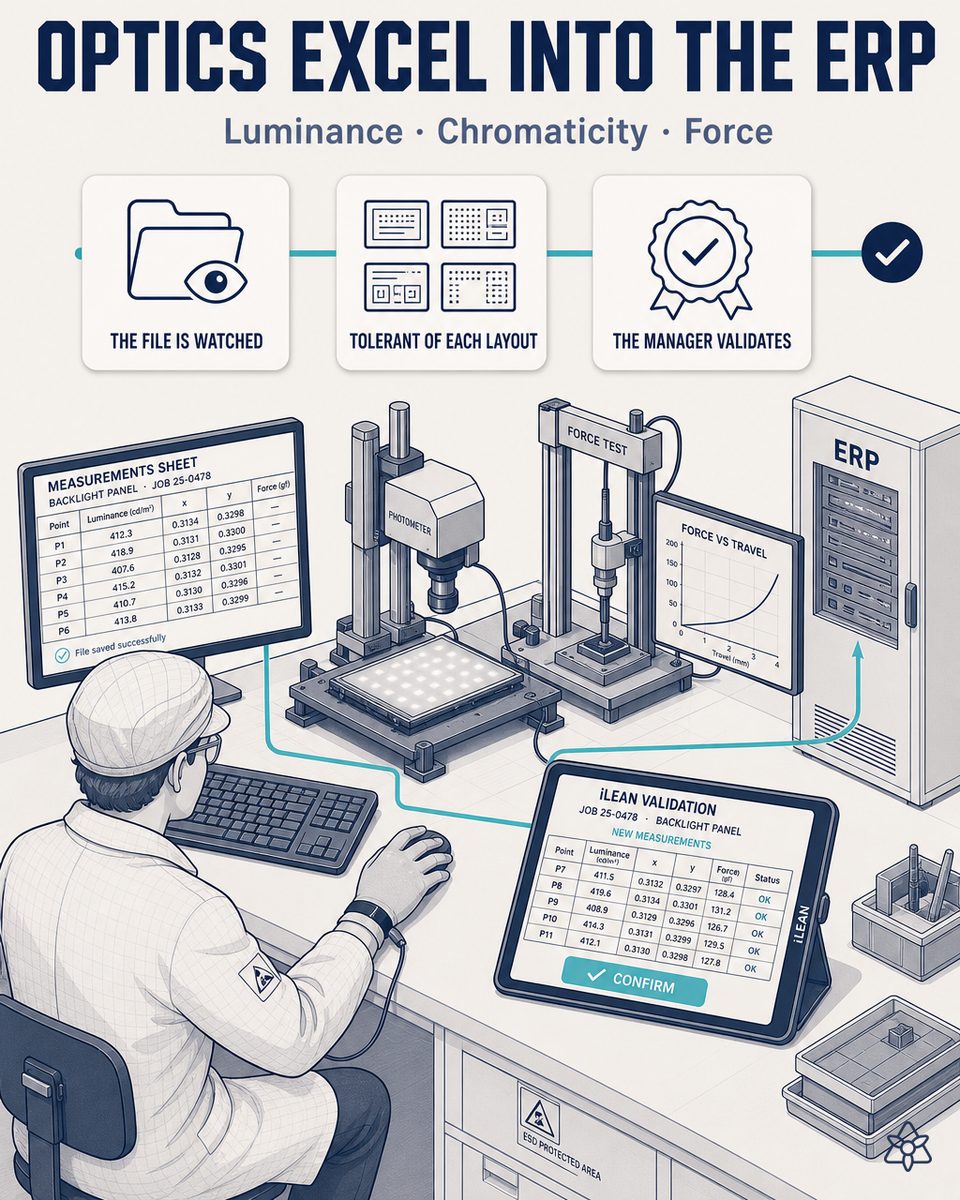
The lag is greatest exactly when the data is most urgent.
Two truths coexist: the laboratory's, alive, in spreadsheets; and the ERP's, official and out of date, because someone has to transcribe it. When the customer asks for process capability data on a photometric parameter, someone reconciles both by hand:
- The irony is in when it happens — the lag is greatest during the industrialization of a new project, which is when the most measurements are taken and when every process design decision depends on them.
- Half a workday per month of transcription per technician — qualified staff copying between windows, with the typos that introduces into the data the customer is going to look at.
- And there is a third layer, the economic one — if several laboratory and process quality people enter the ERP solely to type in results, each one consumes a named license of the quality module.
In other words: you pay for qualified people to type, and on top of that the data arrives late precisely in the phase where arriving on time decides the process design.
Connect in inward-listening mode — the artifact is observed, never the person.
The laboratory's sheet does not need to change. It needs what is already measured to reach the ERP without anyone typing it again — and the history to be queryable without depending on opening the right file.
iLEAN watches the shared folder and reads the file the moment it is saved. Parsing with an anchored model, tolerant of each engineer having their own column layout. Presentation to the quality manager for a two-tap validation and feed into the ERP's quality module through a programming interface.
How Connect operates on the laboratory's sheets:
- The artifact is observed, never the person — the shared folder and the moment of saving. Nothing is installed on the engineer's computer and their activity is not logged.
- Tolerant of each engineer's layout — in a real laboratory everyone organizes their columns their own way. The model anchors to that instead of demanding a common template nobody would maintain.
- Validation by the quality manager — two taps before anything reaches the ERP. A single person validates what several used to type.
- Feed through a programming interface — into the quality module, without depending on a specific ERP brand.
- History queryable by reference and by parameter — without depending on someone opening the right file, which is what today turns a query into a search.
Disconnected Excel and ERP vs. automatic feed with Connect
| Aspect | Manual transcription | With iLEAN Connect |
|---|---|---|
| Measurement → official data lag | Days or weeks | Minutes |
| Transcription | Half a workday per month per technician | Zero |
| Customer's process capability request | Manual reconciliation of two sources | Unnecessary: they are the same data |
| During industrialization | Maximum lag, maximum need | Real-time data |
| Quality module licenses | 4 named ones for typing in results | 1: the validating manager's |
| History lookup | Opening the right file | By reference and by parameter |
Impact estimate for your plant — to be validated with your own numbers.
The block below is an estimate to be validated against your plant's actual data. We put it forward so the committee has an order of magnitude; we refine it during the assessment.
- Electronic panel plant with its own laboratory — photometry, force-travel, thermal cycling and life testing — and an ERP with a quality module billed per named user.
- Connect pilot on the laboratory folder with a feed into the ERP through an interface after validation. Without changing the sheets or the habit. First value expected within a few weeks.
- Direct savings on ERP licenses: from 4 licenses to 1 in a typical plant laboratory, a −50 to −80% of that module's cost, recurring every year.
- Estimated payback between 4 and 8 months on licenses and transcription alone, not counting the value of real-time data. Estimate to be validated; the exact figure comes from the ERP vendor's last-year invoice.
- And the value that does not enter the calculation but weighs: during the industrialization of a project, every process design decision depends on measurements that today arrive days late.
And the fair question from the finance manager
"What if the model misreads a cell and an out-of-range measurement enters as conforming?" — hallucination is a problem of free generation, not of anchored tasks. Here the AI reads cells from a known sheet and maps them to known fields, with plausible ranges: the best models brought the error below 1.5% [1]. And that remainder does not reach the ERP: Connect holds the feed until the quality manager validates, and an out-of-range value gets flagged instead of slipping through.
[1] OpenAI paper "Why Language Models Hallucinate", 2025 — on the reliability of AI in anchored tasks.
What people ask about feeding the laboratory's measurements into the ERP
Do all the engineers' sheets have to be unified?
No, and it is a deliberate decision. In a real laboratory every engineer organizes their columns their own way, and demanding a common template is a project nobody maintains for more than three months. The parsing is tolerant of that diversity: the model anchors to each sheet's structure and returns the normalized data. The homogenization happens at reading time, not in the daily work. And if someone adds a column or renames a parameter, the variation is detected and flagged for review instead of feeding in a misinterpreted value.
Does Connect watch the laboratory engineer?
No: the artifact is observed, never the person. What is watched is a shared folder and the moment a file is saved. No software is installed on the engineer's computer, their activity is not logged and their performance is not measured. It is a distinction worth making clear with the team before the pilot: the goal is to take off their hands the half-workday per month they spend copying results today, not to check up on how they work.
Why does the lag hurt most during industrialization?
Because that is when the most measurements are taken and when every process design decision depends on them. When industrializing a new project, the laboratory characterizes luminance, chromaticity, force-travel curve and cycling behavior, and those measurements feed decisions taken that same week. If the official data arrives days or weeks late, either you decide on the spreadsheet — and then the ERP does not reflect reality — or you wait, and the project slips. It is the worst possible combination: maximum volume, maximum urgency and maximum lag.
How is the license saving calculated?
By counting how many laboratory and process quality people enter the quality module today solely to type in results. Each one consumes a full named license for a function that is not using the system, but feeding it. In a typical plant laboratory that is four; with Connect the validating manager's is enough — a −50 to −80% of that module's cost, recurring every year. The exact figure comes from the ERP vendor's last-year invoice, which is the first document we ask for.
What does the laboratory gain besides the saving?
A history queryable by reference and by parameter without depending on opening the right file. Today, answering "how has this reference's luminance behaved over the last six months?" requires knowing which sheets it is in and opening them one by one. With the data fed in and structured, that is a query — and it can be cross-referenced with the reflow oven curve and with the startup file of those same batches. It is the difference between having measurements and having demonstrable process capability.
More cases from this series
- Evidence is not reconstructed: it is generated at the moment of the factEvery critical change leaves its dossier with photos, signatures and measurements, organized by…
- Your product’s genealogy starts at the receiving dockDelivery note, reel labels, certificates and moisture data captured by photo and fed into the ERP. From…
- So an engineering change never catches you producing the previous revisionCustomer email and portal read on arrival: iLEAN cross-checks the notice against active orders and…
- The line startup file, available at second zeroSetup sheet, reflow profile and first article captured with a photo: the startup file exists at second…
- Recording what the person walking the plant knows — without them stoppingEarpiece and voice mode: the process engineer dictates while walking and iLEAN structures the incident…
- The reflow oven stays the same — but now it talksAn external camera reads the reflow oven panel and digitizes the thermal curve per reference, without…
Send us your quality module license structure and we will calculate the real savings.
We work on your plant's real data, not ours. Assessment with no commitment.
Calculate the real license savings ‹ See all 12 electronic panel cases See automotive