Recording what the person walking the plant knows — without them stopping
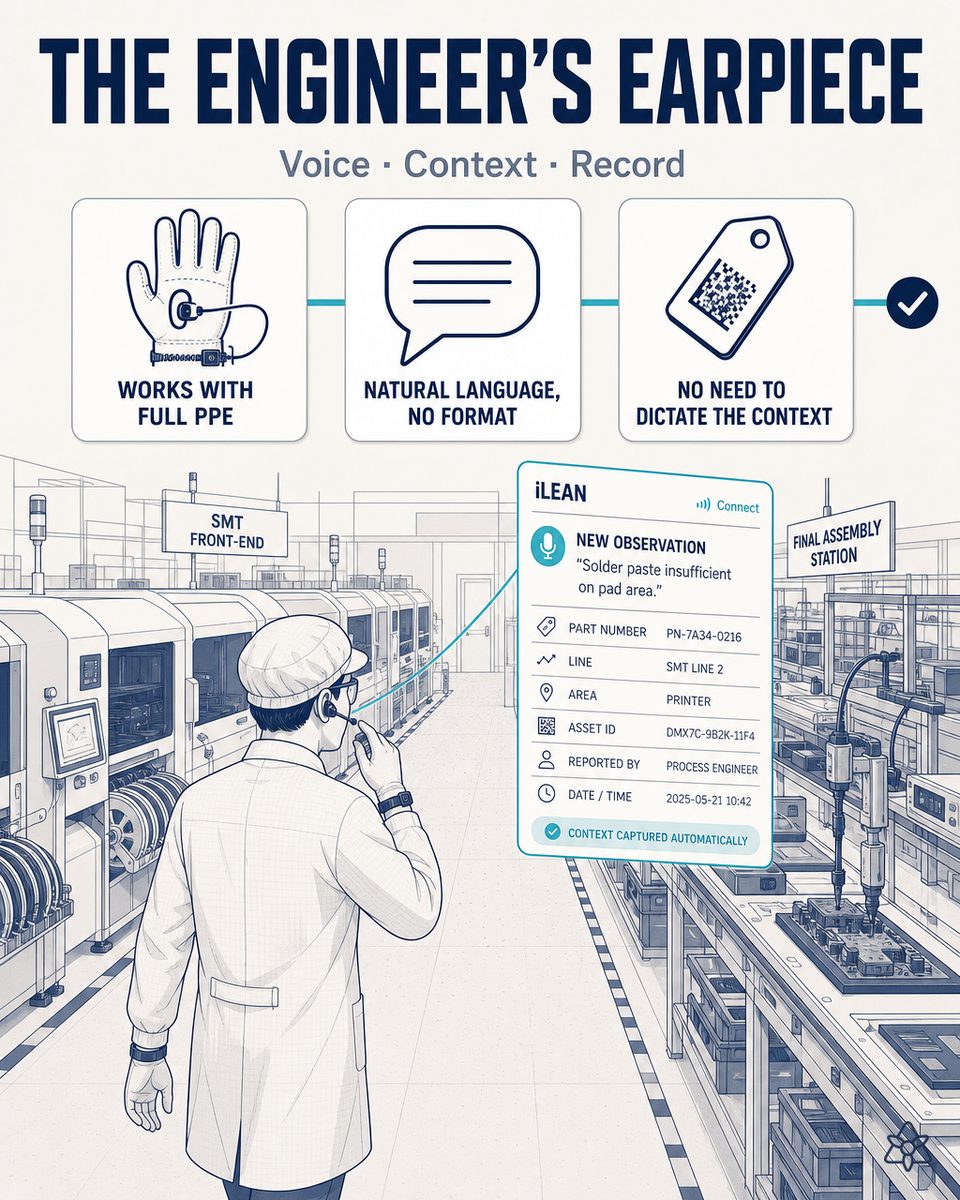
The process engineer and the shift supervisor spend the day between the SMT front-end and final assembly with their hands busy and with gloves and an antistatic wrist strap on, where typing is not an option. And they are the ones who know what is written down nowhere. With iLEAN Connect in voice mode, they dictate while walking and the system structures it tied to the active line, reference, order and shift.
Nobody asks for it to be recorded because recording it is materially uncomfortable.
A plant's most valuable operational knowledge is in no system: it is in the heads of the few people who walk it every day. That a line has had repeated false rejects on the same footprint for three shifts, that a station needs reinforcement, that a batch of reels comes with stiffer tape than usual:
- You have to stop, take off the gloves, find a terminal and type — with an antistatic wrist strap on and while moving, that does not happen. So it is not recorded, and at the end of the shift it disappears.
- In a young plant the effect multiplies — that knowledge is concentrated in very few people: it leaves with the person, with the shift or with the next project.
- It is the operation's most fragile asset — and the only one with no backup whatsoever.
The shift handover ends up based on what someone remembers to tell, and incidents repeat because nobody documented the first one.
Connect in voice mode — no need to dictate the context.
The difference between recording and capturing lies in structure and anchoring: the system already knows which line, which reference, which order and which shift are active, so the person only has to say what they see.
A bluetooth earpiece with a wake word, compatible with gloves and protective equipment. The person dictates in natural language, unformatted, while walking. iLEAN structures it as an incident, process observation or request, and automatically ties it to the active line, reference, order and shift.
How Connect operates in voice mode in an electronic panel plant:
- Compatible with gloves and protective equipment — including the antistatic wrist strap. It is a starting requirement in an ESD area, not an add-on: if it forces you to take something off, it does not get used.
- Natural language, no format — there are no fields to fill in aloud and no syntax to learn. You speak the way you would tell a colleague.
- No need to dictate the context — the system already knows the line, the reference, the order and the shift. "False rejects on the same footprint" lands tied to its place without reciting anything.
- Support returned within seconds — by voice to the earpiece or by a notice to the responsible person's tablet, with coordination between roles when appropriate.
- Searchable and cross-referenced — everything is recorded and cross-referenced with the rest of the plant's signals, which is what turns a loose observation into a pattern.
Knowledge that dies with the shift vs. knowledge recorded in real time
| Aspect | Without voice capture | With iLEAN Connect voice |
|---|---|---|
| What survives the shift | Whatever someone remembers to tell | The structured incident with its context |
| Shift handover | Based on memory | Based on what was recorded |
| Repeated incidents | Repeat because nobody documented the first | Traced |
| Cost of recording | Stop, remove gloves, find a terminal | Talking while walking |
| Link to line, reference, order and shift | Depends on someone reconstructing it | Automatic |
| Knowledge concentrated in few people | Leaves with them | Stays in the system |
Impact estimate for your plant — to be validated with your own numbers.
The block below is an estimate to be validated against your plant's actual data. We put it forward so the committee has an order of magnitude; we refine it during the assessment.
- Young electronic panel plant ramping up, with operational knowledge concentrated in very few people who walk the floor every day.
- Connect voice pilot with an earpiece for the process engineer or the shift supervisor, anchored to the active context. First value expected within a few weeks.
- Indicative payback between 6 and 12 months via reduced meeting time and fewer repeats of already-known incidents. Estimate to be validated.
- Its main value is as an enabler: continuous improvement and root cause analysis depend on this information existing, and today it does not.
- And in a young plant it weighs double: knowledge is so concentrated that it leaves with the person, with the shift or with the next project — the operation's most fragile asset.
And the fair question from the works council
"Is this a microphone over the line people?" — no. The earpiece activates with its own wake word and captures what the person decides to dictate, just as if they wrote it; it does not listen continuously and does not pick up conversations. What is stored are incidents and process observations tied to line, reference, order and shift. And reliability plays on anchored ground: structuring a short dictation against a known context is where the best models brought the error below 1.5% [1].
[1] OpenAI paper "Why Language Models Hallucinate", 2025 — on the reliability of AI in anchored tasks.
What people ask about voice capture in a panel plant
Does it work in an ESD area, with gloves and a wrist strap?
It is designed for that: the earpiece is compatible with gloves and protective equipment, including the antistatic wrist strap, and activates with its own wake word without pressing anything. It is a starting requirement, not an add-on — any solution that forces you to take off a glove, break the wrist strap connection or handle a terminal simply does not get used in an electronics plant. The gesture is speaking, which is the only thing the environment allows at no cost.
Do you have to dictate the context of each incident?
No, and that is the detail that makes the system usable. iLEAN already knows which line, which reference, which order and which shift are active at the moment of dictation, so the person only says what they see: "repeated false rejects on the same footprint" or "this batch of reels comes with stiffer tape". The anchoring is supplied by the system. If reference, order and line had to be recited before each observation, the cost of recording would be high again — and we would be back at the starting point.
How is it different from a voice memo?
In structure and in later use. A voice memo is a file someone would have to listen to, transcribe and classify, and that in practice nobody reopens. Connect turns the dictation into an incident, process observation or request already typed and tied to its context, and it also cross-references with the rest of the plant's signals. That is what later makes it possible to see that the false rejects on that footprint have been repeating for three shifts, or that they coincide with a specific batch of reels. An audio file allows none of that.
What does the system return besides storing?
Support within seconds, by voice to the earpiece itself or by a notice to the responsible person's tablet, with coordination between roles when appropriate. If what was dictated needs maintenance or quality, the notice reaches the relevant role with the context already attached, instead of waiting for the person to track them down. That return is what sustains usage: a system that only recorded would be abandoned in two weeks, while one that solves something in the moment gets used out of self-interest.
Why is it so critical in a young plant?
Because knowledge is concentrated in very few people and has no backup. In a mature plant, what one person knows usually also lives in procedures, in history and in other colleagues with years behind them. In a ramping plant it does not: the operational know-how belongs to three or four people who are also industrializing the next project. That knowledge leaves with the person, with the shift or with the project, and it is the operation's most fragile asset — which is why capturing it has a value here it would not have in another context.
More cases from this series
- Evidence is not reconstructed: it is generated at the moment of the factEvery critical change leaves its dossier with photos, signatures and measurements, organized by…
- Your product’s genealogy starts at the receiving dockDelivery note, reel labels, certificates and moisture data captured by photo and fed into the ERP. From…
- The laboratory’s measurements, in the ERP in minutes and with fewer licensesLuminance, chromaticity and force-travel: iLEAN reads the laboratory’s Excel on save and feeds it into…
- So an engineering change never catches you producing the previous revisionCustomer email and portal read on arrival: iLEAN cross-checks the notice against active orders and…
- The line startup file, available at second zeroSetup sheet, reflow profile and first article captured with a photo: the startup file exists at second…
- The reflow oven stays the same — but now it talksAn external camera reads the reflow oven panel and digitizes the thermal curve per reference, without…
How much of your plant's know-how lives only in three people's heads?
We work on your plant's real data, not ours. A short pilot is enough to see the volume of what is lost today. Assessment with no commitment.
Start there with an iLEAN consultant ‹ See all 12 electronic panel cases See automotive