So an engineering change never catches you producing the previous revision
At an automotive supplier, the most expensive notices do not enter through the management system: they enter by email or through the customer portal. An engineering change, a delivery schedule adjustment, a nonconformity analysis request. They land in the inbox of a person who is on the shop floor, and meanwhile the line produces with the previous revision. With iLEAN Connect silently copied in, the relevant role receives a concrete action, not a notification.
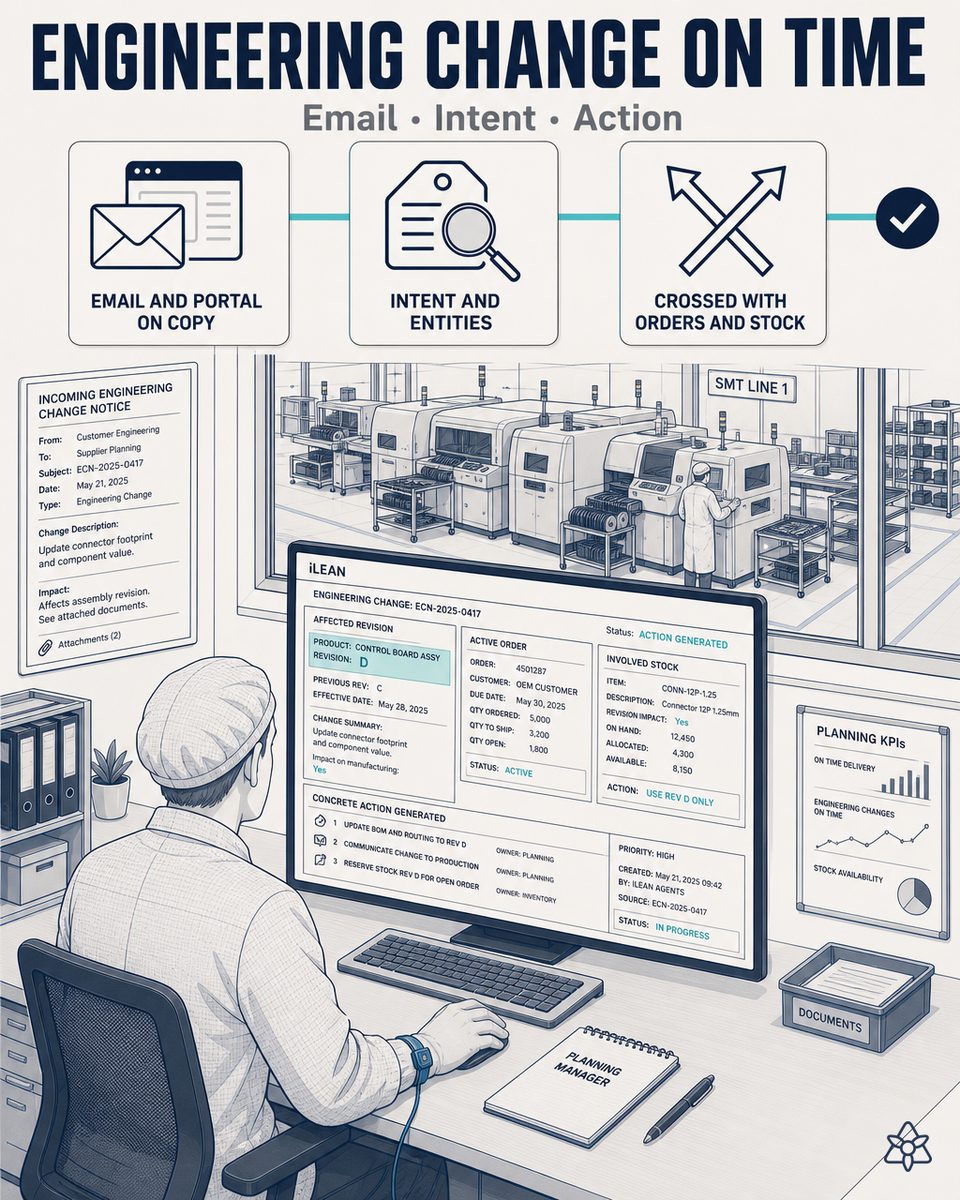
The cost of a change not detected in time is double.
There is what gets manufactured in excess with the old revision, which can end up as obsolete stock or rework. And there is credibility with a customer who measures its suppliers' response time and translates it into ranking position:
- In a ramping plant the volume of this critical correspondence is high — with several projects entering at once, and the person receiving it cannot be watching the inbox in real time: they are on the floor, industrializing.
- Hours of latency between the customer informing and the plant reacting — and into that gap fit decisions made on stale information, which later have to be undone.
- Production with the previous revision — which ends up as obsolete stock if it cannot be reused, or as rework if it can. Neither outcome is cheap.
And the second cost appears in no ledger line: the position in the supplier ranking is built over years and erodes with every slow response.
Connect in chaotic-sources mode — a concrete action, not a notification.
Critical information arrives through whatever channel the customer chooses, and that does not change. What does change is what happens in the following second: reading it, cross-referencing it with the real state and returning something actionable.
A dedicated mailbox silently copied twenty-four hours a day and reading of the customer portal notifications. Extraction of intent — engineering change, schedule change, nonconformity, documentary request — and of entities: reference, revision, effective date, quantity. Cross-reference with active orders and finished-goods stock carrying the affected revision.
How Connect operates on customer notices:
- Email and portal, silently copied 24 h — the customer keeps notifying through its usual channel. Nobody asks it to switch channels and no intermediate portal is built.
- Intent and entities — it tells an engineering change from a schedule adjustment and from a documentary request, and extracts reference, revision, effective date and quantity.
- Cross-reference with active orders and affected stock — knowing there is a new revision is not enough: you need to know what is being produced right now and how much has already been built with the previous revision.
- A concrete action with the scope already calculated — to the relevant role, not to a generic mailbox. The person receives the impact, not the task of figuring it out.
- The system blocks nothing on its own — the responsible person decides and signs. Humans in command.
A notice in an inbox vs. a notice cross-referenced with active orders
| Aspect | An inbox and a person on the floor | With iLEAN Connect copied in |
|---|---|---|
| Notice → reaction latency | Hours | Seconds |
| Basis of the decision | What was read three hours ago | The real state of the moment |
| Production with an obsolete revision | Happens | Avoided |
| Scope of the change | Has to be calculated by hand | Already calculated: affected orders and stock |
| What the responsible person receives | A notification | A concrete action |
| Response time to the customer | Measured and penalized in the ranking | Measurably shortened |
Impact estimate for your plant — to be validated with your own numbers.
The block below is an estimate to be validated against your plant's actual data. We put it forward so the committee has an order of magnitude; we refine it during the assessment.
- Automotive electronic panel supplier with several projects ramping up and customer notices arriving by email and portal.
- Connect pilot on a dedicated mailbox and the portal notifications, cross-referenced against active orders and stock. The management system is not touched except on human confirmation. First value expected within a few weeks.
- Indicative payback between 3 and 7 months depending on the frequency of engineering changes; in plants with several simultaneous launches it usually sits at the low end of the range. Estimate to be validated.
- The measurable saving is the material manufactured in excess with the previous revision — obsolete stock or rework, depending on whether it can be reused.
- And the one that is not measured but decides awards: the response time the customer translates into supplier ranking position.
And the fair question from the customer quality manager
"What if the AI misinterprets a customer notice?" — it executes nothing: it proposes with the scope calculated and a person decides and signs. The system does not block on its own. On the reading itself, hallucination is a problem of free generation, not of anchored tasks: extracting reference, revision and effective date from a notice and cross-referencing them with the active orders is where the best models brought the error below 1.5% [1]. And an ambiguous notice gets flagged instead of resolving itself.
[1] OpenAI paper "Why Language Models Hallucinate", 2025 — on the reliability of AI in anchored tasks.
What people ask about reading customer notices with AI
Do we have to ask the customer to change channels?
No — and with an OEM customer it would be unthinkable: the channel is set by them. Connect is silently copied on a dedicated mailbox and also reads the customer portal notifications, which is where a good part of the formal notices arrive. Nobody outside the plant learns there is a system reading, and nobody inside has to forward anything. The channel is respected exactly as it is; what changes is what happens in the second after the notice enters.
How is this different from an email alert?
It does not announce that a message has arrived: it says what to do with it. Connect cross-references the extracted intent with the active orders and the finished-goods stock carrying the affected revision, and returns the scope already calculated — which orders must be stopped or reconfigured and how much manufactured material is compromised. That difference is what allows deciding in minutes: an alert forces someone to investigate the impact; a concrete action brings it already done.
Can the system stop an order on its own?
No. The system blocks nothing on its own: the responsible person decides and signs. Connect calculates the impact and puts it in front of the role that can act, but the decision to stop, reconfigure or let it run is human. At an automotive supplier, where stopping an order has consequences on the customer's delivery schedule, that boundary is not a design nuance: it is the condition for the system to be deployable.
Why does response time matter so much?
Because the customer measures it and translates it into supplier ranking position. In automotive, the evaluation is not only quality and delivery: it includes the agility with which a supplier responds to an engineering change or an analysis request. That component weighs in the next awards and is built over years. That is why the cost of latency has two faces — the excess material manufactured, which can be calculated, and the credibility, which appears in no ledger line but decides future business.
How is the return measured?
With two figures the plant can produce. First, how much material was manufactured with the previous revision in recent months due to notices detected late, and whether it ended up as obsolete stock or rework. Second, the current average latency between the customer informing and the plant reacting — which tends to surprise when actually measured. The estimated 3-to-7-month payback comes from the first; in plants with several simultaneous launches it sits at the low end of the range because the volume of critical notices is much higher.
More cases from this series
- Evidence is not reconstructed: it is generated at the moment of the factEvery critical change leaves its dossier with photos, signatures and measurements, organized by…
- Your product’s genealogy starts at the receiving dockDelivery note, reel labels, certificates and moisture data captured by photo and fed into the ERP. From…
- The laboratory’s measurements, in the ERP in minutes and with fewer licensesLuminance, chromaticity and force-travel: iLEAN reads the laboratory’s Excel on save and feeds it into…
- The line startup file, available at second zeroSetup sheet, reflow profile and first article captured with a photo: the startup file exists at second…
- Recording what the person walking the plant knows — without them stoppingEarpiece and voice mode: the process engineer dictates while walking and iLEAN structures the incident…
- The reflow oven stays the same — but now it talksAn external camera reads the reflow oven panel and digitizes the thermal curve per reference, without…
How many engineering changes do you handle per month?
We work on your plant's real data, not ours. We measure the latency you have today and calculate the case. Assessment with no commitment.
See what latency you have today ‹ See all 12 electronic panel cases See automotive