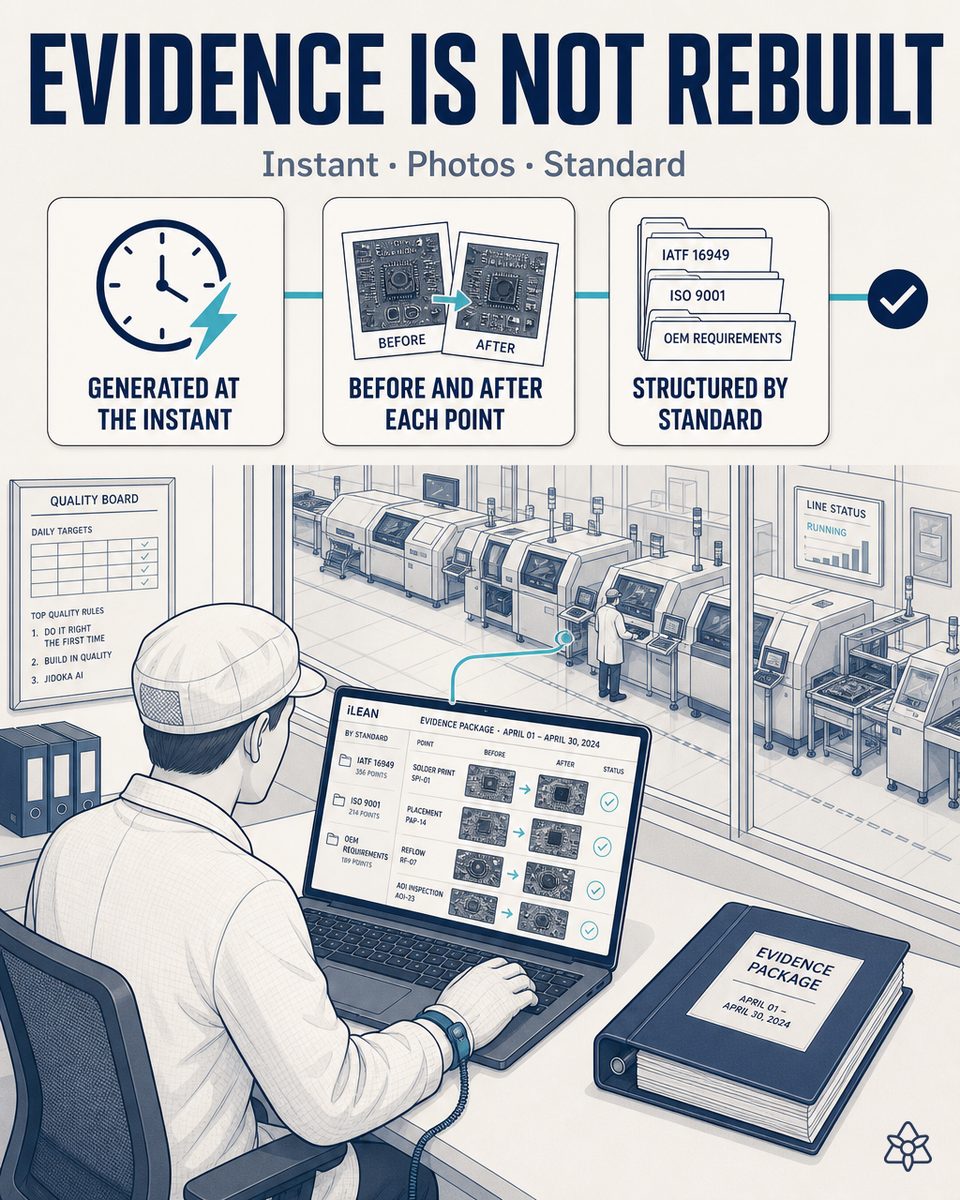
Evidence is not reconstructed: it is generated at the moment of the fact
At an automotive supplier, the audit is not an annual event, it is a routine: process audit, capability demonstration before every launch, part approval package per project and the certifications' own calendar. Each appointment consumes weeks from the people who should be industrializing the next project. With Edge and Agents, every critical change leaves its dossier the instant it happens.
The most frequent nonconformity is not that the process is wrong: it is that it is not evidenced.
The evidence exists, but it is scattered across folders, emails and papers in formats that do not talk to each other:
- Preparing a process audit or a capability demonstration consumes weeks of engineering — which in a ramping plant is the scarcest resource: the same people who should be industrializing the next project.
- It was done right and there is no way to prove it — the nonconformity does not point to a process failure, it points to a documentary gap. Two very different things, and only one should cost money.
- And the cost is not only the time: it is the risk — a documentary gap in a customer's audit can condition the award of the next program.
In an industry where the next program is awarded partly on the audit history, the ability to demonstrate what you do stops being administrative and becomes commercial.
Edge captures, Agents organizes — the agents prepare and order; the dialogue stays human.
The key is that the evidence is not reconstructed: it is generated at the moment of the fact, as a consequence of the work itself. Agents only has to structure it and keep the index alive.
Every critical change — setup, reference change, first-article validation, laboratory measurement — automatically leaves its before-and-after photos of each point, the decision log, who signed, what was measured and with what result. Agents structures it by certifying standard, with the organization each auditor expects.
How the evidence is generated and organized:
- Generated at the instant of the fact — there is no later documentation step someone can forget on a high-pressure day.
- Before-and-after photos of each point — plus decision log, signer, measurements and results. That is what an auditor considers proof, not a procedure describing what should happen.
- Structured by certifying standard — with the organization each auditor expects, and with a living index: it is not assembled on request, it is assembled already.
- The auditor asks for a period and the package is there — zero human work afterwards.
- The quality manager reviews and decides what is handed over — the agents prepare and order; the dialogue with the auditor stays human.
Prior reconstruction vs. evidence generated in the moment
| Aspect | Weeks of preparation | With iLEAN Edge + Agents |
|---|---|---|
| Preparation before each audit | Weeks of engineering | Zero |
| Origin of the evidence | Folders, emails and papers that do not talk to each other | The critical change itself, in the moment |
| Nonconformity from a documentary gap | Frequent even with the process right | Eliminated in the covered processes |
| Organization | Redone for every standard | A single index by standard and period |
| Resource consumed | The scarcest: engineering during ramp-up | None |
| Dialogue with the auditor | Human | Human — unchanged |
Impact estimate for your plant — to be validated with your own numbers.
The block below is an estimate to be validated against your plant's actual data. We put it forward so the committee has an order of magnitude; we refine it during the assessment.
- Automotive electronic panel supplier with process audits, capability demonstrations per launch and part approval packages per project.
- Deployment resting on the Edge and Connect cases already running: they generate the evidence, Agents structures it. First value expected within a few weeks of changes being recorded.
- Weeks of engineering freed per audit cycle and protection of the certifications that are a condition for supplying.
- Estimated payback between 6 and 12 months depending on audit frequency and the number of launches per year. Estimate to be validated.
- And the risk that gets bounded: a documentary gap in a customer's audit can condition the award of the next program — a cost of another order than the engineering weeks.
And the fair question from the quality manager
"Will an auditor accept a package assembled by agents?" — the auditor does not accept the package, they accept the evidence: the before-and-after photo, the decision record, the signature and the measurement, which are the same ones scattered around today. Agents generates no content: it structures existing evidence by standard, which is an anchored task — where the best models brought the error below 1.5% [1]. And the one who reviews and decides what is handed over is still the quality manager.
[1] OpenAI paper "Why Language Models Hallucinate", 2025 — on the reliability of AI in anchored tasks.
What people ask about automatic audit evidence
Why does preparing an audit consume weeks?
Because the evidence exists but is scattered across folders, emails and papers in formats that do not talk to each other. Gathering it for a specific period forces searching several places, cross-checking dates and trusting nothing is missing. And at an automotive supplier this does not happen once a year: there is the process audit, the capability demonstration before every launch, the part approval package per project and the certifications' own calendar. Each appointment consumes a ramping plant's scarcest resource — the engineering that should be industrializing the next project.
What is the difference between the process being right and being able to prove it?
All the difference, and it is the source of the most frequent nonconformity. The auditor does not usually find the process is wrong: they find it is not evidenced. It was done right and there is no way to prove it — and that scores the same as if it had been done wrong. The practical difference is that a process problem is corrected with an action; an evidence problem is corrected with a system that generates it at the moment of the fact, which is exactly what this case does.
What evidence exactly is generated?
For each critical change — setup, reference change, first-article validation, laboratory measurement — the system automatically keeps the before-and-after photos of each point, the decision log, who signed, what was measured and with what result. It is not a report written afterwards: it is the trail of the work itself. That is why there is no additional step someone can forget on a high-pressure day, which is when the gaps are born.
Is the package handed to the auditor directly?
Not without passing through a person. Agents keeps the index alive and assembles the package for whatever period is requested, but the quality manager reviews and decides what is handed over. The agents prepare and order; the dialogue with the auditor stays human. It is an important distinction: what gets automated is the gathering work, which is mechanical and consumes weeks, not the judgment about what to show and how to explain it, which is where the manager adds value.
Why is a documentary gap a commercial risk?
Because in automotive the audit history weighs in the award of the next program. A customer that finds a documentary gap does not only raise a one-off nonconformity: it records that the supplier cannot demonstrate its process control, and that enters the evaluation that decides who builds the next model. That is why this case's value does not end with the engineering weeks freed — those can be calculated — but in protecting the commercial position, which is of another order.
More cases from this series
- Your product’s genealogy starts at the receiving dockDelivery note, reel labels, certificates and moisture data captured by photo and fed into the ERP. From…
- The laboratory’s measurements, in the ERP in minutes and with fewer licensesLuminance, chromaticity and force-travel: iLEAN reads the laboratory’s Excel on save and feeds it into…
- So an engineering change never catches you producing the previous revisionCustomer email and portal read on arrival: iLEAN cross-checks the notice against active orders and…
- The line startup file, available at second zeroSetup sheet, reflow profile and first article captured with a photo: the startup file exists at second…
- Recording what the person walking the plant knows — without them stoppingEarpiece and voice mode: the process engineer dictates while walking and iLEAN structures the incident…
- The reflow oven stays the same — but now it talksAn external camera reads the reflow oven panel and digitizes the thermal curve per reference, without…
How many engineering weeks did your last process audit cost you?
We work on your plant's real data, not ours. We review what evidence you generate today and what would be missing. Assessment with no commitment.
See how we would apply it in your plant ‹ See all 12 electronic panel cases See automotive