Your product’s genealogy starts at the receiving dock
The truck arrives with electronic components: a delivery note with many lines, dozens of reels each with its label, vacuum-sealed bags with their moisture indicator and sensitivity level, and certificates of conformity to file. Either the carrier waits and bills the delay, or the entry is logged in a hurry and the batches end up approximate. With iLEAN Connect: a photo of the delivery note and the labels, one validation tap and a feed into the ERP.
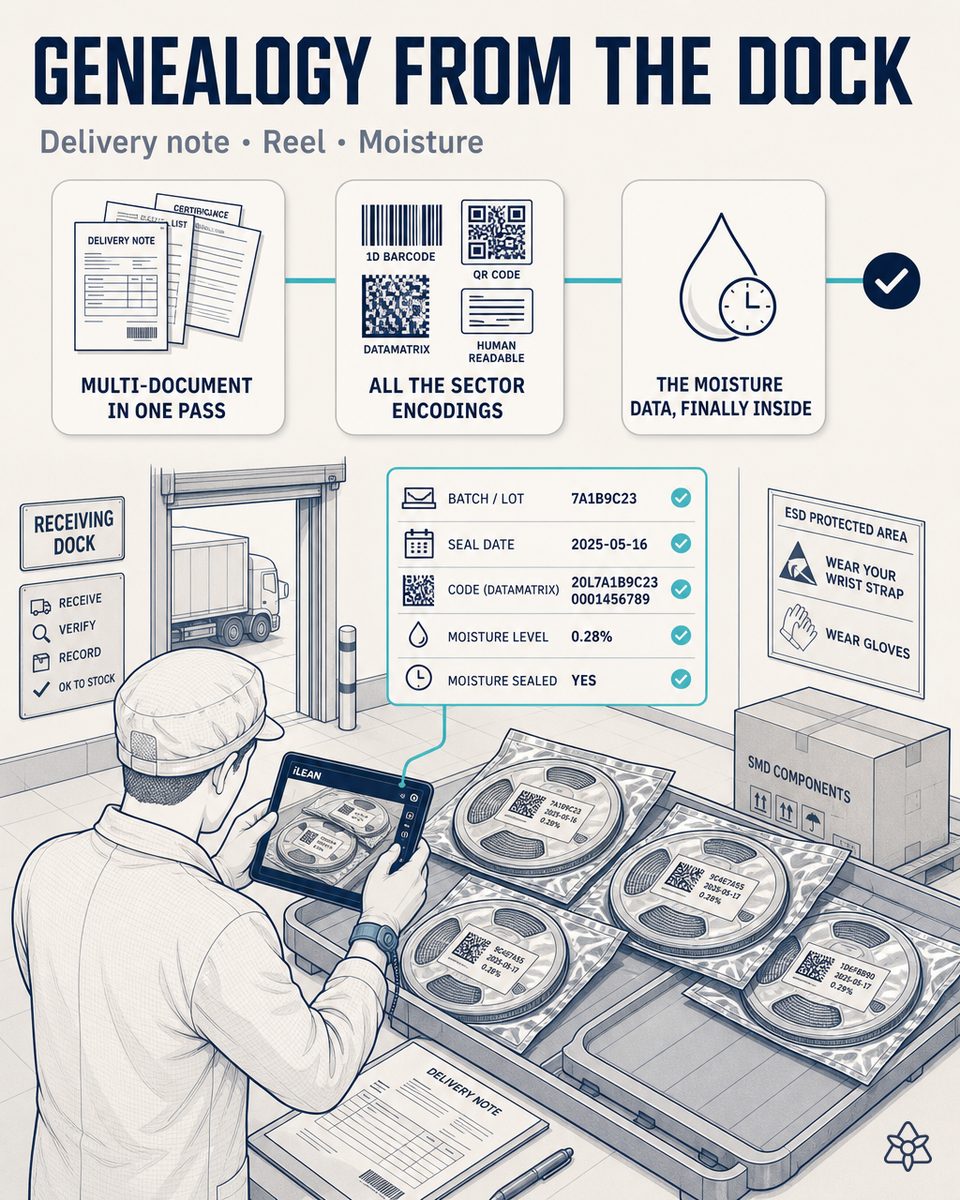
Backward traceability starts here — and if it fails here, nothing that comes after is any use.
If the reel's batch does not enter correctly at receiving, no later genealogy works, however sophisticated the rest of the system:
- When a component's manufacturer issues a quality notice on a batch range, the plant that did not log the entry properly does not know exactly which boards that material was mounted on — and has to contain blindly.
- There is one data point that almost never reaches the system because it is tedious to type: the bag's moisture sensitivity level and seal date. It is precisely the one that determines how long that component can stay exposed in the plant and, with it, the risk of delamination when passing through the oven.
- And meanwhile, the carrier waits — and the delay gets billed.
It is the point where saving two minutes today can cost an unscoped containment six months from now.
Connect in multi-document photo mode — the truck leaves on time.
The necessary information is already printed on the delivery note, the labels and the certificates. What is missing is the path to the ERP without a keyboard — and room in it for the moisture data nobody types today.
A photo of the delivery note and a photo of the reel labels. Recognition of the sector's standard barcodes, data matrices and QR codes, plus optical reading of plain text. Extraction of manufacturer reference, batch, quantity, seal date and moisture sensitivity level, and reading of the certificate of conformity, which is archived and linked to the batch.
How Connect operates at the receiving dock:
- Multi-document in a single pass — delivery note, labels and certificates. They are not three independent captures: they stay related to each other and to the batch.
- All the sector's encodings — standard barcodes, data matrices, QR and plain text. Whatever the reel brings gets read without demanding anything from the supplier.
- The moisture data, finally inside — sensitivity level and seal date enter as fields. It is the data that governs the allowed exposure time and the delamination risk in the oven.
- Certificate archived and linked to the batch — not in a separate folder: tied to the material that entered.
- One-tap validation and feed through an interface — the responsible person reviews the summary and confirms. The truck leaves on time.
Logging in a hurry vs. a complete inbound genealogy
| Aspect | Manual logging with the truck waiting | With iLEAN Connect photo |
|---|---|---|
| Reel batches | Approximate out of haste | Read from the code, exact |
| Moisture sensitivity level | Almost never reaches the system | A structured field from entry |
| Component manufacturer quality notice | Forces blind containment | Scoped to the boards carrying that batch |
| Certificate of conformity | Filed separately | Linked to the batch |
| Carrier delays | Get billed | Eliminated |
| Receiving module licenses | 3 active | 1: the validating manager's |
Impact estimate for your plant — to be validated with your own numbers.
The block below is an estimate to be validated against your plant's actual data. We put it forward so the committee has an order of magnitude; we refine it during the assessment.
- Electronic panel plant receiving components on reels with vacuum-sealed bags, moisture indicator and certificates of conformity.
- Connect photo pilot at the dock with a feed into the ERP through an interface after one-tap validation. Without asking suppliers for changes. First value expected within a few weeks.
- Direct savings on ERP licenses: from 3 licenses to 1 in the receiving module, a −50 to −70% recurring, plus the elimination of billed delays.
- Estimated payback between 4 and 9 months. Estimate to be validated with the ERP invoice and the delay history.
- The lever that does not fit in the spreadsheet: being able to scope a containment when a component's manufacturer issues a notice on a batch range. Either you know which boards it was mounted on, or you contain everything.
And the fair question from the quality manager
"What if it misreads a reel batch?" — hallucination is a problem of free generation, not of anchored tasks. On top of that, the batch is read from the code — sector barcode, data matrix or QR — not from free text, which is the most reliable reading there is. In anchored tasks the best models brought the error below 1.5% [1], and here there are two more nets: doubtful lines arrive highlighted and nothing is fed in without a person confirming it.
[1] OpenAI paper "Why Language Models Hallucinate", 2025 — on the reliability of AI in anchored tasks.
What people ask about electronic component receiving
Why is logging at receiving so critical?
Because backward traceability starts there. If the reel's batch does not enter correctly, no later genealogy works, however sophisticated the rest of the system — you can have perfect unit traceability on the line and not know which component was inside. The moment that hurts is specific: when the manufacturer of a component issues a quality notice on a batch range and the scope has to be decided. With the entry properly logged it is scoped to the affected boards; without it, containment is blind.
What is the moisture data and why does it matter?
Moisture-sensitive components arrive in vacuum-sealed bags with an indicator and a declared sensitivity level. That level, together with the seal date, determines how long the component can stay exposed in the plant before needing reconditioning. If exceeded, the risk is delamination when passing through the reflow oven — a defect that is not always visible and that affects long-term reliability. It is a data point that almost never reaches the system simply because it is tedious to type, and it is exactly the kind of field photo capture solves at no cost.
Do suppliers have to be asked for a specific format?
No. Recognition covers the sector's standard barcodes, data matrices and QR codes, plus optical reading of plain text for whatever comes uncoded. Electronic component manufacturers label with very established standards, so most of the information is read from code — the most reliable reading possible — and the rest is extracted from the delivery note as it arrives. Nothing has to be asked of anyone and no per-supplier templates have to be maintained.
How long does receiving a truck take this way?
Little enough for the truck to leave on time, which is the goal. Today the time goes into logging a long delivery note line by line and copying the batch of dozens of reels; with Connect that is a few photos and a validation over the summary, where only the flagged lines demand attention. The carrier delays, which today get billed and accepted as part of the process, disappear — and they are among the few savings that show up directly on an invoice and are therefore easy to defend.
How does it translate into ERP licenses?
By counting how many people need access to the receiving module today only to book goods in. Typically three. With Connect the entry happens through a programming interface and only the validating manager keeps the license: the usual reduction is from 3 licenses to 1, a −50 to −70% recurring cost of that module. It is an easy saving to audit because it comes from the number of contracted users versus those who actually need to operate it, and it is calculated against the vendor's real invoice.
More cases from this series
- Evidence is not reconstructed: it is generated at the moment of the factEvery critical change leaves its dossier with photos, signatures and measurements, organized by…
- The laboratory’s measurements, in the ERP in minutes and with fewer licensesLuminance, chromaticity and force-travel: iLEAN reads the laboratory’s Excel on save and feeds it into…
- So an engineering change never catches you producing the previous revisionCustomer email and portal read on arrival: iLEAN cross-checks the notice against active orders and…
- The line startup file, available at second zeroSetup sheet, reflow profile and first article captured with a photo: the startup file exists at second…
- Recording what the person walking the plant knows — without them stoppingEarpiece and voice mode: the process engineer dictates while walking and iLEAN structures the incident…
- The reflow oven stays the same — but now it talksAn external camera reads the reflow oven panel and digitizes the thermal curve per reference, without…
Could you scope today which boards a specific component batch was mounted on?
We work on your plant's real data, not ours. We look at your real delivery notes and labels and calculate the case with you. Assessment with no commitment.
See how we would apply it in your plant ‹ See all 12 electronic panel cases See automotive