The camera that stops a bad weld
At the pace of a robotic cell, the human eye can't inspect 100% of the weld seams. iLEAN Edge places a camera over the line, infers in milliseconds, and rejects the defective part before palletizing.
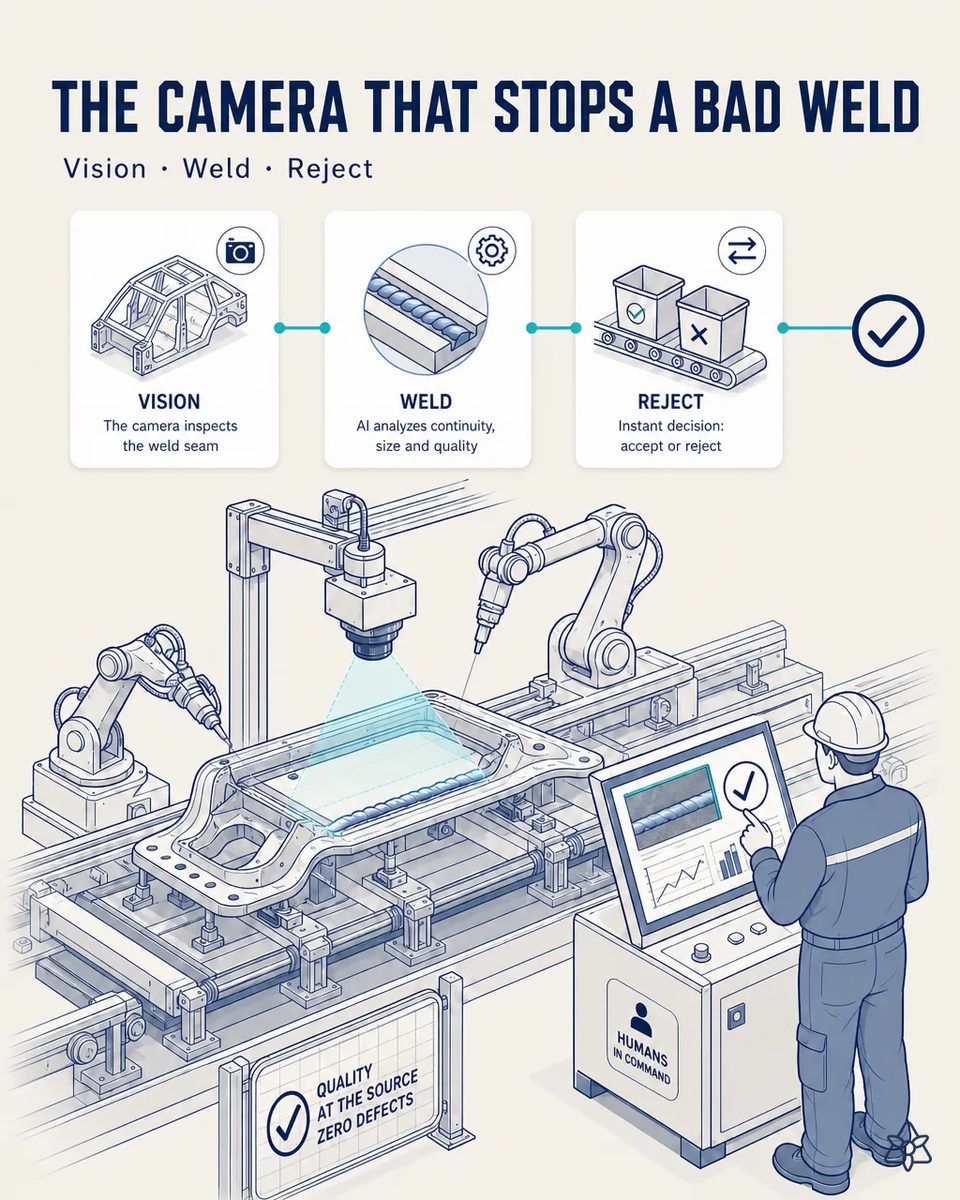
At cell cadence, nobody inspects one hundred percent of anything.
100% human visual inspection is impossible at real robotic-cell pace. Sampling inspection leaves gaps in safety-relevant structural parts.
- The human eye cannot inspect every weld seam at the pace a robotic cell runs. It is not a training problem or an attitude problem: it is physically impossible.
- So the plant inspects a sample — typically one to five percent — and lives with the arithmetic that follows.
- On a safety-relevant structural part, that gap is not an abstract statistic. The seam that was not looked at is the one that shows up in a claim.
- And the borderline defect — a short seam, a spatter-covered nugget, a geometry that drifted a fraction after a fixture knock — is exactly the one a sample is least likely to catch, because it does not announce itself and it does not repeat on every part. It is also the one most likely to survive final inspection and reach the customer's incoming check.
Edge — local inference in milliseconds, before the pallet.
Edge: local CNN vision trained on the specific weld seam and geometry of each part number, with no cloud dependency for inference.
Inference runs locally at the cell, with no cloud dependency: the verdict has to exist before the part moves on, and a network round trip does not fit inside that window. That is why this is Edge and not a service in a datacenter, and it is also why a plant network incident never turns into a line stoppage or a batch released without inspection.
Sampling inspection versus Edge vision
| Aspect | Sampling inspection | With iLEAN Edge |
|---|---|---|
| Coverage | 1-5% of parts | 100%, part by part |
| Consistency | Depends on fatigue and shift | Objective and constant at cadence |
| Weld seam and geometry | Judged by eye | Classified by a trained local model |
| Where the defect is caught | At final inspection, or at the OEM | Before palletizing |
| Claims for visual or dimensional defects | Recurring | Drastically reduced |
| Borderline cases | They slip through | Escalated to a person |
From 1-5% sampling to 100% part coverage. Drastic reduction of OEM claims for visual/dimensional defects.
Impact estimate — to be validated with your numbers.
The block below is an estimate to be validated against your plant's actual data. We put it forward so the committee has an order of magnitude; we refine it during the assessment.
- Estimated payback 5-12 months, depending on your current scrap and claim ratio.
- From 1-5% sampling to 100% coverage of the parts in the covered family.
- A drastic reduction of OEM claims for visual and dimensional defects, which is where the relationship actually gets measured.
- And the defective part is rejected before palletizing, instead of being found at final inspection, at the customer's incoming check or, in the worst case, in a sorting campaign at their plant.
Estimated payback 5-12 months depending on current scrap/claim ratio. Estimate to validate.
And the fair question from the production manager
“What if it rejects good parts?” — the false positive is the real risk of any vision system, which is why the model is trained on good and bad seams of your specific part numbers, with that cell's lighting and fixtures, and not on a generic dataset. Classifying a seam against a catalog trained on your own parts is an anchored task, where the best models drop below 1.5% error [1]. And borderline cases are not simply rejected: they are escalated for a person to decide, and every decision feeds back into training.
[1] OpenAI paper "Why Language Models Hallucinate", 2025 — on the reliability of AI in anchored tasks.
What people ask about weld seam vision
Does it keep up with the cell's cadence?
Yes. Inference is local and resolves in milliseconds per part, so it does not depend on the plant network or on a cloud service being reachable. The verdict exists before the part moves to the next station, which is the only way this works.
What defects does it actually catch?
Seam continuity and length, missing or displaced weld points, spatter and the overall geometry of the assembly. The catalog is defined with your quality team from the defect modes you already record in your own scrap codes.
How many parts are needed to train it?
Fewer than people fear, because a weld defect catalog is short and repetitive: the same handful of failure modes account for most of what you reject. What matters is that they are real parts from your part numbers, good and bad, from that cell.
Does it replace final dimensional inspection?
No, and it should not be presented that way. Final inspection and the measuring machine remain the reference; what changes is that they stop spending time on parts already known to be defective, which frees capacity where you have least of it.
Does it handle several part numbers on the same camera?
Yes, switching model according to the active work order, with no operator intervention. That is normal on a line that alternates structural references through the day and it is a designed-in condition, not an exception.
More cases from this series
- Zero nonconformity on structural partsFour coordinated rings — ERP, robot, Edge and evidence pack — stop the line before an out-of-spec part…
- Batch startup without paperPhotograph the work order and the dimension sheet at startup: the batch exists in the system at zero…
- The coil delivery note that enters itselfPhotograph the delivery note and the heat-number label: iLEAN extracts the data and pushes it to the ERP…
- The delay alert that arrives in timeiLEAN reads the coil supplier's email at zero latency and cross-checks active work orders before the…
- The connected welding robotConnect stitches the robotic welding cell to the ERP via API: the correct program travels automatically,…
- Hands-free voice on the lineWith a headset and Connect's voice mode, the line supervisor logs incidents while walking between…
Tell us what percentage of your parts get a weld seam inspected today.
We work on your plant's real data, not ours. Assessment with no commitment.
Request estimated ROI within 48h ‹ See all cases of body structural assembly See automotive