The connected welding robot
The robotic welding cell has an open API but lives isolated from the MES: on every part-number change, someone types the program by hand. With iLEAN, the program and parameters travel automatically from the active work order.
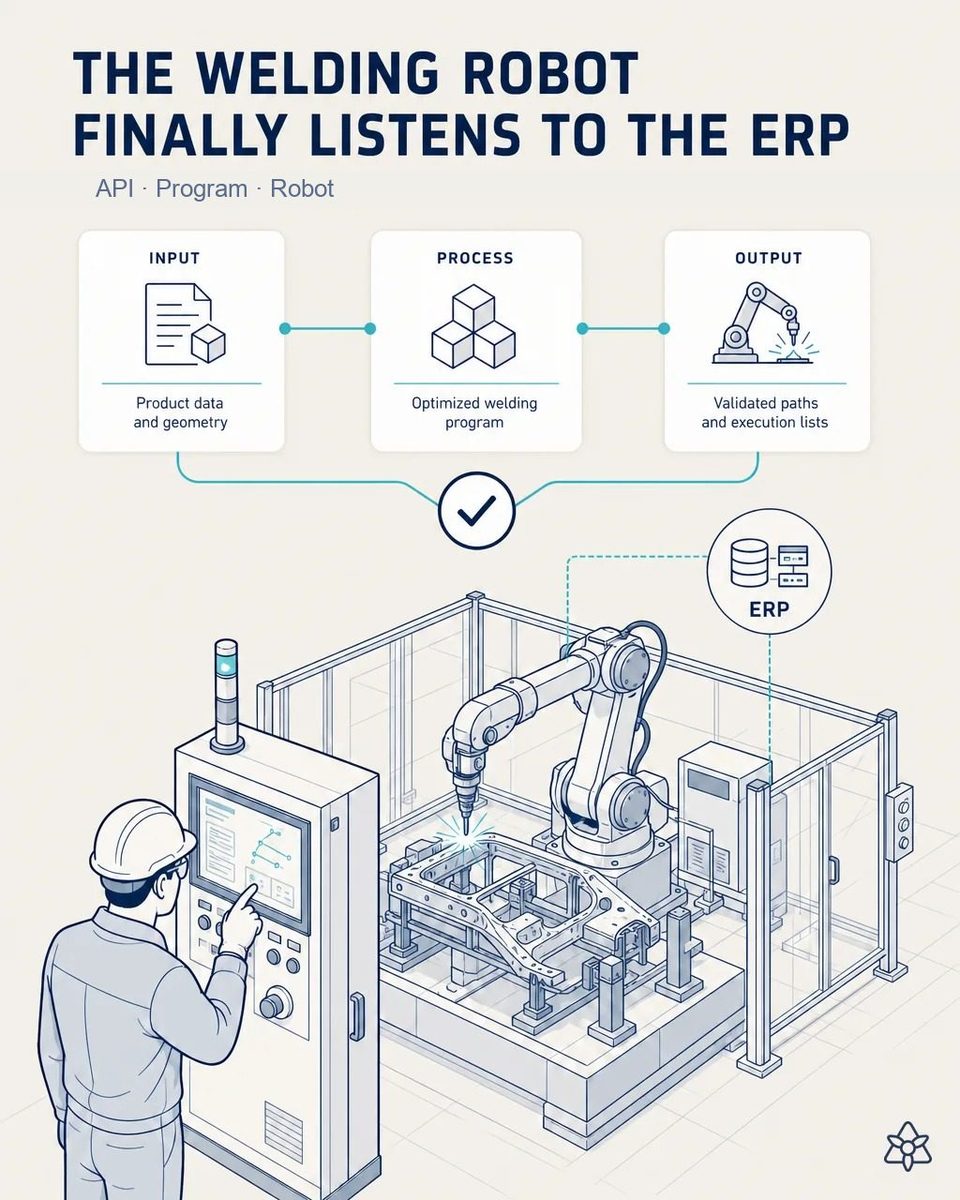
A modern cell, an open API, and a person typing anyway.
The welding cell is the last physical step before final inspection. A wrong program selected by hand can mean hundreds of out-of-spec parts.
- The robotic welding cell is the last physical step before final inspection: after it, the structural assembly is welded and whatever went wrong is already inside the part.
- It has a documented interface and it is perfectly capable of receiving its program from outside. It lives isolated from the MES all the same, because the integration project never reached the top of the list.
- So on every part-number change somebody selects the program by hand on the panel, with data that already exists in the ERP.
- One wrong selection means hundreds of structural parts welded to the wrong program: scrap, or sorting piece by piece, and a nonconformity handed to the customer if the pallet already shipped. And the exposure repeats on every changeover, several times a day, with the same person under the same pressure to get the line running again.
Connect stitches the two systems through APIs, replacing neither.
Connect stitches two modern systems via API: when the ERP marks a work order as started, it automatically publishes the welding program and target parameters to the robotic cell.
What was actually executed comes back confirmed to the system: not the program that was requested, but the one the cell reports having run, with the parameters it ran it at. That distinction is what turns welding into evidence instead of an assumption, and evidence is what an OEM asks for when a structural assembly is questioned months later.
The isolated cell versus the stitched cell
| Aspect | Today | With iLEAN Connect |
|---|---|---|
| Selecting the welding program | By hand on the panel | Published from the active work order |
| The same data typed twice | Once in the ERP, once at the cell | Once, in the ERP |
| Wrong program on a batch | A monthly occurrence | Eliminated at the source |
| Welding parameters | Assumed to be the right ones | Targeted and returned confirmed |
| Changeover time at the cell | Minutes on the critical path | A work order status change |
| The robot and the ERP | — | Neither is replaced |
From monthly manual program-selection errors to zero human error at the source.
Impact estimate — to be validated with your numbers.
The block below is an estimate to be validated against your plant's actual data. We put it forward so the committee has an order of magnitude; we refine it during the assessment.
- Estimated payback 3-6 months, counting only the changeover time recovered at the cell.
- The real value is the error that disappears: a drastic reduction of structural nonconformity risk from a program selected by hand.
- From manual program-selection errors every month to zero human error at the source.
- And what was actually welded comes back confirmed from the cell, so it can be used as evidence in front of the customer instead of assumed from what the work order asked for.
Estimated payback 3-6 months; drastic reduction of structural-nonconformity risk. Estimate to validate.
And the fair question from the production manager
“Wouldn't a proper integration project be cleaner?” — it would, on the day it reaches the top of the list, and that is exactly the problem: this is the classic modern machine still isolated because there was never a window. The stitching replaces neither system, needs no shutdown and no reprogramming of the robot, so it does not compete in that queue. Matching the work order to its welding program is an anchored task, where the best models drop below 1.5% error [1], and the cell returns what it actually ran, so the match is verified rather than assumed.
[1] OpenAI paper "Why Language Models Hallucinate", 2025 — on the reliability of AI in anchored tasks.
What people ask about connecting the welding cell
Do we have to reprogram the robot?
No. The programs are the ones you already validated and homologated with the customer. What changes is who selects them: the active work order instead of a person reading a number off a panel under time pressure.
What if the cell rejects the published program?
It is detected and raised immediately, because the exchange is two-way. Today a failed selection raises no signal at all: the system simply assumes that what was requested is what ran, and nobody finds out until the parts are measured.
Does it cover parameter changes, not just program numbers?
Yes: the target parameters travel with the program, and what the cell reports having executed comes back and is stored against the batch.
Is it compatible with our robot brand?
The case rests on the documented interface the cell already has. That is the requirement, and any cell with an open API meets it regardless of the brand.
Does the same pattern work for other cells on the line?
Yes. Any modern island fed by hand today fits the same way. You start with the welding cell because that is where the structure stops being correctable.
More cases from this series
- Zero nonconformity on structural partsFour coordinated rings — ERP, robot, Edge and evidence pack — stop the line before an out-of-spec part…
- Batch startup without paperPhotograph the work order and the dimension sheet at startup: the batch exists in the system at zero…
- The coil delivery note that enters itselfPhotograph the delivery note and the heat-number label: iLEAN extracts the data and pushes it to the ERP…
- The delay alert that arrives in timeiLEAN reads the coil supplier's email at zero latency and cross-checks active work orders before the…
- Hands-free voice on the lineWith a headset and Connect's voice mode, the line supervisor logs incidents while walking between…
- Two-tap human validationNothing iLEAN captures enters the MES without a human validating it first with two taps on an industrial…
Tell us how many part-number changes you run per day on the welding cell.
We work on your plant's real data, not ours. Assessment with no commitment.
Request estimated ROI within 48h ‹ See all cases of body structural assembly See automotive