Two-tap human validation
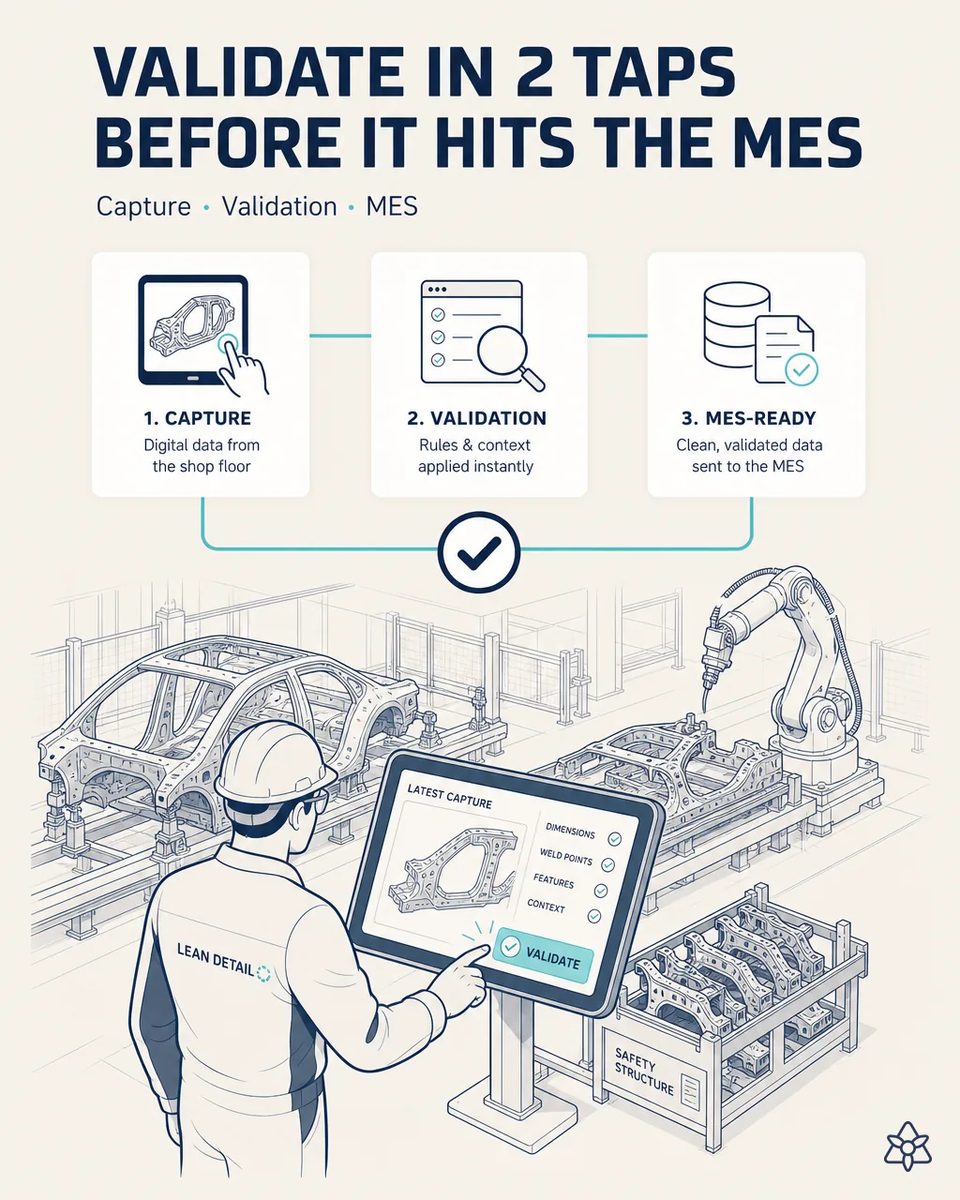
What sets iLEAN apart from an autonomous agent is that nothing enters the MES without a human seeing it first. On a tablet at the line, every capture shows up as a visual summary confirmed with two taps.
The cultural brake is not the technology, it is who writes to the master.
The fear that AI will enter data on its own and contaminate the master ERP is the main cultural brake on digitization, in an environment where any mis-crossed data can become a customer nonconformity.
- The fear that an AI will enter data on its own and contaminate the MES master is the main cultural brake on digitizing a structural line, and it is a reasonable fear.
- In this sub-sector a mis-crossed datum is not a typo: a dimension attached to the wrong batch, or a heat number tied to the wrong part number, becomes a customer nonconformity months later.
- So the honest alternative today is to keep typing by hand, which is slow, late and also wrong — just wrong in a way people are used to.
- And when the OEM asks who validated a datum on a crash-relevant part, a system with no named human behind each record has no answer to give — which is a problem long before anybody starts talking about artificial intelligence.
Connect with early human verification — two taps at the line.
Connect early human verification mode: every capture, whether photo, voice or email, goes to the tablet with a visual summary before crossing into the master. UI designed for two-second validation.
This is the piece that guarantees the master is never contaminated and that every datum has a responsible person by name. Without it, the other eleven cases do not get approved: nobody in a plant audited under IATF 16949 signs off on AI writing unattended into the system quality depends on.
Unvalidated capture versus confirmed capture
| Aspect | Today | With iLEAN |
|---|---|---|
| Who writes to the MES master | A person, typing late | A person, confirming in seconds |
| Time it costs the operator | A walk to a terminal | Two taps on the line tablet |
| What the record proves | That somebody typed it | What summary they saw and confirmed |
| A mis-crossed datum | Surfaces as a customer claim | Caught on screen before it enters |
| Photo, voice and email captures | Each with its own route | One single validation gate |
| Corrections made by the operator | Lost | Stored, and they improve extraction |
From unvalidated data contaminating the ERP to validated data with seconds of latency, a clean master.
Impact estimate — to be validated with your numbers.
The block below is an estimate to be validated against your plant's actual data. We put it forward so the committee has an order of magnitude; we refine it during the assessment.
- No standalone payback: this is an enabling piece for the whole iLEAN matrix, with strategic value rather than a directly monetizable saving. That is the brief's own framing.
- What it buys is approval: it is the reason the other eleven cases become deployable in a plant under continuous audit.
- The master stays clean, and every record carries the name of whoever confirmed it.
- And unvalidated data stops reaching the MES with hours of latency, which is the state that produces untraceable nonconformities.
Enabling piece for the whole iLEAN matrix; strategic value, not directly monetizable.
And the fair question from the production manager
“If a person confirms in the end, what is the AI actually saving?” — the work is not in deciding, it is in assembling. Today somebody has to walk to a terminal, find the batch and type. Reading and pre-filling the summary is an anchored task, where the best models drop below 1.5% error [1]; the operator only confirms or corrects, and every correction is stored so extraction improves exactly where it failed.
[1] OpenAI paper "Why Language Models Hallucinate", 2025 — on the reliability of AI in anchored tasks.
What people ask about two-tap validation
How long does it take the operator?
Seconds. The summary arrives already assembled with dimensions, weld points and context, and it is resolved with two taps without leaving the station. The interface is designed for a two-second decision with gloves on, not for a data entry session.
Can iLEAN write to the MES on its own?
No, and it is not a configurable option that somebody could switch on later: it is the architecture. Captured data crosses into the master only after a human confirmation, and that is true of every one of the twelve cases.
What exactly gets recorded?
Which summary was shown, who confirmed it, when, and what they corrected if anything. That record is what answers the OEM when they ask who validated a datum on a crash-relevant part, and it is what an auditor looks for behind an automated process.
What if the operator disagrees with the capture?
They correct it on the tablet and the correction is stored with its author. It works both as an audit trail and as feedback that improves extraction at that specific point, so the same misreading does not keep reappearing shift after shift.
Does it have to be deployed before the other cases?
In practice yes. It is the piece that makes the rest approvable, because it is what guarantees no automated process writes into the master unattended. Deployed the other way round, the first capture case usually stalls in the quality review.
More cases from this series
- Zero nonconformity on structural partsFour coordinated rings — ERP, robot, Edge and evidence pack — stop the line before an out-of-spec part…
- Batch startup without paperPhotograph the work order and the dimension sheet at startup: the batch exists in the system at zero…
- The coil delivery note that enters itselfPhotograph the delivery note and the heat-number label: iLEAN extracts the data and pushes it to the ERP…
- The delay alert that arrives in timeiLEAN reads the coil supplier's email at zero latency and cross-checks active work orders before the…
- The connected welding robotConnect stitches the robotic welding cell to the ERP via API: the correct program travels automatically,…
- Hands-free voice on the lineWith a headset and Connect's voice mode, the line supervisor logs incidents while walking between…
Tell us what it would take for your quality team to approve AI on the line.
We work on your plant's real data, not ours. Assessment with no commitment.
Request estimated ROI within 48h ‹ See all cases of body structural assembly See automotive