Zero nonconformity on structural parts
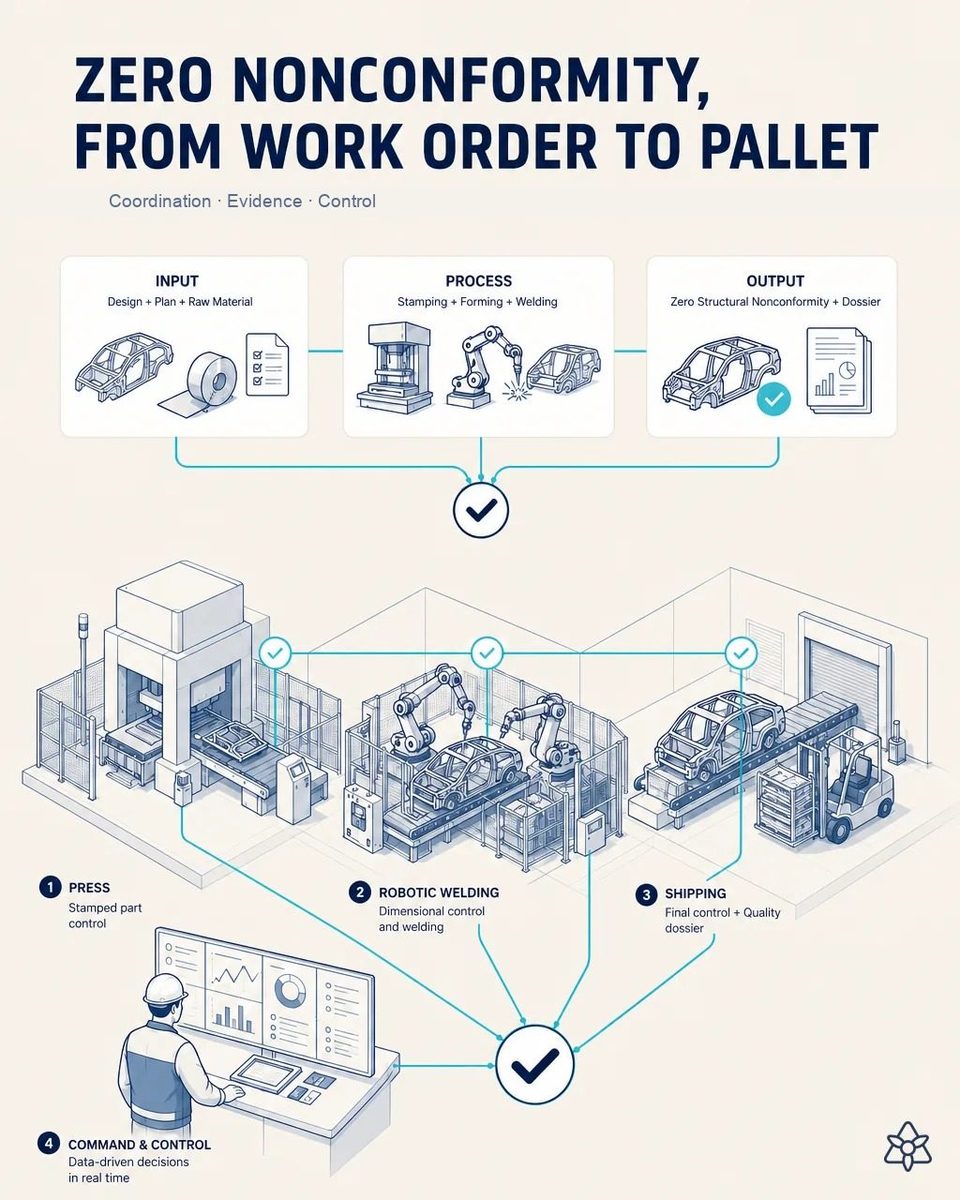
The capital pain of any Tier 1 structural-parts supplier is the same: zero nonconformity, and in the worst case zero recall. The iLEAN flagship system coordinates 4 cross-checking verification rings, from the work order to the pallet.
A structural recall is almost never caused by a single failure.
A nonconformity or recall on a safety-relevant structural part is the sub-sector's biggest reputational and financial risk, with costs from tens to hundreds of thousands of euros and the risk of losing OEM homologation.
- It is the concatenation: a coil at the edge of its certified properties, a die change signed off in a hurry, a welding program selected by hand and a first piece measured after the batch had already started.
- Each link on its own looks acceptable and passes its own control. Together they produce the part that fails in a crash test or, worse, in the field.
- That is why isolated controls are not enough: they have to cross-check each other, because what gives the concatenation away is independent sources ceasing to agree.
- And the consequence is the sub-sector's biggest risk, financial and reputational at once: costs from tens to hundreds of thousands of euros in sorting, freight, rework and penalties, plus the risk of losing OEM homologation and with it the programs already awarded for the coming years.
Agents — four coordinated rings, from the work order to the pallet.
4 coordinated rings: the ERP defines the part, the welding robot executes without typing, Edge cross-checks what actually ran in real time, and the evidence pack documents it all. SMED AI speeds up die changes without weakening verification.
No single ring solves it: each one already exists today in some form and the part still escapes. The strength is in the cross-check, because four independent sources that stop agreeing is a signal no individual control can produce. And SMED AI is what lets die changes stay fast without the verification getting thinner to make room for them.
The four rings, and what each one closes
| Ring | Which cases it draws on | What it closes |
|---|---|---|
| 1 · Definition | Batch startup (1) + coil receiving (7) | Which steel and which work order make up the batch |
| 2 · Execution | Welding cell (8) + press panel (2) | The program and the process actually run |
| 3 · Line | Weld vision (9) + die change (10) | The defect that passes every control separately |
| 4 · Evidence | Metrology (6) + evidence pack (11) | Dimensions and an auditable dossier per pallet |
| Cross-check | Two-tap validation (5) | Every datum confirmed by a named person |
| Changeover speed | SMED AI | Faster die changes, the same verification |
From undetected nonconformity risk on the floor to discrepancies caught on the line, not at the customer.
Impact estimate — to be validated with your numbers.
The block below is an estimate to be validated against your plant's actual data. We put it forward so the committee has an order of magnitude; we refine it during the assessment.
- Estimated payback 6-12 months against the first structural nonconformity avoided.
- Protection against a recall above EUR100K, and against the loss of a multi-year OEM relationship, which is the figure that actually decides the project.
- Discrepancies caught on the line rather than at the customer's incoming inspection.
- And root cause after a claim: from rebuilt over weeks across paper, spreadsheets and memory, to queryable in minutes from the batch number the customer gives you.
Estimated payback 6-12 months against the first structural nonconformity avoided; protects against recall (>EUR100K) and the multi-year OEM relationship. Estimate to validate.
And the fair question from the production manager
“Do we have to deploy all twelve cases to get this?” — no, and framing it that way would be the way never to start. The rings are built in layers and each case pays on its own from the first month. With batch startup and coil receiving you already have ring 1, which is where most of the missing structural traceability sits, and the model uncertainty question stays bounded: stops happen on a verifiable discrepancy between sources, not on a model's doubt below the 1.5% error of an anchored task [1].
[1] OpenAI paper "Why Language Models Hallucinate", 2025 — on the reliability of AI in anchored tasks.
What people ask about the complete system
Where do you start?
With the case that has the fewest dependencies and the shortest deployment, which in this matrix is batch startup. What matters is that each layer pays for itself on its own, so the program never depends on a single large approval.
What does the cross-check give that each control does not?
Exactly what escapes today: the concatenation. A coil at the edge of its certified properties passes its control, a hurried die change passes its own, and the part that accumulates both fails the test no individual control was looking for.
What if a ring raises a false discrepancy?
JIDOKA AI stops on a verifiable disagreement between sources, not on model uncertainty. When the doubt belongs to the model, the case is escalated to a person to decide.
Does it replace the MES or the ERP we already have?
No. Ring 1 rests precisely on the work order being the truth. iLEAN cross-checks the systems against each other and against what actually happened on the line.
Can the return be estimated before committing?
Yes. With your claim history, the cost of the last sorting campaign and the number of die changes per month, the return per layer is estimated before deciding the order of deployment.
More cases from this series
- Batch startup without paperPhotograph the work order and the dimension sheet at startup: the batch exists in the system at zero…
- The coil delivery note that enters itselfPhotograph the delivery note and the heat-number label: iLEAN extracts the data and pushes it to the ERP…
- The delay alert that arrives in timeiLEAN reads the coil supplier's email at zero latency and cross-checks active work orders before the…
- The connected welding robotConnect stitches the robotic welding cell to the ERP via API: the correct program travels automatically,…
- Hands-free voice on the lineWith a headset and Connect's voice mode, the line supervisor logs incidents while walking between…
- Two-tap human validationNothing iLEAN captures enters the MES without a human validating it first with two taps on an industrial…
Tell us what your last structural sorting campaign cost you.
We work on your plant's real data, not ours. Assessment with no commitment.
Request estimated ROI within 48h ‹ See all cases of body structural assembly See automotive