The coil delivery note that enters itself
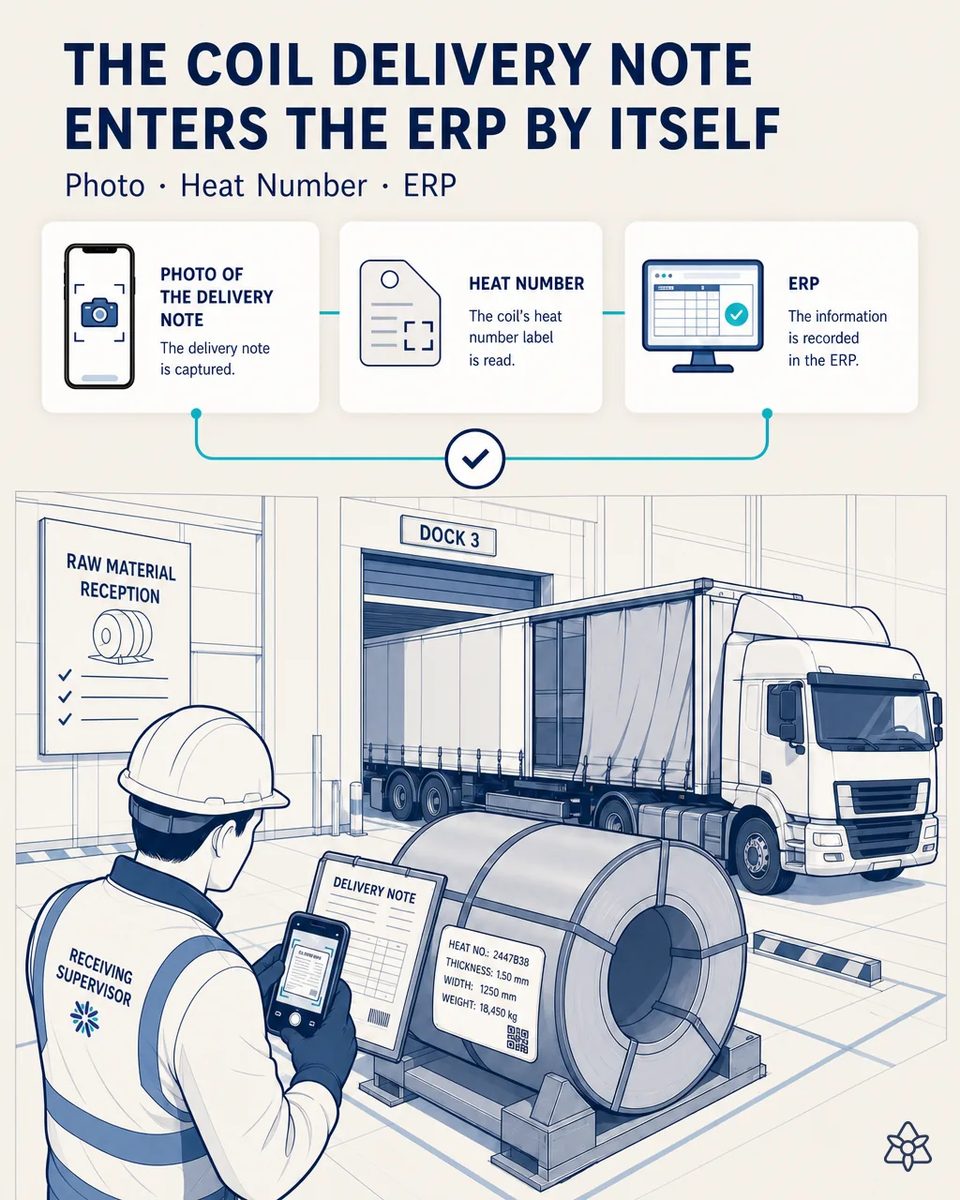
The steel coil truck waits while the receiving supervisor types line by line into the ERP. With iLEAN Connect, one photo of the delivery note and the heat-number label is enough for everything to enter the ERP after a one-tap validation.
The foundation of all structural traceability depends on typing under pressure.
The truck waits racking up demurrage while the receiving supervisor types. If they rush, wrong heat numbers get entered that surface weeks later as an untraceable nonconformity.
- The truck arrives with high-strength steel coils: a delivery note with several lines, a mill certificate per heat and a label on each coil with heat number, grade, thickness, width and weight.
- Both ways out are bad. Either the truck waits forty-five minutes racking up demurrage, or the receiving supervisor types in a hurry.
- A heat number typed wrong does not fail today. It fails weeks later, when a claim arrives and the heat the failed structural part came from cannot be proved.
- And the mill certificate ends up filed loose in a cabinet, when it is precisely the document that closes the genealogy an OEM asks for on a crash-relevant part. Nobody links it to anything at the dock, because linking it by hand would mean keeping the truck standing there even longer.
Connect in photo-to-analog mode — delivery note, certificate and label, with no supplier changes.
Connect photo-to-analog mode: AI vision recognizes the supplier's delivery-note format and the heat-number labels (GS1-128, QR, barcode or OCR), with one-tap tablet validation.
The mill certificate stops being a filed sheet of paper and becomes linked to the coil from minute one, and from there to every structural part blanked out of it. That is what turns the heat-to-part genealogy into a query instead of a reconstruction with the clock running, which is the only version of that exercise the customer ever accepts.
Today's receiving versus captured receiving
| Aspect | Today | With iLEAN Connect |
|---|---|---|
| Truck at the dock | 45 minutes | Minutes |
| Heat number in the ERP | Typed under pressure | Read from the label and confirmed |
| Mill certificate | Loose in a cabinet | Linked to the coil from minute one |
| Heat to structural part genealogy | Rebuilt during the claim | Complete and queryable |
| Carrier demurrage | Recurring | Eliminated |
| Receiving module licenses | Two or three | One, the supervisor who validates |
From a 45-minute truck wait to minutes. From hidden heat-number errors to complete photo-based traceability.
Impact estimate — to be validated with your numbers.
The block below is an estimate to be validated against your plant's actual data. We put it forward so the committee has an order of magnitude; we refine it during the assessment.
- 💰 CFO angle: the receiving module typically needs two or three active licenses; with Connect only the supervisor validates: a typical 50-70% reduction, recurring.
- Estimated payback 3-8 months.
- From a 45-minute truck wait down to minutes, truck after truck, with the carrier demurrage that goes with it eliminated and the dock freed for the next delivery.
- And complete photo-based traceability, with the note and the label stored as they were, instead of hidden heat-number errors that surface weeks later as an untraceable nonconformity nobody can close.
CFO angle: typical 50-70% reduction in receiving-module ERP licenses. Estimated payback 3-8 months. Estimate to validate.
And the fair question from the production manager
“Does it recognize every steel supplier's delivery note?” — yes, and without asking any of them to change theirs: the model extracts the table structure with no per-supplier template. Labels are read by their symbology where there is one — GS1-128, QR or barcode — and by optical recognition where there is not. It is an anchored task, where the best models drop below 1.5% error [1], and the supervisor confirms before anything enters.
[1] OpenAI paper "Why Language Models Hallucinate", 2025 — on the reliability of AI in anchored tasks.
What people ask about digitizing coil receiving
Is the mill certificate read too?
Yes, and it is the part that adds most: grade, thickness and mechanical properties end up linked to the heat, so proving which steel a structural part came from stops being a cabinet search and becomes a query with the certificate attached.
What if the delivery note and the coil label disagree?
The discrepancy is highlighted in the summary before the supervisor validates, with both readings side by side. Today nobody performs that cross-check with a truck waiting at the dock, which is precisely why it gets missed.
Do we need barcode scanners?
Not necessarily. A photo from a phone or an industrial tablet is enough, and labels are read by their symbology when there is one. If the plant already has scanners that work well, they integrate just the same and nothing is thrown away.
Does it work for a partial delivery or a rejected coil?
Yes. The quantity actually received is what gets confirmed on the tablet, and a coil held back for a certificate deviation is recorded as such against its heat, so it cannot be consumed by mistake later in the week.
Can we start with receiving alone?
Yes, and it is a good starting point: the result is visible from the first truck, it does not depend on any other case being deployed, and it builds the first link of the genealogy everything else hangs from.
More cases from this series
- Zero nonconformity on structural partsFour coordinated rings — ERP, robot, Edge and evidence pack — stop the line before an out-of-spec part…
- Batch startup without paperPhotograph the work order and the dimension sheet at startup: the batch exists in the system at zero…
- The delay alert that arrives in timeiLEAN reads the coil supplier's email at zero latency and cross-checks active work orders before the…
- The connected welding robotConnect stitches the robotic welding cell to the ERP via API: the correct program travels automatically,…
- Hands-free voice on the lineWith a headset and Connect's voice mode, the line supervisor logs incidents while walking between…
- Two-tap human validationNothing iLEAN captures enters the MES without a human validating it first with two taps on an industrial…
Tell us how long a coil truck stands at your dock today.
We work on your plant's real data, not ours. Assessment with no commitment.
Request estimated ROI within 48h ‹ See all cases of body structural assembly See automotive