The delay alert that arrives in time
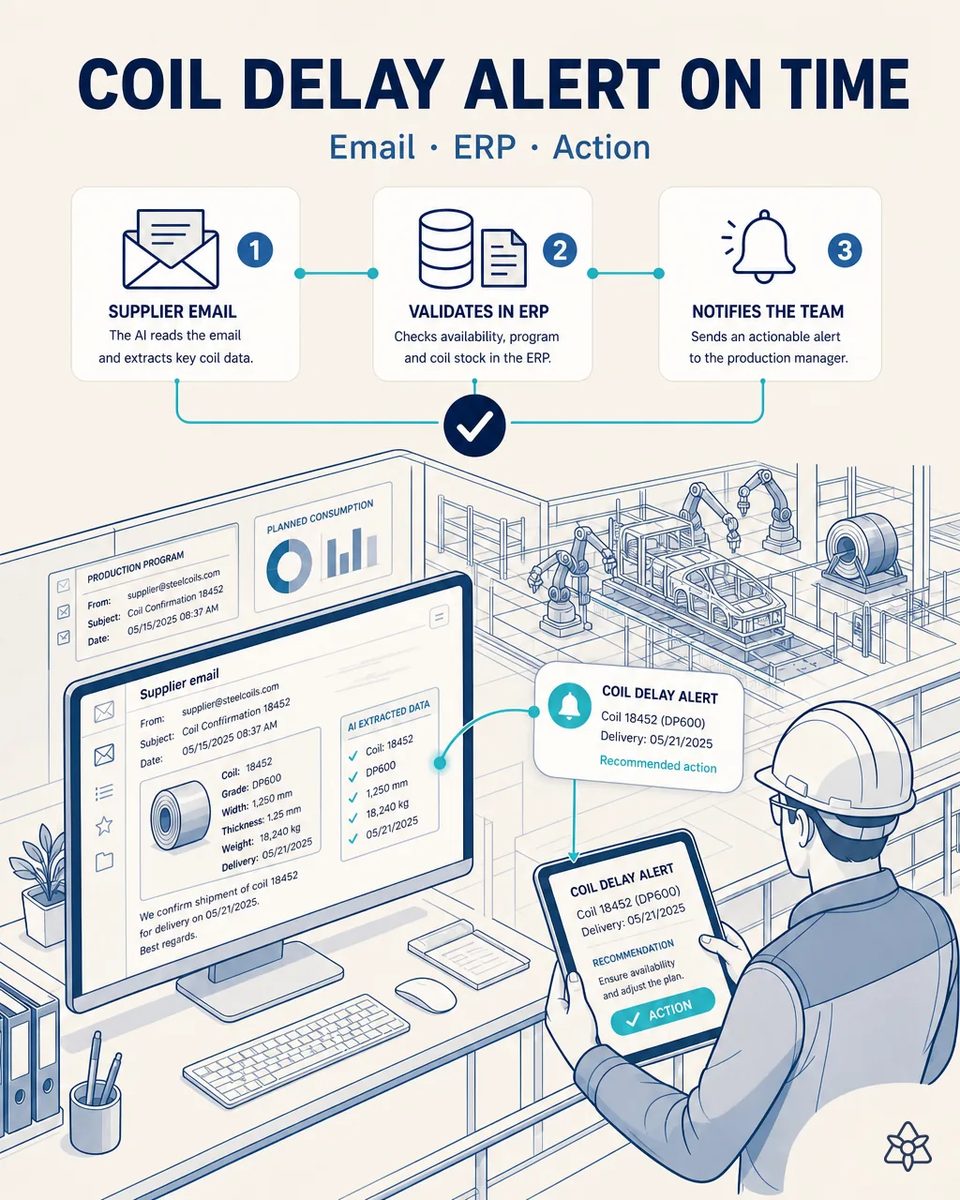
A steel coil supplier's email warns of a delay or a quality deviation, but it's read too late. With iLEAN Connect, the system reads it at zero latency, cross-checks active work orders, and alerts with a concrete action before the line stops.
Nobody designed the channel the bad news travels through.
Critical supplier alerts arrive by email to people who can't watch the inbox in real time. By the time they're read, planning decisions have already been made that now break.
- The formal schedule arrives by electronic data interchange, but what actually changes the week arrives by email: a high-strength coil slipping two days, a mill certificate with a deviation in thickness or mechanical properties, a partial shipment.
- It lands in natural language, unformatted, at one buyer's personal address, competing with a hundred other messages.
- A coil that slips two days and is read the same morning is a stopped press; read the day before, it is a sequence change.
- And a mechanical property deviation read late is worse: parts already formed from a coil that should have been quarantined before it entered the blanking line, with every downstream welding operation already performed on them. At that point the decision is no longer about planning, it is about how much of the week's output has to be held and sorted.
Connect in chaotic-sources mode — a mailbox in copy, twenty-four seven.
Connect chaotic-sources mode: a mailbox in copy 24/7. An LLM extracts intent, entities (supplier, coil, dates) and cross-references the ERP, returning a concrete action to the right role.
The difference between reading the alert and acting on it is the cross-check: it is not enough to find out sooner, you have to know which work orders and which structural part numbers depend on that coil, and how many days of cover you actually have. That is what comes back, already resolved, and it goes to the role that has to move rather than to the address the mill happened to write to.
Today's alert versus the cross-checked alert
| Aspect | Today, in the inbox | With iLEAN Connect |
|---|---|---|
| When it is read | 2-3 hours of human latency | Seconds |
| A coil slipping two days | A stopped press | A sequence change in time |
| Mill certificate deviation | Found after forming | Quarantined before blanking |
| Which work orders are affected | Worked out by hand | Crossed against the live ERP |
| Who it reaches | Whoever it was addressed to | The role that must act |
| What you receive | One more email | A concrete action with its scope |
From 2-3 hours of human latency to seconds. Replanning decisions based on the line's real state.
Impact estimate — to be validated with your numbers.
The block below is an estimate to be validated against your plant's actual data. We put it forward so the committee has an order of magnitude; we refine it during the assessment.
- Estimated payback 3-7 months, depending on how often critical alerts reach you.
- Press stoppages that become a replanned sequence instead of an idle line and reactive overtime.
- Steel with a certified deviation quarantined before it is formed, not after.
- And replanning decided on the line's real state — which work orders are open, which coils are in stock and which are committed — not on what somebody remembers from an email thread.
Estimated payback 3-7 months depending on critical-alert frequency. Estimate to validate.
And the fair question from the production manager
“Are you going to read my purchasing team's email?” — no. iLEAN sits in copy on a dedicated operational mailbox: it only sees what is sent to that channel with mills and carriers. On extraction, classifying the intent of a supplier notice is an anchored task, where the best models drop below 1.5% error [1] — and the replanning is decided by a person.
[1] OpenAI paper "Why Language Models Hallucinate", 2025 — on the reliability of AI in anchored tasks.
What people ask about reading coil supplier alerts
Does it tell a real deviation from a routine confirmation?
Yes, and that is what matters most. A mechanical property deviation on a structural grade is flagged top priority because its cost grows by the hour, while a shipment confirmation that changes nothing interrupts nobody and never reaches the line.
Does it know which parts depend on the delayed coil?
When it is crossed with the ERP, yes: grade, width and thickness point to the work orders that consume that coil, and that is the difference between replanning one line with precision and replanning blind across the whole week.
Does it replace electronic data interchange with the mill?
No. EDI carries the formal order, which is its job and it does it well. This case covers what gets communicated by hand in free text, which is what actually breaks the week and what no system reads today.
Does it work with alerts written in another language?
That is normal with an international steel supplier and it is designed for. Intent and entity extraction do not depend on the language of the message, and the action comes back in the language your team works in.
Can it act on its own to reschedule?
No. It proposes a concrete action to the role that must act — planning, purchasing or quality — and the decision stays with a person. What changes is that the person decides with hours to spare instead of with the press already stopped.
More cases from this series
- Zero nonconformity on structural partsFour coordinated rings — ERP, robot, Edge and evidence pack — stop the line before an out-of-spec part…
- Batch startup without paperPhotograph the work order and the dimension sheet at startup: the batch exists in the system at zero…
- The coil delivery note that enters itselfPhotograph the delivery note and the heat-number label: iLEAN extracts the data and pushes it to the ERP…
- The connected welding robotConnect stitches the robotic welding cell to the ERP via API: the correct program travels automatically,…
- Hands-free voice on the lineWith a headset and Connect's voice mode, the line supervisor logs incidents while walking between…
- Two-tap human validationNothing iLEAN captures enters the MES without a human validating it first with two taps on an industrial…
Tell us what the last unannounced coil delay cost you in stopped press time.
We work on your plant's real data, not ours. Assessment with no commitment.
Request estimated ROI within 48h ‹ See all cases of body structural assembly See automotive