Hands-free voice on the line
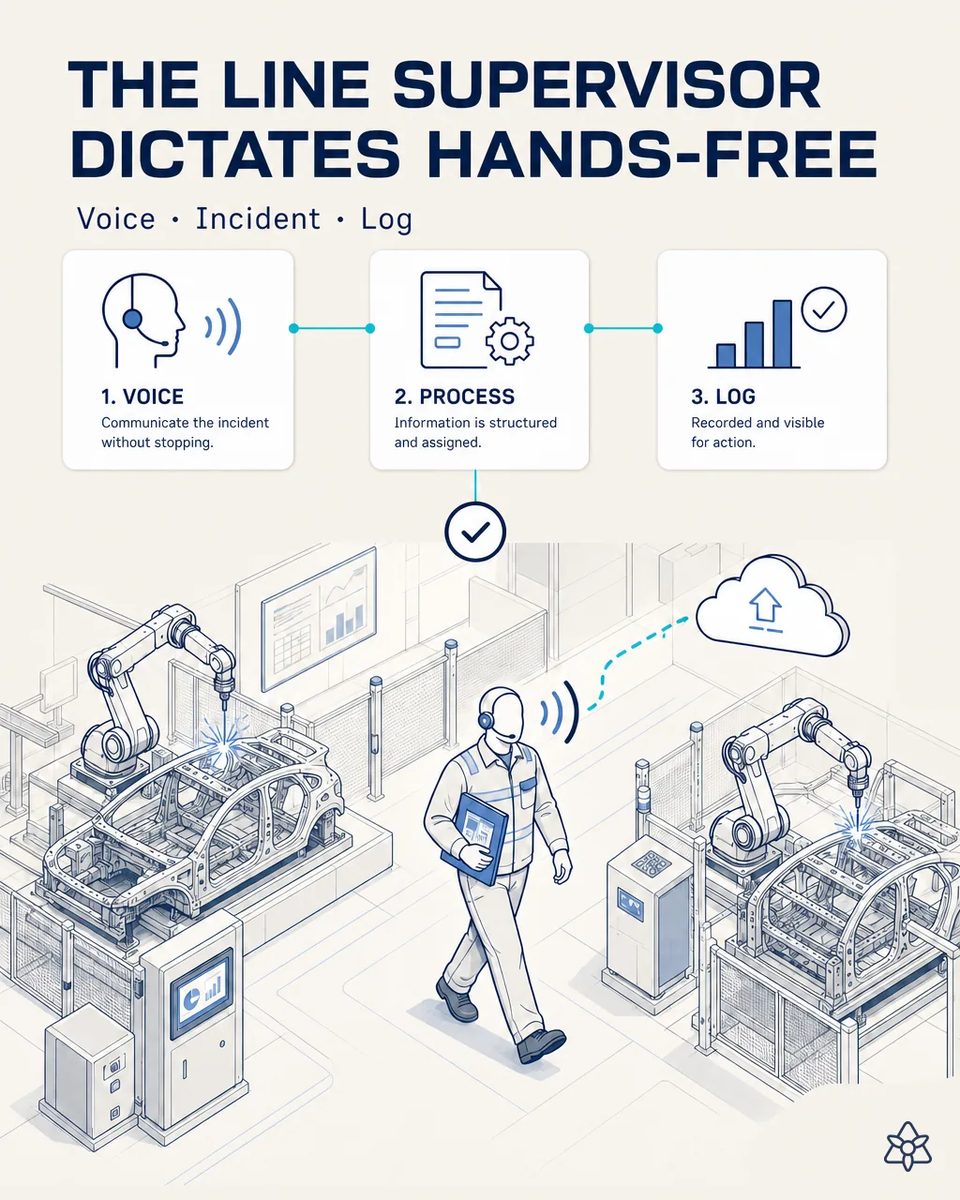
The line supervisor spends most of the shift walking between robotic cells with their hands full. All that knowledge dies at the end of the shift. With iLEAN Connect's headset mode, they dictate it while walking and the system structures it in seconds.
The recurring problem is never recognized as recurring.
Critical operational knowledge lives in the line supervisor's head and never enters the system, in an environment where every robotic cell generates dozens of micro-events per shift.
- The line supervisor knows more about the line than any system: which cell has been drifting on one weld point since the last electrode dressing, which fixture clamp needs retouching every two hours, which gun has been tripping its sequence since the last die change upstream.
- Every robotic cell generates dozens of micro-events per shift, and none of them is big enough to open a ticket — which is precisely why they never enter the system.
- Nobody asks the supervisor anything, because they cannot type with a headset and gloves on, and they record nothing, because recording means walking back to the office and opening a screen.
- What survives is a five-minute verbal handover and, at best, a page in a notebook that nobody else reads. The cumulative effect is worse than it looks: the same problem gets solved again every time, by a different person, on a different shift, with no memory of the three previous attempts or of what was already ruled out.
Connect in voice mode — iLEAN listens to the supervisor, not to the operators.
Connect voice mode with a custom wake-word. An LLM structures the dictation as an incident linked to the active cell/line/shift, with a voice or push response.
Humans in command, taken literally: it records what the supervisor chooses to dictate, when they choose to. That distinction is not cosmetic — it is what keeps the case alive in month six instead of being read on the floor as a way of tracking people.
Today's shift versus the captured shift
| Aspect | Today | With iLEAN Connect |
|---|---|---|
| Knowledge of the shift | Dies at the end of it | Accumulated, queryable memory |
| Cell micro-events | Too small to be written down | Recorded in seconds, by voice |
| Shift handover | Five verbal minutes | An automatic written summary |
| A recurring cell fault | Invisible: solved again each time | Detected as a pattern with dates |
| Supervisor's effort | Walk back to the office | Speak while walking the line |
| Ordinary floor conversation | — | Not recorded |
From knowledge that dies at shift end to real-time information cross-referenced with live cell data.
Impact estimate — to be validated with your numbers.
The block below is an estimate to be validated against your plant's actual data. We put it forward so the committee has an order of magnitude; we refine it during the assessment.
- No standalone payback: this is an enabling piece. The brief frames it as strategic value for continuous improvement, hard to monetize upfront, and that is how it is presented.
- What it does deliver is the raw material of continuous improvement: the cell history that today only exists in one person's head.
- Estimate it with Process Engineering, against how many times this year the same cell fault was diagnosed from scratch.
- And the shift handover goes from five verbal minutes to a written summary that already exists when the next shift walks in.
Strategic value for continuous improvement; hard to monetize upfront. Estimate to validate with Process Engineering.
And the fair question from the production manager
“Is this a way of keeping track of my team?” — no: iLEAN listens to the line supervisor, not to the operators, and only to what they choose to dictate. There is no continuous listening and no location tracking. Structuring a dictation into cell, shift, part number and symptom is an anchored task, where the best models drop below 1.5% error [1], and the supervisor sees the structured record and corrects it if it got something wrong. What they gain is not having to remember, at the end of the shift, what they saw in cell four eight hours earlier.
[1] OpenAI paper "Why Language Models Hallucinate", 2025 — on the reliability of AI in anchored tasks.
What people ask about capturing the shift by voice
Does it work with the noise of a robotic welding bay?
That is the design condition. The headset is compatible with hearing protection and recognition is prepared for industrial noise and for the vocabulary of the trade: weld point, gun, dresser, fixture, clamp.
Does the supervisor have to speak in a particular way?
No. They speak the way they would tell a colleague. iLEAN structures it afterwards as an incident tied to cell, line, shift and part number.
How does it decide that a fault is recurring?
Because every record is tied to the cell and the asset. When the same symptom appears for the third time in the same place, it stops being a shift anecdote and becomes a pattern with dates.
Does it generate the shift handover on its own?
Yes, from what was dictated during the shift, already structured. It is usually the first thing the team notices, because today that handover depends entirely on the memory of whoever is leaving.
If it has no payback of its own, why deploy it?
Because it feeds everything else. Without the supervisor's account, the process data from the press and the cells has no context, and the root cause of a structural defect is half a story.
More cases from this series
- Zero nonconformity on structural partsFour coordinated rings — ERP, robot, Edge and evidence pack — stop the line before an out-of-spec part…
- Batch startup without paperPhotograph the work order and the dimension sheet at startup: the batch exists in the system at zero…
- The coil delivery note that enters itselfPhotograph the delivery note and the heat-number label: iLEAN extracts the data and pushes it to the ERP…
- The delay alert that arrives in timeiLEAN reads the coil supplier's email at zero latency and cross-checks active work orders before the…
- The connected welding robotConnect stitches the robotic welding cell to the ERP via API: the correct program travels automatically,…
- Two-tap human validationNothing iLEAN captures enters the MES without a human validating it first with two taps on an industrial…
Tell us how many times this year you diagnosed the same cell fault from scratch.
We work on your plant's real data, not ours. Assessment with no commitment.
Request estimated ROI within 48h ‹ See all cases of body structural assembly See automotive