Batch startup without paper
In an automotive body structural parts factory, the operator starts every batch with a paper work order and the first-piece dimensional check sheet. Today those documents disappear for hours in a folder. With iLEAN Connect, two phone photos are enough for the batch to exist in the central system at zero latency.
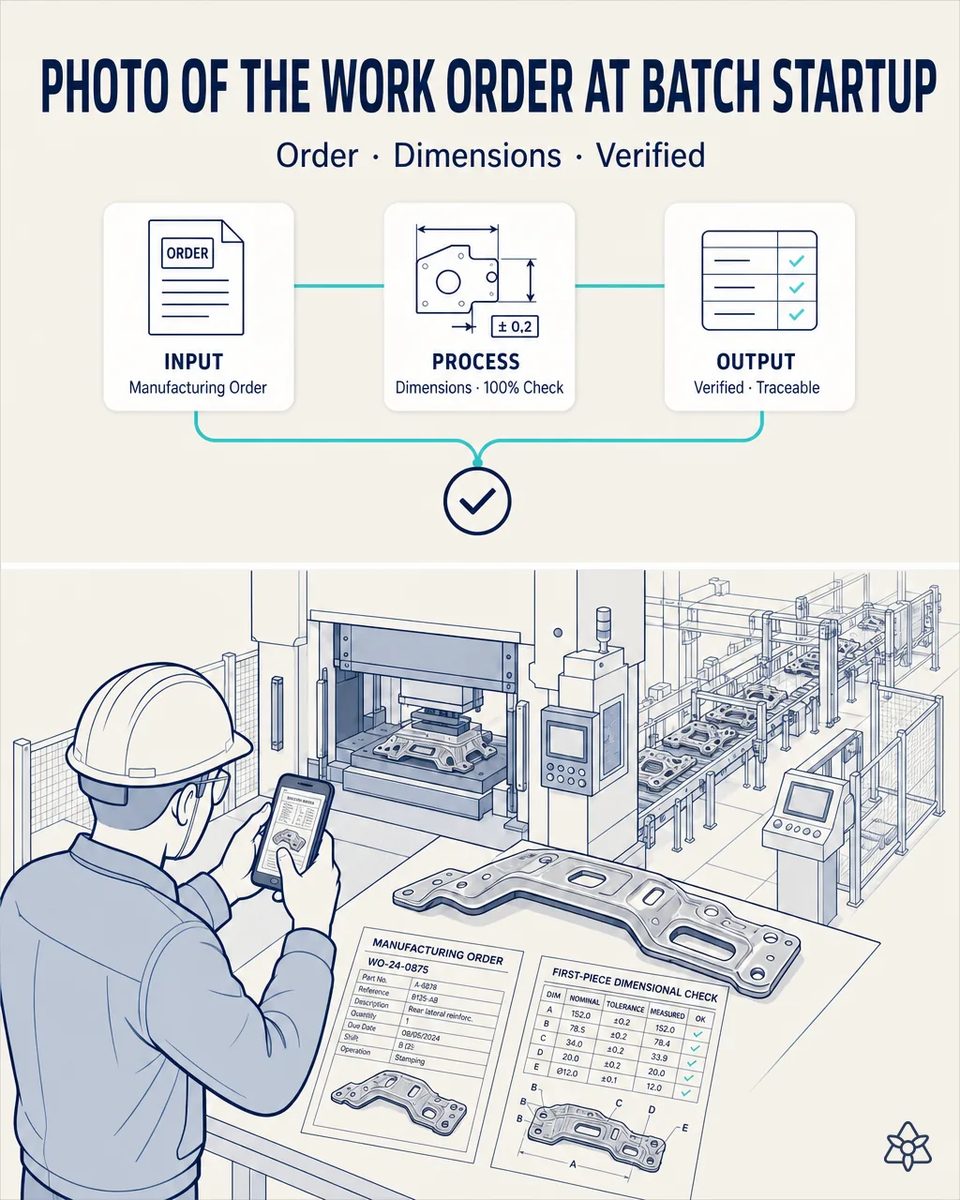
The two documents that define a structural batch live in a folder.
The work order is printed from ERP data and any tooling adjustment is noted by hand. The first-piece dimensional check sheet is handwritten per quality procedure. Both can sit undigitized for 4-8 hours, and when an IATF 16949 auditor asks to reconstruct a batch, it's sheet by sheet.
- The work order prints from the ERP with part number, quantity, operation and die, and then it gets annotated by hand: a tooling shim, a blank holder adjustment, a coil change mid-batch.
- The first-piece dimensional check is handwritten because the control plan says so, with nominal, tolerance, measured value and the inspector's pass or fail.
- Between the signature and digitization, four to eight hours pass — and considerably more across a weekend shift.
- During that gap the batch physically exists and is being welded downstream, but exists in no queryable system, which is exactly the state you do not want when an IATF 16949 auditor picks a batch at random and asks you to walk them through it. Reconstructing it means going to the folder, finding the right sheet and hoping the annotations are legible.
Connect in photo mode — the operator keeps filling in their paperwork.
Connect photo mode: the operator photographs the work order and the dimension sheet with their phone or industrial tablet. A grounded LLM extracts part number, batch, measured dimensions and pass/fail result, saving it to central memory with no change of habit.
It is the lowest-friction case of the twelve, because it asks the line for nothing new: the operator adds a photo to what they already did with pen and paper. No screen to learn, no field to fill in, no step added to a startup that already sits on the shift's critical path. That is usually why it is the first one approved by a plant that has never deployed AI on the floor.
Startup on paper versus startup captured
| Aspect | Today, on paper | With iLEAN Connect |
|---|---|---|
| Capture latency | 4-8 h, more across a weekend | Second zero |
| Reconstructing a batch for the auditor | Sheet by sheet in a folder | One query by work order number |
| First-piece dimensions | Handwritten, unqueryable | History by part number and die |
| Tooling adjustment noted by hand | Lost unless somebody types it | Extracted and tied to the batch |
| Coil change mid-batch | A note in the margin | A recorded event on the batch |
| Operator's habit | — | Unchanged: two photos |
From 4-8 hours of latency to zero. From manual batch reconstruction for audits to instant web lookup by work order number.
Impact estimate — to be validated with your numbers.
The block below is an estimate to be validated against your plant's actual data. We put it forward so the committee has an order of magnitude; we refine it during the assessment.
- Estimated payback 4-9 months, depending on how many batch startups you run per day.
- Transcription time recovered by production and by quality.
- From 4-8 hours of latency — more across a weekend — down to second zero.
- And reconstructing a batch for an audit stops being a folder search and becomes a lookup by work order number.
Estimated payback 4-9 months depending on daily startup volume. Estimate to validate.
And the fair question from the production manager
“What if it misreads a measured dimension on the first-piece check?” — reading fields from a document with a known structure is an anchored task, where the best models drop below 1.5% error [1]. And there is a second net: the summary goes to the line tablet and the inspector confirms or corrects it before anything crosses into the system.
[1] OpenAI paper "Why Language Models Hallucinate", 2025 — on the reliability of AI in anchored tasks.
What people ask about digitizing batch startup
Do we have to change the first-piece check sheet?
No, and it could not be done: its fields come from that part number's control plan and it is handwritten by procedure. Vision reads the sheet exactly as it exists today.
Does it read the handwritten notes on the printed work order?
Those are the part with the most value, because that is where the real tooling adjustment is written. They are extracted like any other field, and a low-confidence value is flagged for a person to confirm.
What happens with startups on the night shift?
That is where the gap is widest today, because nobody transcribes anything until the morning shift arrives and finds the folder. With capture, a batch launched at three in the morning exists in the system from the first minute, exactly like one launched mid-morning.
Do we need to integrate with the MES from day one?
No. The case works from the first startup against iLEAN's central memory, and the push to the MES or ERP is connected afterwards, once the value is demonstrated. That order matters, because it removes the integration project from the critical path of the decision.
Does it help with PPAP documentation?
Yes, indirectly and considerably: the first-piece history by part number and die is exactly what gets rebuilt by hand when a part approval package has to be assembled against the clock. Having it already structured turns days of assembly into a filtered query, and a blurred or half-cut photo is rejected on the spot so no batch is ever stored with half its startup data.
More cases from this series
- Zero nonconformity on structural partsFour coordinated rings — ERP, robot, Edge and evidence pack — stop the line before an out-of-spec part…
- The coil delivery note that enters itselfPhotograph the delivery note and the heat-number label: iLEAN extracts the data and pushes it to the ERP…
- The delay alert that arrives in timeiLEAN reads the coil supplier's email at zero latency and cross-checks active work orders before the…
- The connected welding robotConnect stitches the robotic welding cell to the ERP via API: the correct program travels automatically,…
- Hands-free voice on the lineWith a headset and Connect's voice mode, the line supervisor logs incidents while walking between…
- Two-tap human validationNothing iLEAN captures enters the MES without a human validating it first with two taps on an industrial…
Tell us how long a batch startup takes to exist in your system today.
We work on your plant's real data, not ours. Assessment with no commitment.
Request estimated ROI within 48h ‹ See all cases of body structural assembly See automotive