ISO 45001 with AI — from the office spreadsheet to a living management system.
ISO 45001 is a continuous-improvement system for occupational health and safety (OHS). iLEAN Connect feeds it in real time with incidents seen on the line, training signed by voice and PPE issuance with photo; the agent keeps the file alive and prepares the audit dossier. The person signs — the system requires it where it matters, thanks to the three rings.
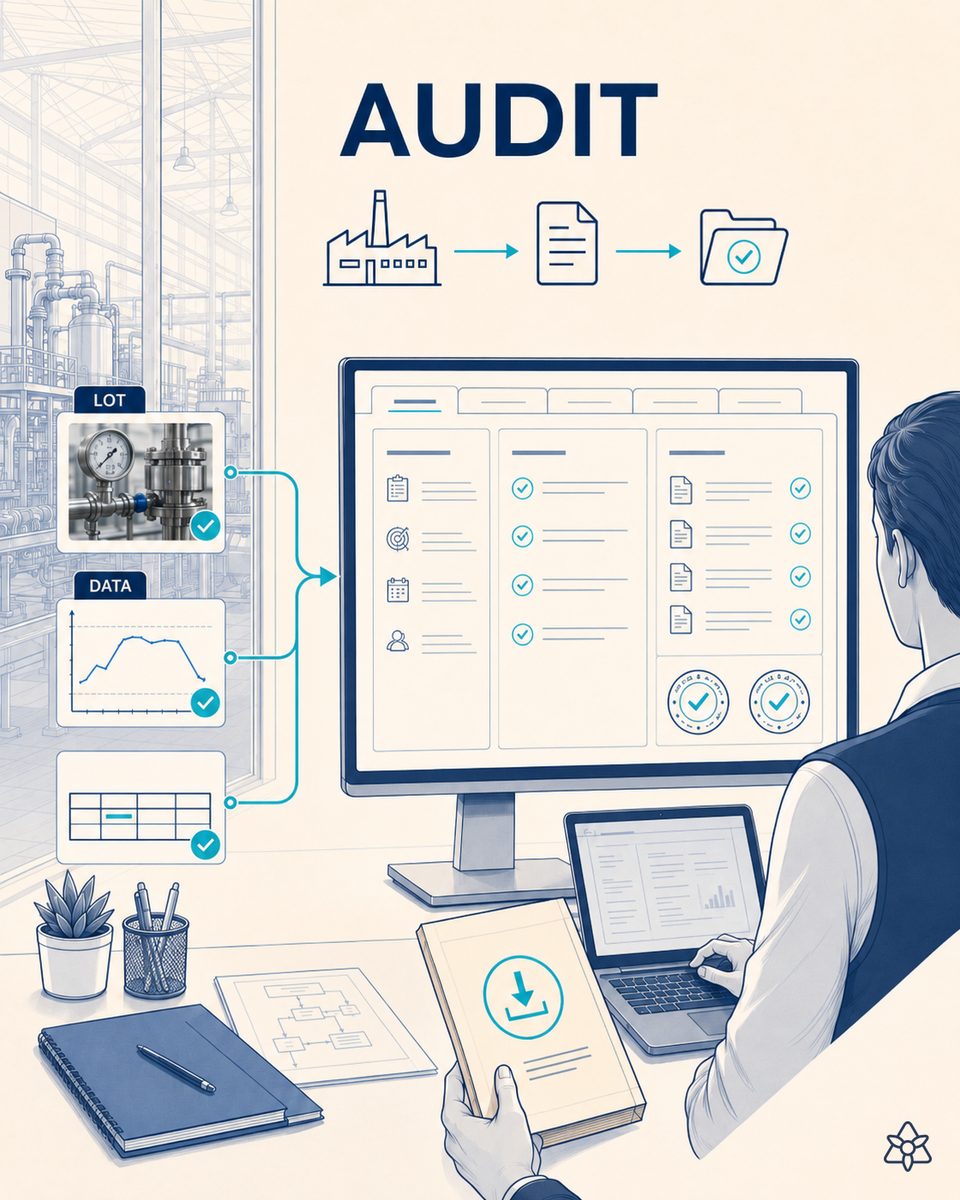
The certificate on the wall, the real risk on the line.
The vast majority of ISO 45001 certified plants keep their OHS management system in a collection of spreadsheets, shared folders and procedures that get updated right before the audit. It works — the certificate holds — but underneath there are three persistent gaps:
- The incident data never arrives alive. What happened on the night shift is filled in the next morning, with no photo, no sequence, none of the context an auditor would ask for if they knew to ask.
- Training is signed once and forgotten. The new operator on the line never receives the training specific to their workstation, because the system does not know that operator was reassigned.
- PPE issued is never validated in use. The issuance signature sits on a sheet; if someone does not wear their goggles, nobody knows until something happens.
The result: the documentary system survives the external audit, but it does not capture the reality of the day, which is exactly what the standard demands. And when a serious accident happens, the investigation uncovers the gap between the paper and the plant. ISO 45001 was not born to live in a folder.
iLEAN keeps the OHS system fed by the plant floor — not by the office.
iLEAN does not replace your documentary system, nor does it force you to change consultancy. It acts as the filler that closes the gap between the real plant and the audit folder: it captures events as they happen, classifies them against the ISO 45001 matrix and keeps the file alive. The OHS officer stops being the system's copyist and becomes the person who directs it.
Connect hears the shift team. Edge sees the critical zone. The agent prepares the management review. The three rings guarantee that whatever is critical is signed by a person.
The three iLEAN pieces applied to ISO 45001:
- Connect — the data entry point of the OHS system. The operator reports incidents and near misses by voice; PPE issuance is validated with a photo of the equipment and of the operator; on-the-job training is recorded with audio from the trainer and the recipient's signature. It also captures what arrives from outside: the insurer's report, the equipment manufacturer's notice, the regulator's circular.
- Edge — computer vision over critical zones (forklifts, presses, electrical room access). It documents near incidents with the full visual sequence, without recording faces. It brings the OHS system the objective evidence the manual form never had.
- Agent — it lives on the Central platform. It cross-checks incidents, training, PPE, non-conformities and emergency plans against the ISO 45001 matrix and local legislation (occupational risk prevention law in Spain, EU equivalents). It composes the management review with the real KPIs. And it triggers corrective actions with a reasoned priority. The three rings ensure that closing a major non-conformity is signed only by a person — the external auditor appreciates it.
Manual ISO 45001 OHS system vs. a living one with iLEAN
| Aspect | Classic documentary system | With iLEAN Connect + Edge + Agent |
|---|---|---|
| Incident reporting | Form filled in after the fact | Voice, photo and Edge sequence at second zero |
| Hazard identification | Annual review with a checklist | Continuous, fed by near misses and shift observations |
| Training per workstation | Paper signature, filed away | Trainer audio, digital signature, reminder when the workstation changes |
| PPE issuance | Signed sheet, no photo | Photo of the equipment issued, validation in use by Edge |
| Corrective action | Monthly meeting | Immediate proposal; the committee signs with a reasoned priority |
| External audit | Spreadsheets rebuilt the night before | Living exportable dossier; the auditor opens what is real |
Impact estimate for your plant — to be validated with your numbers.
The block below is an estimate to be validated with the concrete data of your plants. We set it out so management has an order of magnitude; we refine it during the diagnostic.
- A company with 2–5 ISO 45001 certified plants, a safety committee at each plant, a corporate OHS officer. Annual audit + two internal visits.
- Connect pilot at one plant to feed the OHS system in real time + a document-management agent. First value expected within a few weeks: near-miss reports multiply, training becomes tied to the real workstation, the dossier is exportable.
- Indicative payback between 5 and 9 months, conservative. Levers: OHS officer hours freed up, fines avoided, insurance premium reduction over the medium term, and the hard lever of the serious accident avoided.
- Expected reduction in audit preparation effort ≥30% (estimate) — documentation stops being rebuilt.
And the reasonable doubt from the CAIO / management
«What about the agent's reliability when classifying incidents against the standard?» — hallucination is a problem of free generation, not of tasks anchored to a source (mapping an incident against the ISO 45001 matrix is exactly that). On anchored tasks the best models brought the error rate below 1.5% [1]. Even so, closing a major non-conformity is signed by a person — the three rings require it by design, and that aligns with the direction the European AI Act is taking: human oversight over high-risk AI.
[1] OpenAI paper «Why Language Models Hallucinate», 2025 — on the reliability of AI in anchored tasks.
What people ask about ISO 45001 with AI
What does ISO 45001 demand that a spreadsheet cannot hold?
ISO 45001 demands a living management system: continuous hazard identification, risk assessment, worker participation, a record of incidents and near misses, documented training per workstation, PPE issued and signed for, tested emergency plans, non-conformities with traceable corrective action, and management review. An office spreadsheet holds the certificate at audit time — but it does not hold the reality of day-to-day work, and auditors notice it more and more.
How does iLEAN feed the OHS management system in real time?
iLEAN Connect captures from the plant floor: the operator reports incidents and near misses by voice from the earpiece or the phone; PPE issuance is signed with a photo of the ID and of the equipment; on-the-job training is recorded with audio from the trainer. Edge watches critical zones with computer vision. The agent cross-checks everything against the hazard matrix and the ISO documentation, keeps the file alive and prepares the management review report without the OHS officer assembling it by hand the night before.
Who signs the decisions in the system?
The person always signs — the system allows it by design. The agent proposes the incident classification, the priority of the corrective action, the calendar of pending training. The OHS manager and the safety committee decide and sign. The three rings guarantee that critical operations (changing a procedure, closing a major non-conformity) are executed only by a person — not «everything goes through one person», but the system requires it where it matters. It fits the AI Act and the manufacturer's own liability.
Is the dossier valid for an external audit?
Yes — that is exactly what it is designed for. The living file lets you export the evidence pack the auditor asks for (Bureau Veritas, AENOR, SGS): incidents with photo and Edge sequence, signed training, traceable PPE issuance, emergency plans with recorded drills, non-conformities closed with their corrective action. The auditor goes from asking for spreadsheets rebuilt overnight to opening a dossier that is the real management system, not its makeup.
How much does it cost and when does it pay back?
The typical pilot covers one plant with an Edge terminal in a critical zone + Connect for the OHS team + a document-management agent. First value in a few weeks. Indicative payback between 4 and 9 months, conservative, with the hard lever being the cost of a fine or a serious lost-time injury avoided and the OHS officer hours saved on assembling dossiers. We ask for your plant's data and send you the estimated ROI within 48h — with your numbers, not ours.
More cases in lean manufacturing
- IMDS: material traceability for automotiveiLEAN automates your IMDS (International Material Data System) reporting for Tier 1/2 automotive. From…
- ISO 13485 with AI — the device file, alive and traceable from the part to post-market.iLEAN keeps DHF/DMR live, UDI tracking and post-market monitoring under ISO 13485, EU MDR and 21 CFR 820…
- ISO 22000 with AI — HACCP, PRPs and traceability without rebuilding the dossier the night before the audit.iLEAN manages HACCP, PRPs and traceability under ISO 22000 with evidence always ready. No audit sprint,…
- ISO 9001 with AI — the certifier arrives and the dossier is already built.iLEAN keeps ISO 9001 evidence live per workstation. No pre-audit sprint: the dossier is already built…
- Jidoka: autonomation — the machine catches its own erroriLEAN applies Jidoka with computer vision: the machine catches its own error, stops, and alerts the…
- JIT — Just-in-Time: produce only what's needed, when it's needediLEAN runs JIT by coordinating suppliers through their channels (email, WhatsApp, EDI). Raw material…
Tell us about your case and within 48h we'll send you the estimated ROI of this AI project for your OHS system.
We work on your plant's real data, not on ours. Diagnostic with no commitment.
Request estimated ROI within 48h See near misses