ISO 9001 with AI — the certifier arrives and the dossier is already built.
ISO 9001 lives on continuous evidence, not on pre-audit sprints. iLEAN keeps the evidence live per workstation — it captures what the plant floor generates, links it to the right batch and customer, and leaves the quality system ready every day of the year, not just the week before the audit.
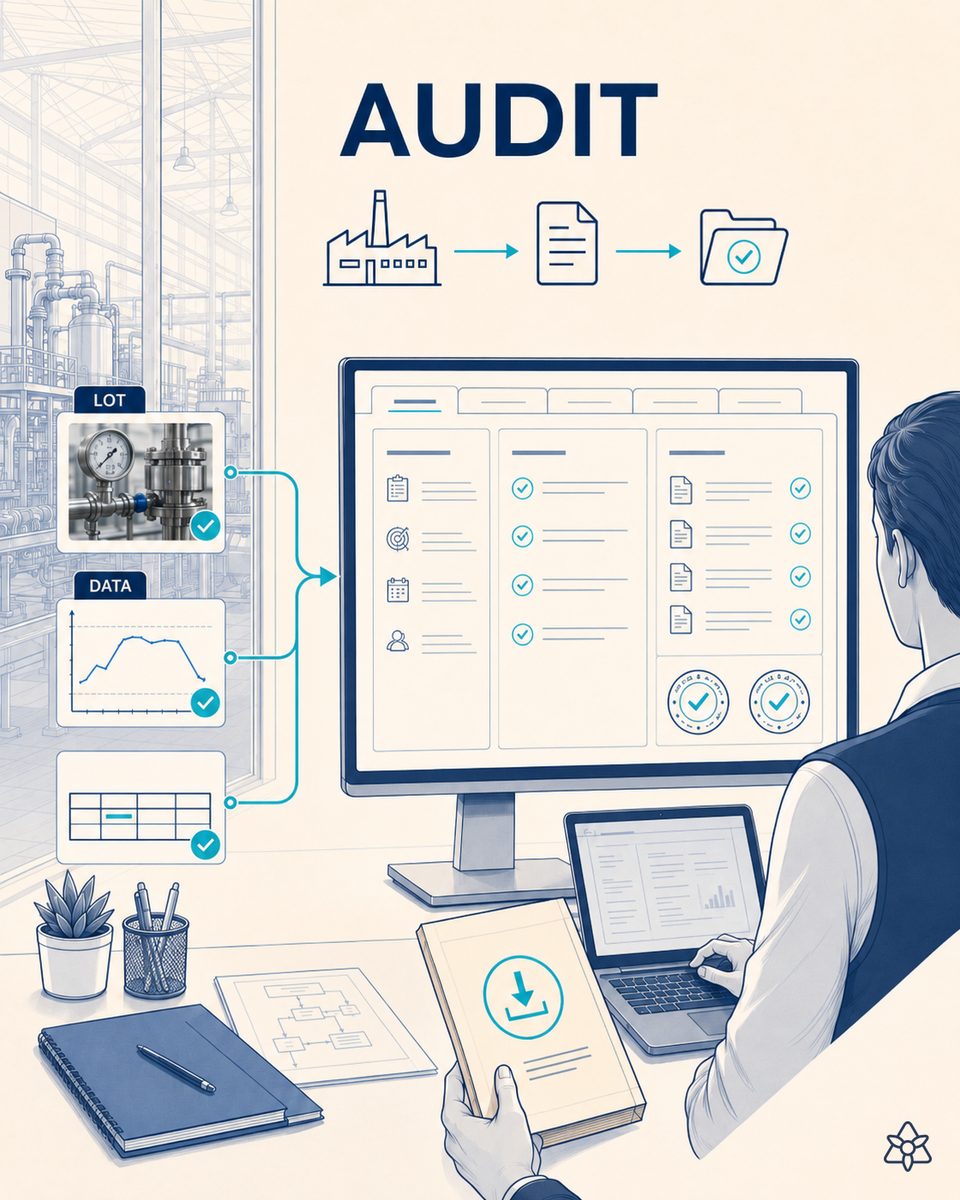
The pre-audit sprint is the trap ISO 9001 never meant to set.
The standard does not ask for a sprint. It asks for continuous evidence that the quality system works: that every planned control was done, that every non-conformity was handled, that every corrective action closed the loop. What actually happens on the plant floor is a different story:
- Evidence lives in islands — a control sheet signed on paper, the SCADA log of line 3, the supplier email with the batch certificate, the spreadsheet on the R&D manager's desktop with the latest recipe. Each island is looked after by whoever generates it, but none of them is connected to the dossier the auditor asks for.
- The quality team ends up acting as human glue — the week before the audit it rebuilds files by hand, chases overdue signatures, writes up non-conformities that had been open for three months without closing. The quality system runs in sprints, not at steady state.
- And the worst part — between one audit and the next, the system sleeps. The plant floor keeps generating data, but the QMS does not hear about it until the next sprint. By the time the auditor finds a deviation, it had been there for months.
The sentence the quality director has said in the steering committee more than once: "we have ISO 9001, but between audits nobody knows whether the system really works". That sentence is not weakness — it is honesty about a structural problem that, until now, had no affordable solution.
iLEAN does not add another QMS — it seals the gaps between your QMS and the reality of the plant.
The quality system does not fail for lack of a QMS — it fails because there is a gap between what happens on the floor and what reaches the QMS. iLEAN acts as the filler for that gap. It does not ask you to change the QMS, or the ERP, or the sheets your people already use. It sits on top and guarantees that the evidence arrives complete, linked to the right batch, workstation and customer, and signed.
Tracer captures the evidence at second zero. Writer turns it into an auditable dossier. The agent spots the holes in the system and flags them before the auditor does.
The iLEAN pieces applied to ISO 9001 with continuous audit:
- iLEAN Tracer (Connect + integrations) — captures every piece of evidence the moment it is generated: a control sheet photographed by the operator, the log of a legacy machine over OPC-UA, the supplier email with the raw-material certificate, the forgotten spreadsheet of the R&D manager. It links it to the batch and the workstation. If the plant loses the network, capture keeps running on Edge.
- iLEAN Writer — turns the captured evidence into an auditable dossier with the structure ISO 9001 asks for: control records, corrective actions, management reviews, process indicators. The dossier is built while reality is being generated, not the week before the audit.
- Quality agent — cross-checks the captured evidence against the documented plan of the system. If a planned control has not been done, it sees it and flags the responsible workstation. If a non-conformity has gone 30 days without a corrective action, it sees it and flags it. If a supplier has certificates about to expire, it sees it and flags it. The person decides. The line does not restart on its own.
Pre-audit sprint vs. live evidence with iLEAN
| Aspect | QMS + pre-audit sprint | With iLEAN Tracer + Writer + Agent |
|---|---|---|
| State of the dossier between audits | Partial, fragmented across islands | Live, complete, ready today |
| Capture of plant-floor evidence | Manual: paper sheet → batch digitization | At second zero, linked to workstation and batch |
| Pre-audit sprint for the quality team | 2-4 weeks of concentrated work | Review of evidence already built — days |
| Detection of gaps in planned controls | The auditor finds them | The agent flags them first — the person decides |
| Non-conformities left open | Detected at month-end (or in the audit) | Detected the day after the deadline |
| Time to reconstruct the traceability of a batch | Days — searching island by island, calling shifts | Minutes — complete dossier, automatic |
Impact estimate for your plant — to be validated with your own numbers.
The block below is an estimate to be validated with the data from your QMS and your quality team. We lay it out so the steering committee has an order of magnitude; we refine it during the diagnostic.
- Mid-sized industrial plant with ISO 9001 + 1-2 vertical standards (IATF 16949 / ISO 13485 / ISO 22000), a QMS in place and a quality team of 3-8 people.
- First value expected within a few weeks: digitization of the plant-floor evidence of 1-2 critical processes (process controls + non-conformities) cross-checked against the QMS.
- Indicative payback between 4 and 9 months, depending on the monthly volume of control sheets and the cost of the pre-audit sprint in person-hours.
- Expected reduction in time spent on administrative evidence tasks: ≥30% (estimate to be validated). The hard lever is not the hours saved — it is that one major non-conformity avoided in the next audit pays for the whole pilot.
And the quality director's reasonable doubt
"What if the AI gets a control sheet or a certificate wrong?" — hallucination is a problem of free generation, not of anchored tasks. In tasks where the AI merely recontextualizes a piece of data (reading a control sheet and linking it to a batch, extracting the date from a certificate), the best models brought the error rate below 1.5% [1]. And even so, nothing critical is decided alone: iLEAN proposes, and the person signs. The system allows — and configures — any record relevant to the audit to pass mandatorily through human validation. The three safety rings exist precisely for this.
[1] OpenAI paper "Why Language Models Hallucinate", 2025 — on the reliability of AI in anchored tasks.
What people ask about ISO 9001 with continuous audit and AI
How do you digitize ISO 9001 evidence without rebuilding the QMS?
iLEAN Connect captures the evidence the moment it is generated, wherever it lives — a paper control sheet the operator photographs with a phone, the SCADA log of an 18-year-old machine, a supplier spreadsheet, a non-conformity email. The system indexes it, links it to the right workstation, batch and customer, and files it signed into the repository you already use. The QMS is not rebuilt: what gets sealed is the gap between what happens on the floor and what reaches the system.
Does it also work for regulated sectors (pharma, medical, aerospace)?
Yes. ISO 9001 is the base; on top of it you couple ISO 13485 (medical devices), ISO 22000 (food), EN 9100 (aerospace), IATF 16949 (automotive). iLEAN treats ISO 9001 as the common substrate — capture, traceability and dossier — and then adds the specific requirements of each vertical. The three safety rings let you configure the level of human validation each standard demands: auto-approval for routine evidence, mandatory sign-off for critical operations.
Does it integrate with the QMS we already have?
Yes. iLEAN sits on top of the QMS — proprietary or one of the major platforms — and fills in what the QMS left uncovered: the evidence generated outside it (plant floor, mobile, paper, legacy machine). The QMS remains the master system of record; iLEAN guarantees the evidence arrives complete and on time, not partial and at month-end.
Is the external audit faster with live evidence?
Yes, and for a reason the steering committee gets on the first pass: the auditor asks for the traceability of a batch and the dossier is complete in minutes, not days. It is not magic — the dossier was already built when the batch was made, not when the auditor showed up. The pre-audit sprint (that week of the quality team rebuilding files by hand) shrinks drastically, because there is no longer any need to reconstruct what is already reconstructed.
How much does it reduce the quality team's workload?
Estimate to be validated with data from your plant: a reduction of ≥30% in the time spent on administrative evidence and dossier tasks — because it stops being a manual sprint and becomes the validation of something already done. The hard lever is not the hours saved, it is that the quality team can spend its time on quality (root cause of non-conformities, process improvement) instead of collecting paper. Send us the data from your current QMS and we send back the estimated ROI in 48h.
More cases in lean manufacturing
- ISO 13485 with AI — the device file, alive and traceable from the part to post-market.iLEAN keeps DHF/DMR live, UDI tracking and post-market monitoring under ISO 13485, EU MDR and 21 CFR 820…
- ISO 22000 with AI — HACCP, PRPs and traceability without rebuilding the dossier the night before the audit.iLEAN manages HACCP, PRPs and traceability under ISO 22000 with evidence always ready. No audit sprint,…
- ISO 45001 with AI — from the office spreadsheet to a living management system.How iLEAN turns the ISO 45001 OHS management system into a living file: incidents, PPE, training and…
- Jidoka: autonomation — the machine catches its own erroriLEAN applies Jidoka with computer vision: the machine catches its own error, stops, and alerts the…
- JIT — Just-in-Time: produce only what's needed, when it's needediLEAN runs JIT by coordinating suppliers through their channels (email, WhatsApp, EDI). Raw material…
- Kaizen: continuous improvement captured from the flooriLEAN captures Kaizen ideas from the floor by photo/voice, AI-evaluates them and runs PDCA follow-up…
Tell us about your case and within 48h we send back the estimated ROI of this AI project for your ISO 9001 system.
We work on the real data of your QMS and your plant, not on ours. Diagnostic with no strings attached.
Request estimated ROI in 48h See Lean Manufacturing