ISO 22000 with AI — HACCP, PRPs and traceability without rebuilding the dossier the night before the audit.
ISO 22000 covers three pillars — HACCP, PRPs/OPRPs and traceability. iLEAN manages all three with live evidence per workstation: intermediate cleaning captured at second zero, the CCP check linked to the batch, the traceability dossier ready when the auditor asks. Compatible with FSSC 22000, BRCGS and IFS.
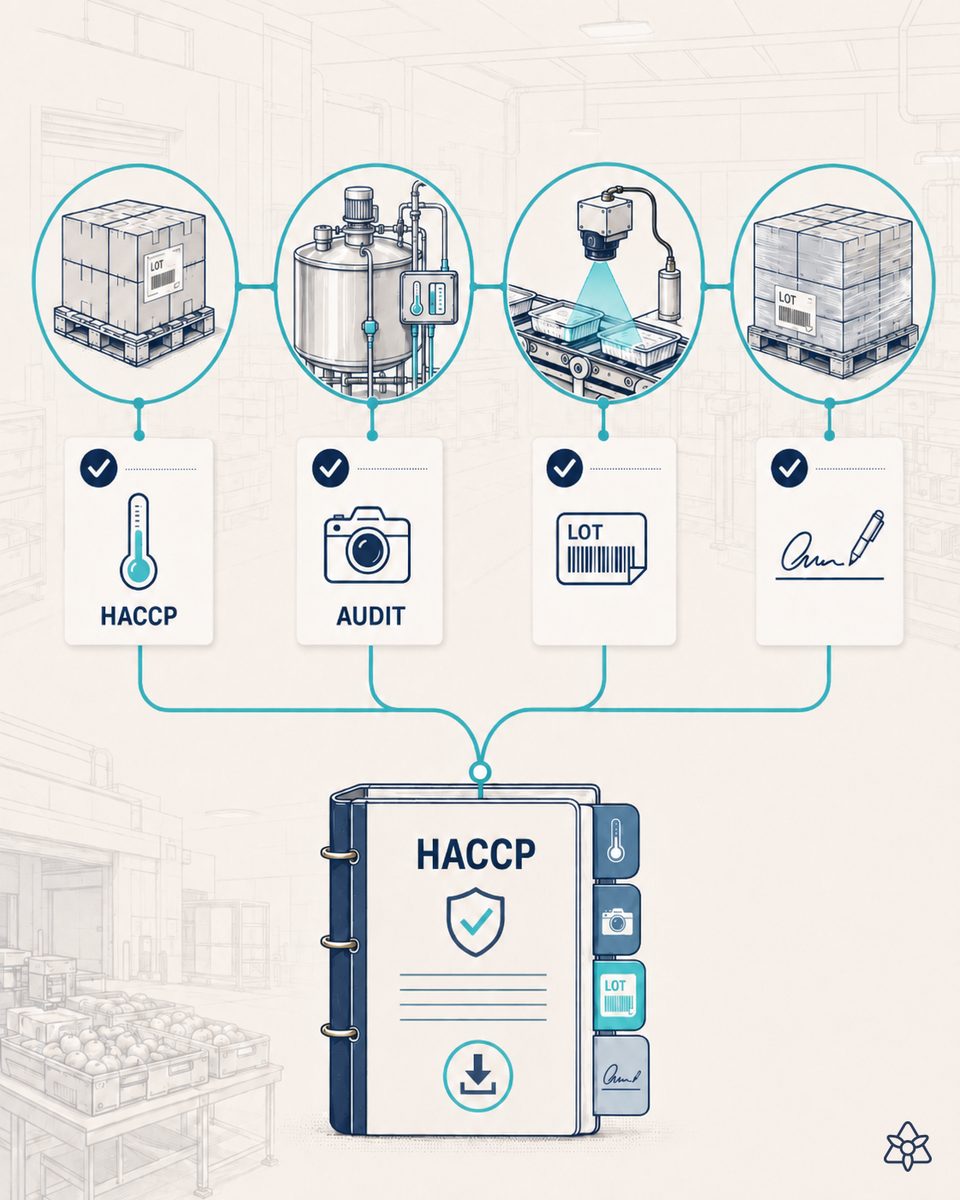
HACCP on the plan, the dossier on paper, reality on the floor — three worlds that don't talk to each other.
In most plants the food safety system doesn't fail by design — it fails in the distance between the documented HACCP and what actually happens each shift. The quality manager tells it like this:
- The HACCP is complete — hazard analysis, CCPs identified, OPRPs defined. It passed the implementation audit. It lives in a document reviewed once a year.
- The plant complies — most of the time — intermediate cleaning between allergen batches, cold room temperature, pest control, packaging integrity. But the evidence is generated on paper, on a SCADA screen, on a log sheet the operator signs and hands in at the end of the shift.
- And then the gap — when the auditor asks you to cross the HACCP plan with the real evidence for batch 4729, it has to be rebuilt. And rebuilding means going sheet by sheet, island by island, calling past shifts. The classic system works 99% of the time. The 1% that ends up in RASFF (or in a major audit finding) is the batch whose evidence fell through the gap.
The sentence every food plant manager gets instantly: "my HACCP is fine — what fails is that between audits I don't know exactly what evidence I have for each CCP, each shift, each batch".
iLEAN doesn't redo your HACCP — it seals the gap between the plan, the plant and the dossier.
The problem isn't a lack of HACCP — it's information living in islands that, at the critical moment (the pre-audit sprint, the recall for an undeclared allergen), cannot be put together in time. iLEAN acts as the filler that closes those gaps without asking you to change your HACCP plan, your ERP, your traceability system or the log sheets your people already use.
Edge sees what happens at the CCP. Connect captures the OPRPs at second zero. Writer builds the dossier while the plant produces. The person signs — never the other way round.
The iLEAN pieces applied to ISO 22000:
- iLEAN Edge — terminals with computer vision (CNN) over the CCPs: foreign body detection before packaging, allergen labeling verification, heat-seal integrity, cold room temperature. It detects and, where appropriate, holds the batch in milliseconds. It works without a network: if the plant loses WiFi, Edge keeps reading and holding batches, because food safety cannot depend on connectivity.
- iLEAN Tracer (Connect + integrations) — captures the OPRPs at second zero: intermediate cleaning between allergen batches (photo + checklist + signature), the temperature log of the old machine, the supplier certificate arriving by email, the incident an operator dictates through an earpiece. All linked to the batch and the workstation. It connects to the traceability system you already have (proprietary, SAP, or a multi-storey spreadsheet).
- iLEAN Writer + HACCP Agent — Writer turns the captured evidence into an auditable dossier with the structure ISO 22000 asks for (CCP records, OPRP records, validation of control measures, management review). The agent cross-checks the evidence against the HACCP plan and warns when a planned control has not been performed within its time window, or when an OPRP has gone days without a record. The person decides and signs.
HACCP in sprints vs. an FSMS with live evidence
| Aspect | HACCP + pre-audit sprint | With iLEAN Edge + Tracer + Writer |
|---|---|---|
| State of the dossier between audits | Partial, spread across shifts and islands | Live, complete, ready today |
| OPRP evidence (cleaning, temperature) | Paper log sheet, signed at end of shift | Captured at second zero, linked to the batch |
| Allergen labeling control | Checklist + a pair of eyes at SKU changeover | Edge verifies the printed label, holds if it doesn't match |
| Traceability of a batch | Days — searching across islands, calling shifts | Minutes — complete dossier, automatic |
| Operation without a network | n/a — depends on the online system | Edge keeps running as long as the panel has power |
| Multi-plant | Each plant with its own version of the spreadsheet | Rings per plant + consolidated corporate dossier |
Impact estimate for your plant — to be validated with your numbers.
The block below is an estimate to be validated with your plant's data. We put it forward so the committee has an order of magnitude; we refine it during the diagnostic.
- Mid-sized food plant with ISO 22000 (or FSSC 22000) + BRCGS, 2-4 lines, US/UK retail certification adding specific allergen rules.
- First value expected within a few weeks: Edge pilot on a packaging line with labeling verification + OPRP capture (intermediate cleaning) on one critical line.
- Indicative payback between 4 and 9 months, depending on the monthly volume of CCP/OPRP log sheets and the average cost of a recall or rework triggered by a non-conformity detected at the customer.
- Expected reduction in administrative evidence and dossier tasks: ≥30% (estimate to be validated). The hard lever is a single recall avoided — product pulled from the shelf, reverse logistics, destruction, brand damage. One recall pays for the pilot.
And the plant manager's fair objection
"What if the AI lets a mislabeled batch or an unfulfilled OPRP through?" — hallucination is a problem of free generation, not of anchored tasks. In tasks where the AI merely recontextualizes a data point (reading a label and comparing it against the batch recipe, reading a log sheet and linking it to the OPRP), the best models brought the error below 1.5% [1]. And even so, nothing critical is decided alone: iLEAN holds the batch or alerts about the missing evidence, and the person signs. The three security rings exist precisely for this.
[1] OpenAI paper "Why Language Models Hallucinate", 2025 — on the reliability of AI in anchored tasks.
What people ask about ISO 22000 FSMS with AI
What is the difference between ISO 22000 and FSSC 22000?
ISO 22000 is the base food safety management standard. FSSC 22000 adds sector-specific PRP requirements (ISO/TS 22002-X depending on the industry) plus additional scheme requirements, and it is GFSI-recognized — which makes it a must for most retail chains. iLEAN does not decide which scheme you use: it captures the evidence and organizes it according to the records your certification body asks for, whether that is plain ISO 22000 or FSSC 22000.
How are operational PRPs (OPRPs) managed with iLEAN?
OPRPs are specific control measures that require continuous monitoring and evidence records. iLEAN captures compliance with each OPRP at the moment it happens — intermediate cleaning between batches, cold room temperature, packaging integrity, pest control — and links it to the batch and the responsible workstation. If a measure is not executed within its time window, the agent alerts the person in charge before it becomes an audit finding.
How does it map to BRCGS and other GFSI schemes?
BRCGS, IFS and FSSC 22000 share a common core with ISO 22000 — hazard analysis, allergen management, traceability, supplier control, change management. iLEAN maps the captured evidence to the records of each scheme, so a single data point (cleaning between batches, for example) covers the ISO 22000 requirement, the BRCGS one and the retailer that audits you separately, without duplicating work on the floor.
Does it reduce audit effort?
Yes, and the pattern is the same in every plant: the auditor asks for the traceability of a batch and the dossier is complete in minutes, not days. Because the dossier was already built when the batch was made. The pre-audit sprint — that week of quality and production rebuilding files — shrinks drastically. The quality team goes back to doing quality (hazard analysis, HACCP improvement) instead of collecting paper.
Does it work across multiple plants?
Yes. iLEAN is designed for multi-plant operations: each plant runs with its own cryptographic key (security rings per plant), its own level of human validation (configurable without touching code), and a consolidated dossier at corporate level whenever the quality director needs it. If one plant requires mandatory human validation because of its criticality and another operates on auto-approval, the system supports it without replicating installations.
More cases in lean manufacturing
- Hoshin Kanri: digital Lean strategy deploymentiLEAN digitizes Hoshin Kanri: live X-matrix, cascading catchball, drift alerts. Strategy reaches the…
- IMDS: material traceability for automotiveiLEAN automates your IMDS (International Material Data System) reporting for Tier 1/2 automotive. From…
- ISO 13485 with AI — the device file, alive and traceable from the part to post-market.iLEAN keeps DHF/DMR live, UDI tracking and post-market monitoring under ISO 13485, EU MDR and 21 CFR 820…
- ISO 45001 with AI — from the office spreadsheet to a living management system.How iLEAN turns the ISO 45001 OHS management system into a living file: incidents, PPE, training and…
- ISO 9001 with AI — the certifier arrives and the dossier is already built.iLEAN keeps ISO 9001 evidence live per workstation. No pre-audit sprint: the dossier is already built…
- Jidoka: autonomation — the machine catches its own erroriLEAN applies Jidoka with computer vision: the machine catches its own error, stops, and alerts the…
Tell us about your case and within 48h we'll send you the estimated ROI of this AI project for your ISO 22000 system.
We work on your plant's real data, not on ours. Free diagnostic, no commitment.
Request estimated ROI in 48h See Lean Manufacturing