IMDS: material traceability for automotive
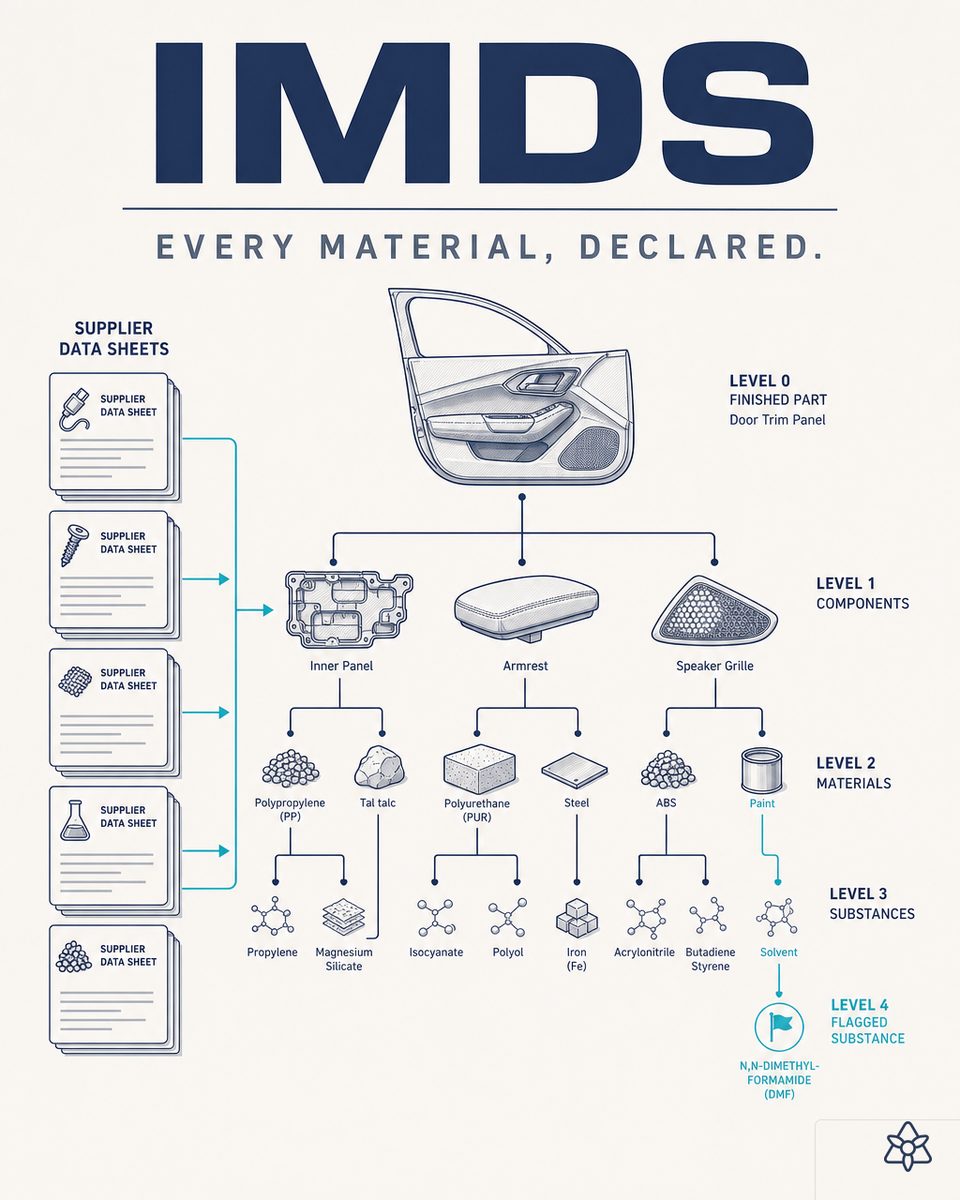
IMDS (International Material Data System) is the mandatory global system for the automotive industry through which Tier 1 and Tier 2 suppliers report the exact material composition of every component they deliver to an OEM — to comply with regulations like REACH and RoHS and to give the OEM full traceability of what's in every car it sells.
Why IMDS isn't optional
IMDS has been managed by DXC Technology since 2000 and is mandatory for any supplier delivering to a European OEM (VW, BMW, Mercedes, Stellantis, Renault) and many Japanese, Korean and American OEMs. Without up-to-date IMDS, orders stop.
Its complexity lies in depth: every component can have dozens of sub-components, each with its exact material composition. A small cable carries info on copper + PVC + additives. And all of that must be reported and maintained when the formulation changes.
IMDS is also the foundation of REACH (European chemical substances regulation) and RoHS (Restriction of Hazardous Substances) compliance. If your plastics supplier changes an additive without telling you, you automatically fall into non-compliance.
iLEAN doesn't replace the method — it brings it into the 21st century.
Every Lean methodology was born to solve an information problem: where stock is, which machine is failing, what changed shift-to-shift. When information is paper, methods are rituals. When it's live data, they become the actual engine of the plant.
Classical method tells you what to measure. The IRIS system guarantees the measurement reaches whoever decides, the moment they decide — without anyone typing it in.
The three capture layers applied: Connect (photo, voice, email, WhatsApp), Edge (computer vision on the line) and Integrations (ERP/MES/SCADA/PLC). On top of that unified information, specialized agents serve the exact context to each person on the floor.
Classical IMDS vs. automated IMDS
| Aspect | Classical IMDS | IMDS with iLEAN |
|---|---|---|
| Data collection | Excel with each supplier | Auto-pull from ERP + digital form to supplier |
| Upload to IMDS system | Manual, by IMDS user | Auto-upload with prior validation |
| Update on change | Only when someone finds out | Alarm when there's a change at any level |
| REACH/RoHS verification | Periodic manual audit | Continuous, instant alert if banned substance enters |
| OEM audit | Panic days before | Instant on-demand report |
What people ask about IMDS
What is IMDS and why is it mandatory in automotive?
IMDS (International Material Data System) is the global database where Tier 1 and Tier 2 suppliers report the exact composition of each automotive component. It's mandatory because OEMs require it contractually and because it underpins REACH and RoHS compliance — without current IMDS, no delivery.
What's the difference between IMDS and CAMDS (China)?
IMDS: global standard managed by DXC from Europe. CAMDS: Chinese equivalent, managed by CATARC, mandatory for selling to Chinese OEMs (BYD, Geely, SAIC). Plants exporting to China manage both in parallel — iLEAN syncs them.
How does iLEAN automate IMDS reporting without Excel?
iLEAN extracts information from your ERP/PLM, completes the material hierarchy by asking your suppliers through their usual channels, validates coherence, and uploads to the DXC IMDS platform via API. Your IMDS operator just reviews and approves.
Do I need IMDS only for specific OEMs or for all of them?
For all European OEMs and most modern global OEMs. Exceptions are very specific OEMs or vehicles not homologated for Europe. If in doubt: if you deliver to a Tier 1 that delivers to a European OEM, you need IMDS.
What happens if an IMDS data point is wrong and the OEM catches it?
Serious consequences: batch rejection, loss of PPAP homologation, contractual fines, and reputational drop in OEM supplier ranking. That's why reporting automation (vs. manual Excel) dramatically reduces risk.
More cases in lean manufacturing
- Multi-product golden batch: every SKU has its perfect batch — and today it lives in the veteran operator's head.iLEAN identifies the real golden batch for each SKU and compares the running batch against it in real…
- Heijunka: production leveling with AI forecastingiLEAN levels your production with AI forecasting, optimal sequencing and balanced product mix. Heijunka…
- Hoshin Kanri: digital Lean strategy deploymentiLEAN digitizes Hoshin Kanri: live X-matrix, cascading catchball, drift alerts. Strategy reaches the…
- ISO 13485 with AI — the device file, alive and traceable from the part to post-market.iLEAN keeps DHF/DMR live, UDI tracking and post-market monitoring under ISO 13485, EU MDR and 21 CFR 820…
- ISO 22000 with AI — HACCP, PRPs and traceability without rebuilding the dossier the night before the audit.iLEAN manages HACCP, PRPs and traceability under ISO 22000 with evidence always ready. No audit sprint,…
- ISO 45001 with AI — from the office spreadsheet to a living management system.How iLEAN turns the ISO 45001 OHS management system into a living file: incidents, PPE, training and…
Tell us about your plant. We'll tell you how we'd do it.
25 years applying Lean in real plants. Free diagnostic conversation.
Request demo See Lean Manufacturing