OCR of heat numbers on hot aluminum ingots with AI — no reading, no traceability; and no traceability, no serious customer.
The ingot leaves the furnace above 400 °C with its heat number embossed on it, and classic OCR cannot cope: infrared radiation, steam, dust and poor light. iLEAN Vision reads while hot with a CNN trained in the foundry, cross-checks with the ERP's heat plan and leaves a dossier per ingot. The person signs off.
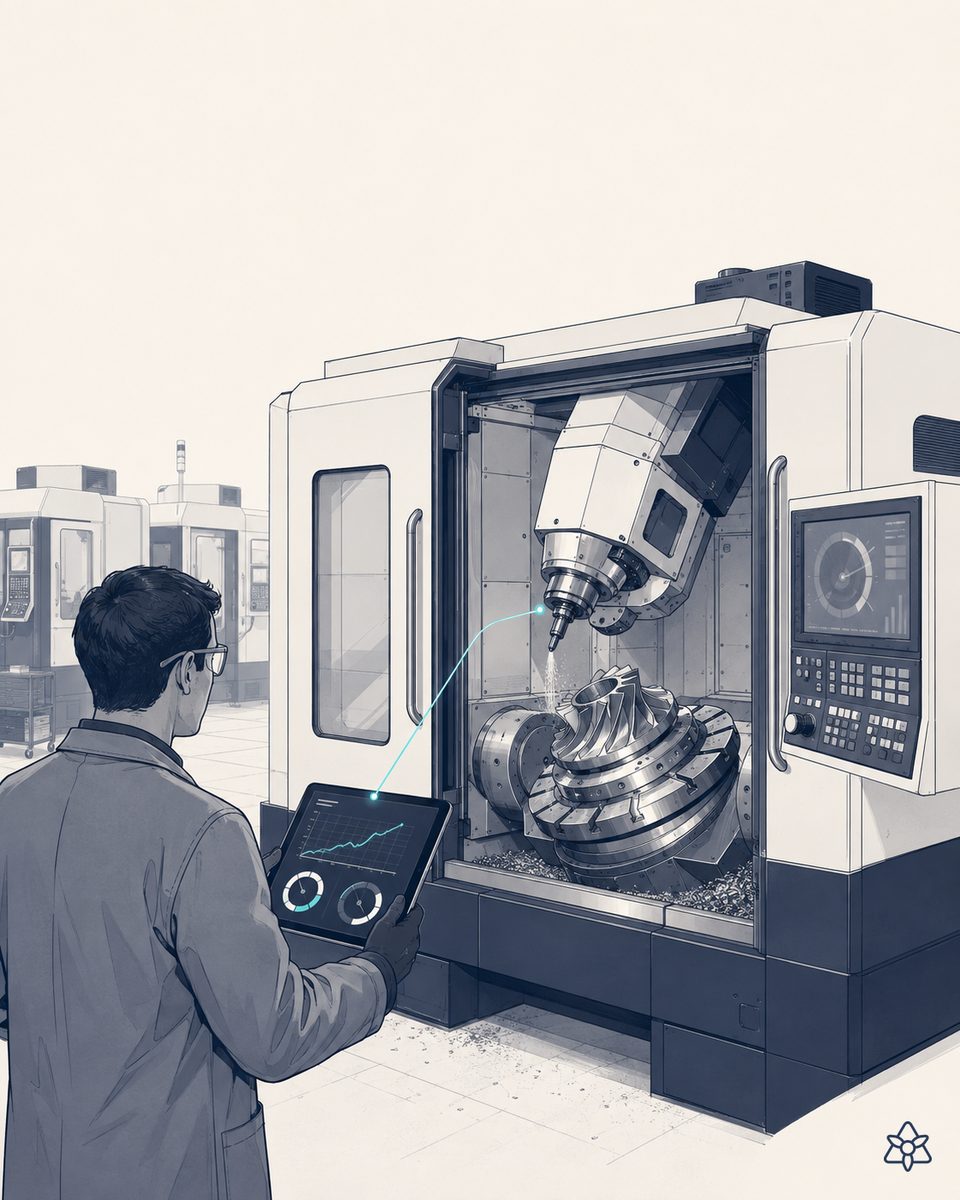
The number is stamped. The hard part is reading it when traceability depends on it.
In an aluminum foundry hall, every heat is identified with a number embossed on the ingot, while hot. That number is the link between the raw material, the chemical composition measured at the heat and the final part that will reach the automotive or aerospace customer. Three realities make its classic reading fail:
- The heat. The ingot leaves the furnace above 400-500 °C and emits radiation that saturates standard OCR cameras. The stamp, clear when cold, blurs when hot.
- The environment. Smoke, oxide dust, steam from the cooling systems and the changing light of the overhead cranes make a "studio" shot impossible.
- The manual record. When the OCR cannot cope, the operator writes it down by hand. One badly copied digit breaks the finished part's traceability weeks later — and there is no way to recover it.
The quality manager knows this, but cannot be in every hall verifying every ingot. The manual record works 99% of the time. That 1% is what surfaces when the customer asks for the material certificate — and the heat shows up as "not located".
iLEAN Vision does not replace the heat leader — it seals the crack between what is stamped hot and what the ERP stores cold.
The heat-OCR problem is not a lack of information: it is information living in islands (the ERP/MES heat plan, the optical reading on the part, the lab's chemical analysis, the shift leader's sheet). At the critical moment — the hot ingot dropping into the cooling area — those data points are never cross-checked in time. iLEAN acts as the filler that closes those gaps without asking you to change the furnace or the mould.
Edge sees the hot embossed number. Connect reads the heat plan and the chemical analysis. The agent cross-checks and, if the reading does not fit, flags the ingot. The person signs off — never the other way round.
The iLEAN pieces applied to heat-number OCR in aluminum:
- iLEAN Vision (Edge) — a terminal hardened for hot environments with an industrial camera, suitable IR filters and structured lighting. A CNN trained on real ingots in plant conditions, not on cold studio parts. It reads, decodes and flags in milliseconds. It works with no network. If the hall loses its WiFi, Edge keeps reading and recording locally.
- Connect — captures the ERP/MES heat plan, the lab's chemical analysis (the analyser's spreadsheet, the chromatograph's sheet) and the mould changes the shift leader decides. The filler works in the foundry too: what sat in a forgotten lab spreadsheet enters the system at second zero.
- Agent — cross-checks the optical reading with the heat plan, validates it if it fits within confidence and, if not, holds that ingot's traceability as "pending re-read". When a customer asks for a material certificate, the per-ingot dossier comes out automatically — a boring, concrete agent, exactly the kind that closes sales.
Classic OCR + manual note vs. hot reading with iLEAN Vision
| Aspect | Classic OCR + the shift leader's note | With iLEAN Vision + Connect + Agent |
|---|---|---|
| Hot reading (400+ °C) | Frequent failure, discard by default | Foundry-trained CNN reads while hot |
| Number validation | Blind optical reading | Cross-check with the ERP's heat plan |
| Parallel manual record | Yes, accumulated human error | Automatic signed record per ingot |
| Material certificate for the customer | Reconstructed by hand per lot | Dossier per ingot, automatic |
| Operation with no network | n/a | Edge keeps operating on cabinet power |
| IATF 16949 / AS9100 traceability | Vulnerable to a badly copied digit | Anchored to the optical reading + chemical analysis |
Impact estimate for your plant — to be validated with your numbers.
The block below is an estimate to be validated with the specific figures of your plant. We set it out so the committee has an order of magnitude; we refine it during the diagnostic.
- Secondary aluminum foundry with embossed numbered ingots, automotive/aerospace customers demanding heat → part → final product traceability.
- iLEAN Vision pilot at a furnace exit area (hardened camera + lighting, integration with the ERP's heat plan and the lab's chemical analysis). First expected value within a few weeks.
- Indicative payback between 4 and 9 months, depending on the annual cost of heats not located during material certification and the cost of the manual cold re-read of ingots.
- A reduction of heats with incomplete traceability of ≥ 30% over the baseline — the hard lever is a material certificate delivered on time to a key customer. One order not lost over traceability pays for the pilot.
And the quality manager's reasonable doubt
"What if the AI confuses an 8 with a 0 while hot?" — hallucination is a problem of free generation, not of anchored tasks. When the AI simply reads a number whose expected range it already knows (the ERP's planned heat), the best models brought the error below 1.5% [1]. And even so, what is critical is never decided alone: iLEAN flags the ingot if confidence does not reach the threshold and the person signs off. The three safety rings are there for exactly this.
[1] OpenAI paper "Why Language Models Hallucinate", 2025 — on the reliability of AI in anchored tasks.
What people ask about heat-number OCR on aluminum ingots
Why does classic OCR fail to read the heat number on a hot ingot?
The ingot leaves the furnace above 400-500 °C and emits infrared radiation that saturates standard camera sensors. The embossed stamp, legible when cold, appears as low contrast on a glowing surface while hot. And the hall's atmosphere carries smoke, oxide dust and steam. Classic OCR, trained on cold parts in a studio, fails in this environment. iLEAN Vision uses a CNN trained in real foundry conditions.
Which camera does Edge use to read an ingot at 400 °C?
Edge is mounted with an industrial camera with a suitable IR-cut filter, optics with an aperture adjusted for the ingot's radiation and, where needed, structured lighting that adds contrast over the embossing. The Edge terminal is qualified for foundry environments. What makes the difference, however, is not the optics: it is the CNN trained on real hot ingots, not demo parts.
How is traceability preserved when a reading is inconclusive?
The agent cross-checks the optical reading with the ERP/MES heat plan: at this time, in this mould, number X should be coming out. If the OCR returns something compatible with X, it validates; if it is not compatible or confidence is low, it flags the ingot for review and alerts the shift leader. Traceability does not break at what is critical — the person signs off and the part is recorded as pending a cold re-read.
How does it fit automotive traceability (IATF 16949) and aerospace AS9100?
Metallurgical traceability heat → part → final product is a requirement in automotive and aerospace. iLEAN Vision leaves a signed record of every reading (image of the stamp, decoded number, ERP heat, confidence, time) per ingot. When a customer asks for the lot's material certificate, the dossier comes out of the system, not out of the quality manager's manual reconstruction. It is the boring, concrete agent pattern applied to the foundry.
How much does an Edge pilot cost in an aluminum foundry hall?
The order of magnitude of an Edge pilot in a foundry is close to that of any Edge pilot in a plant: an initial investment covering a terminal hardened for hot environments, an industrial camera with suitable optics, structured lighting and the integration with your ERP/MES, plus an annual licence. The reasonable payback to present to the committee is a matter of several months — the hard lever is a single heat lost to traceability avoided, which is worth more than the pilot. Send us your plant's data and we will send back the estimated ROI within 48h.
More cases in ilean vision
- O-ring verification in hydraulic assembly with AI — a twisted seal is not rework, it is a leak at the customer.iLEAN Vision verifies the presence and correct orientation of O-rings in hydraulic cylinders before…
- An aisle crossing 1.5 m from the AGV — and the safety stop arrives just in time.iLEAN Vision detects obstacles and operators in AGV/AMR aisles and stops the fleet before impact. An…
- OCR of DOM/EXP on curved cosmetic packaging with AI — the blurry character reaches the shelf, and comes back as a claim.How iLEAN Vision reads DOM/EXP on curved plastic cosmetic packaging with low legibility — cross-checked…
- Repetitive posture control in automotive assembly — the pain arrives before the data, and the data arrives late.iLEAN Vision measures repetitive cycles and forced postures on the automotive final line to rotate…
- RULA / REBA posture control in meat deboning — anticipate the injury before it appears.iLEAN Vision computes RULA/REBA in real time in the meat deboning room to anticipate musculoskeletal…
- Tablet counting in blisters with AI — the aluminium closes the blister in milliseconds; an under-dose only shows up when the patient opens it.How iLEAN Vision counts and verifies the shape of every tablet in the pharma blister before aluminium…
Tell us your case and within 48h we will send you the estimated ROI of this AI project for your foundry.
We work on your plant's real data, not on ours. Diagnostic with no commitment.
Request estimated ROI in 48h See iLEAN Vision