An aisle crossing 1.5 m from the AGV — and the safety stop arrives just in time.
In a warehouse with an AGV/AMR fleet, the AGV's lidars are the first layer, but they cannot see the crossing from above: an operator stepping in sideways from a blind zone, or a package fallen behind the last rack, is discovered when the braking curve has already begun. iLEAN Vision adds an overhead layer with a CNN that anticipates the event and stops the fleet before impact. The AGV's safety system stays as the first layer — this is the second.
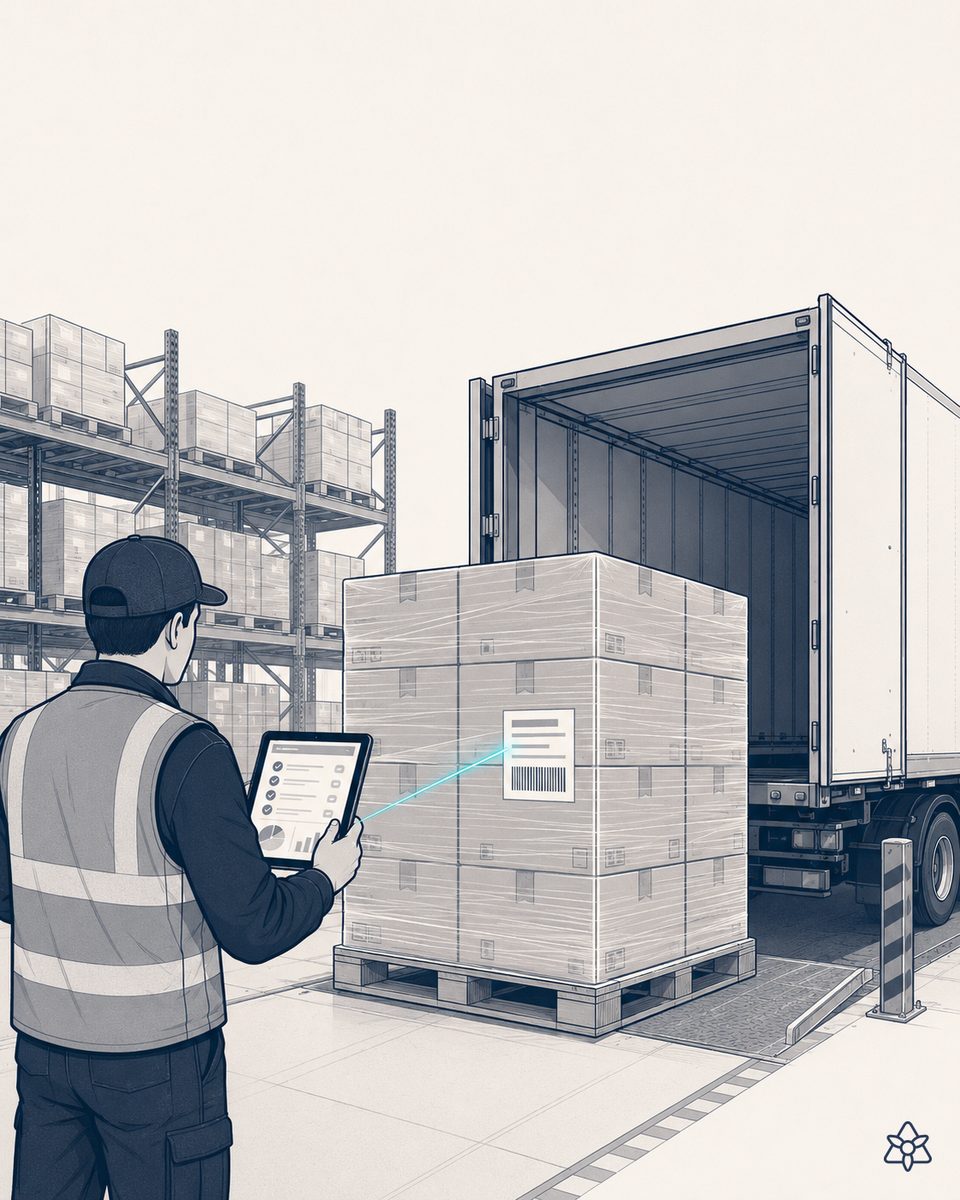
The AGV sees from the AGV. The aisle cannot be seen from the AGV.
The safety of an AGV/AMR fleet depends on crossing three realities that are rarely governed together:
- What the AGV sees with its own lidars — the first layer, SIL/PL-certified by the manufacturer. Essential, but tied to the vehicle's own perspective and reaction speed.
- What happens in the aisle from above — the information it would help to have: crossings with operators, packages in blind zones behind racks, manual pallet trucks entering the AGV zone unannounced.
- How much real authority the warehouse manager has over the fleet — fleet managers are the manufacturer's opaque boxes; integrating an anticipatory stop order from a plant system is not trivial.
The result: most documented near-misses happen at the crossings, and the warehouse manager learns about them from the shift leader's report, not from the fleet manager. The AGV's safety system works 99% of the time. That 1% is what you want to armour with a second, anticipatory layer owned by the plant.
iLEAN does not touch the AGV's safety — it adds an anticipatory layer on top, governed by the plant.
The problem with the AGV/AMR aisle is not that the safety system is bad: it is that it lives on an island owned by the fleet's manufacturer, and the plant has no way to add its own criterion. iLEAN acts as the filler that closes that gap, without touching what is already certified.
Edge sees the aisle from above. Connect sends the order to the fleet manager. The agent cross-checks with the fleet plan and the calendar of operator presence in the zone. The warehouse manager signs the rules.
The three iLEAN pieces applied to obstacle detection in AGV/AMR aisles:
- Edge — terminals with machine vision (CNN) on overhead cameras above critical crossings. They classify person/pallet truck/pallet/package, calculate the trajectory and, if there is a risk of crossing with an imminent AGV, trigger the actuator (a stop order to the fleet manager or a dry contact to the safety PLC). It works with no network. If the plant loses its WiFi, Edge keeps protecting the crossing.
- Connect — captures the fleet's state (via the fleet manager's API or, for an old fleet, by dry contact) and the calendar of operator presence in the AGV zone. External notices (the shift leader's report of a night incident) arrive at second zero too.
- Agent — cross-checks the Edge event with the fleet plan and the expected operator presence. If it detects a zone where near-misses repeat, it proposes a rule change to the warehouse manager and leaves the dossier. The person validates the change.
AGV safety alone vs. AGV safety + iLEAN Vision layer
| Aspect | Lidars + AGV safety stop only | With iLEAN Vision as a second layer |
|---|---|---|
| Perspective | From the AGV, at its speed | Overhead, sees the whole aisle |
| Anticipating crossings | When it enters the lidar's field | Trajectory predicted before the crossing |
| Packages in blind zones behind racks | Detected on turning | Detected from above, earlier |
| False positives from shadows/reflections | Common with auxiliary PIR/photoelectric | The CNN classifies shape, not just movement |
| Governance by the plant | Limited to the manufacturer's fleet manager | Rules configurable per zone, owned by the plant |
| Incident dossier | Reconstructed by hand per shift | Automatic, with video of the event |
Impact estimate for your plant — to be validated with your numbers.
The block below is an estimate to be validated with the specific figures of your warehouse. We set it out so the committee has an order of magnitude; we refine it during the diagnostic.
- Warehouse of 8,000-20,000 m² with a mixed AGV/AMR fleet (several manufacturers), AGV-zone / operator-zone crossings several times per shift, a documented near-miss history.
- Edge pilot with 2-4 overhead cameras at the critical crossings + integration with the fleet manager. First expected value within a few weeks.
- Indicative payback between 4 and 9 months, depending on the frequency of documented near-misses, the average cost of a long fleet stop and, above all, the cost of an incident with sick leave.
- Expected reduction in near-misses at crossings: ≥ 30% versus the measured baseline. A single avoided incident with leave pays for the pilot with plenty of margin.
And the safety manager's reasonable doubt
"What if the CNN gives a false positive and stops the fleet for no reason?" — the costs of a false positive here (a couple of minutes of stopped fleet) are orders below those of a false negative (a run-over), so the operating rule is calibrated towards prudence. Moreover, hallucination is a problem of free generation, not of anchored tasks: classifying what is seen in an image against a closed catalogue of classes (person/pallet truck/pallet/package) is exactly the kind of task where the best models brought the error below 1.5% [1]. And the AGV's primary SIL/PL safety layer remains intact as the net underneath.
[1] OpenAI paper "Why Language Models Hallucinate", 2025 — on the reliability of AI in anchored tasks.
What people ask about obstacle detection in AGV/AMR aisles
Why is an AI vision layer needed if AGVs/AMRs already have lidars?
The AGV's lidars see from the AGV — and they are the first layer, the essential one. But there are two classes of event that escape them, or that their safety stop detects too late: the operator crossing into the aisle when the AGV is already 1.5 m away and the braking curve cannot make it, and the fallen package in a blind zone behind a rack. An overhead camera with a CNN sees the whole aisle from above, anticipates the crossing and sends the stop order to the fleet before impact. It is an additional layer, not a replacement, governed by the plant and not by the AGV manufacturer.
How does iLEAN Vision connect to the AGV/AMR fleet?
Through iLEAN Connect, which captures the fleet's state from the manufacturer's fleet manager (via API or, if the fleet is old, by dry contact) and returns a stop or slow-down order when Edge detects an obstacle in the protected zone. The output can go through the fleet manager's modern API or through a safety PLC if maintenance prefers it. It works with mixed fleets: AGVs from several manufacturers operating in the same aisles.
Does it comply with ISO 3691-4 and functional-safety regulations for AGV fleets?
iLEAN Vision provides an anticipatory detection layer — it does not replace the AGV's own SIL/PL safety stop, which remains the primary layer. ISO 3691-4 requires the fleet to have its certified functional-safety system; what iLEAN adds is a second anticipatory layer to reduce how often that safety stop arrives just in time. The three-rings architecture guarantees the stop order reaches the safety PLC through a traceable, signed channel.
Does it distinguish an operator, a fallen pallet and the reflection of a beacon?
Yes. The convolutional neural network (CNN) is trained to differentiate person, manual pallet truck, pallet, loose package and fixed furniture. False positives from reflections or moving shadows drop drastically compared with a PIR sensor or a simple photoelectric barrier, because the CNN classifies the shape — it does not merely detect movement. And the response threshold is configurable per warehouse zone: maximum sensitivity at crossings, more tolerance on long straights with good visibility.
How much does a pilot cost in a warehouse with an AGV/AMR fleet?
The order of magnitude of an Edge pilot for anticipatory detection in AGV/AMR aisles is close to that of any Edge pilot in a plant: an initial investment covering 2-4 overhead cameras at the critical crossings, the terminal, integration with the fleet manager and training, plus an annual licence. The reasonable payback to present to the committee is a matter of a few months — the hard lever is a single avoided incident with sick leave or a single avoided long fleet stop. Send us your warehouse's data and we will send back the estimated ROI within 48h.
More cases in ilean vision
- Defects on melamine board — the scratch you see after the cut is a good part thrown away.iLEAN Vision detects scratches, pores and stains on melamine board before cutting and packing in a…
- Multi-format reading on a 3PL sorter with AI — a "no read" is not a lost parcel, it is one more night operator.iLEAN Vision reads barcode, QR and text at once on a 3PL logistics operator's sorter — without slowing…
- O-ring verification in hydraulic assembly with AI — a twisted seal is not rework, it is a leak at the customer.iLEAN Vision verifies the presence and correct orientation of O-rings in hydraulic cylinders before…
- OCR of DOM/EXP on curved cosmetic packaging with AI — the blurry character reaches the shelf, and comes back as a claim.How iLEAN Vision reads DOM/EXP on curved plastic cosmetic packaging with low legibility — cross-checked…
- OCR of heat numbers on hot aluminum ingots with AI — no reading, no traceability; and no traceability, no serious customer.How iLEAN Vision reads the heat number stamped on hot aluminum ingots and cross-checks it with the ERP…
- Repetitive posture control in automotive assembly — the pain arrives before the data, and the data arrives late.iLEAN Vision measures repetitive cycles and forced postures on the automotive final line to rotate…
Tell us your case and within 48h we will send you the estimated ROI of this AI project for your AGV/AMR fleet.
We work on your warehouse's real data, not on ours. Diagnostic with no commitment.
Request estimated ROI in 48h See iLEAN Vision