O-ring verification in hydraulic assembly with AI — a twisted seal is not rework, it is a leak at the customer.
In hydraulic cylinder assembly, the O-ring is the weak point: absent, twisted or partially out of the channel, it passes the closing unnoticed by the operator and shows up at the test bench — or in the field. iLEAN Vision verifies presence and orientation before closing, inhibits the press if something does not add up and lets the person sign. The station never advances on its own.
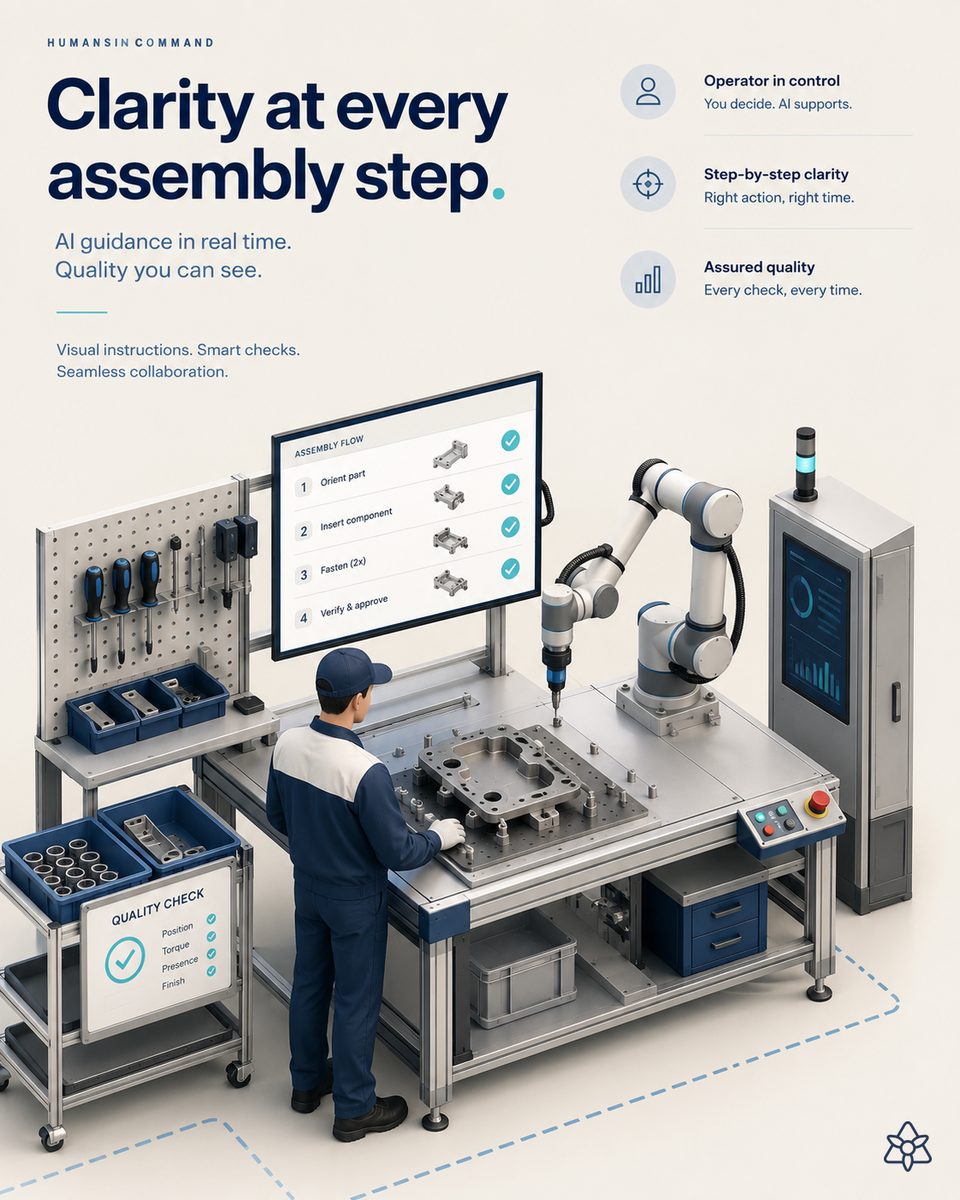
The O-ring is the weak point — and classic systems cannot see it well.
A correctly assembled hydraulic cylinder carries between three and seven O-rings, each in its groove, each with its orientation. Any of them badly fitted ends in the same place: pressure loss. And the failure modes at the station are thoroughly known:
- Absence — an SKU change, a new seal reference, the operator picks the seal from the wrong drawer or, worse, does not pick it at all.
- Twisting — the seal goes into the groove twisted. The operator sees a black ring in place and passes the assembly as good.
- Pinching / extrusion — the seal is left partially out of the channel at closing and gets cut. The part is already sealed. Only the test bench will see it, or the customer.
- The wrong SKU's seal — different thickness or material, valid for a sibling cylinder. It passes the operator's visual inspection; it fails at a hundred hours in the field.
The quality manager knows this. They cover it with the hydraulic test bench and the cylinder's traceability. The bench filters a few in time, but the cylinder is already closed: every failure is rework of dismantling, cleaning, re-greasing and closing again. And the ones that slip past the bench end up at the OEM customer or in the machine in the field. The classic system works 99% of the time. That 1% is the warranty calls and the awkward conversation with the OEM's buyer.
iLEAN does not add a fourth system — it verifies what only the veteran operator knew how to see.
The O-ring problem is not a lack of a test bench: it is that the information arrives late, when the cylinder is already closed. iLEAN acts as the filler that closes that gap between the operator's hand and the press's closing, without asking you to change the station or the ERP.
Edge sees the seal in the groove before closing. Connect cross-checks with the ERP's active SKU and the cylinder's BOM. The agent decides to authorise or inhibit the closing. The person signs off — the press never restarts on its own.
The three iLEAN pieces applied to O-ring verification:
- Edge — a terminal with an industrial camera (with polarised lighting for black seals on a dark groove) and a CNN trained on real samples of your product. It detects presence, twisting, extrusion and reference. It returns OK/NOK by dry contact or OPC-UA to the press's or screwdriver's PLC. It works with no network: if the plant loses its WiFi, Edge keeps verifying and inhibiting the closing.
- Connect — captures the active SKU and the cylinder's BOM from the ERP, and also what arrives from outside (the OEM customer's email with a specification change, the seal manufacturer's alert about a low-quality lot). It brings it to the agent at second zero, without anyone forwarding anything.
- Agent — cross-checks the seal's image with the expected BOM and the active alerts. If it detects a sustained pattern (five twisted seals in one shift = a bad seal lot or an untrained new operator), it does not just inhibit: it alerts the shift leader with a photo and the sequence. The person signs off; the line never restarts on its own.
Manual assembly + test bench vs. iLEAN Vision before closing.
| Aspect | Manual assembly + test bench | With iLEAN Vision (Edge + Connect + Agent) |
|---|---|---|
| Detecting an absent seal | Test bench (cylinder already closed) | Before closing, at the station, in ms |
| Detecting a twisted seal | Sometimes slips past the bench | Detected by silhouette and pattern |
| Detecting an extruded seal | Only in the field | Detected before closing |
| The wrong SKU's seal | Undetected until failure | Cross-checked with the ERP's BOM |
| Cost of a detected failure | Cylinder to dismantling + cleaning | Seal replaced in place |
| Alert to the shift leader | Manual, with the complaint | Sustained pattern → alert with photo |
| File for the auditor (IATF/ISO/EN) | Reconstructed by hand | Photo + decision per unit, automatic |
| No network | n/a | Edge keeps verifying locally |
Impact estimate for your plant — to be validated with your numbers.
The block below is an estimate to be validated with the specific figures of your plant. We set it out so the committee has an order of magnitude; we refine it during the diagnostic.
- A hydraulic cylinder manufacturer for OEMs (mobile machinery, agriculture, industrial), one to several assembly stations, an SKU mix with different seal references.
- Edge pilot at one station (industrial camera with polarised lighting + integration with the closing press or the screwdriver + training the CNN on samples of your product). First expected value within a few weeks.
- Expected reduction in test-bench rework (dismantling + cleaning + new seal) of ≥ 30% over the baseline.
- Indicative payback between 4 and 9 months, depending on the frequency of leaks detected at the test bench and the average warranty cost per field leak.
- The hard lever is a single field leak avoided: warranty, equipment withdrawal, damage to the OEM customer relationship. A single one pays for it with plenty to spare.
And the quality manager's reasonable doubt
"What if the AI gets it wrong and authorises a closing with a bad seal?" — hallucination is a problem of free generation, not of anchored tasks. In tasks where the AI extracts a data point from an image and compares it with a reference (seeing the seal in the groove and comparing it with the SKU's expected image), the best models brought the error below 1.5% [1]. And even so, what is critical is never decided alone: iLEAN inhibits the doubtful closing and the person signs the restart. The three safety rings are there for exactly this.
[1] OpenAI paper "Why Language Models Hallucinate", 2025 — on the reliability of AI in anchored tasks.
What people ask about AI O-ring verification in hydraulic assembly
Why does an O-ring fail in a freshly assembled hydraulic cylinder?
The three typical causes: (1) absence — the operator assembled the cylinder forgetting the seal in the piston's groove, usually because the SKU changed and the seal's reference changed with it; (2) twisting — the seal ended up twisted in the groove during closing and does not seat flat; (3) extrusion / pinching — the seal was left partially outside the channel when the cap closed and got cut. Any of the three passes assembly unnoticed by the operator and shows up at the hydraulic test bench as pressure loss — or, worse, in the field, as the customer's leak.
How does iLEAN Vision verify the O-ring's presence and orientation before closing?
iLEAN Vision installs an Edge terminal with an industrial camera over the assembly station, just before the closing step. The CNN is trained on real samples of your product to recognise: seal present in the channel, seal absent, seal twisted (the black line is not a clean circle), seal partially out of the groove (silhouette deviating from the expected profile) and the wrong SKU's seal (different thickness or colour). The result is returned to the press or the screwdriver in milliseconds — if the seal is not right, closing is not authorised. The person corrects and signs; the station never advances on its own.
Does it work with black seals on a black groove and poor light?
It is classic vision's classic hard case: a black NBR seal on a dark machined groove, with grease and reflections. A rigid vision system needs dedicated lighting and per-SKU thresholds — and still fails when the seal's lot changes. iLEAN Vision gets around the problem because the CNN is trained on your station's real images (including the grease, the workshop's reflections, the operator's shadows) and learns to recognise the seal by silhouette and pattern, not by contrast. For cases of very limited visibility we combine the camera with a polarised light ring — the learning does the rest.
How does it integrate with the closing press or the screwdriver without stopping the station?
iLEAN Vision does not get into the press's or screwdriver's control loop — it lives alongside it. It reads the assembly at the station before closing and returns the result by dry contact or OPC-UA to the station's PLC. If the seal is fine, the press closes; if not, closing is inhibited and the operator receives the dossier (photo, reason, position). The integration with the ERP/MES is via signed file drop between rings: nothing enters the OT network that has not been validated. It works with no network: if the plant loses its WiFi, Edge keeps verifying and inhibiting the closing.
How much does AI O-ring verification cost at a hydraulic assembly station?
The order of magnitude of an Edge pilot at a hydraulic assembly station is close to that of any Edge pilot on a line: an initial investment covering the terminal + industrial camera + integration with the press or the screwdriver + training the CNN on samples of your product, plus an annual licence. The hard lever is a single field leak avoided: warranty, equipment withdrawal, reputational damage with an OEM customer. Every test bench that fires "no pressure" after closing is expensive rework. Send us your plant's data and we will send back the estimated ROI within 48h, with your numbers.
More cases in ilean vision
- Manual malt bag loading at the brewery — the back injury gives no warning, it arrives in week four.iLEAN Vision detects badly executed malt bag lifts at the brewery silo and assists the operator at…
- Defects on melamine board — the scratch you see after the cut is a good part thrown away.iLEAN Vision detects scratches, pores and stains on melamine board before cutting and packing in a…
- Multi-format reading on a 3PL sorter with AI — a "no read" is not a lost parcel, it is one more night operator.iLEAN Vision reads barcode, QR and text at once on a 3PL logistics operator's sorter — without slowing…
- An aisle crossing 1.5 m from the AGV — and the safety stop arrives just in time.iLEAN Vision detects obstacles and operators in AGV/AMR aisles and stops the fleet before impact. An…
- OCR of DOM/EXP on curved cosmetic packaging with AI — the blurry character reaches the shelf, and comes back as a claim.How iLEAN Vision reads DOM/EXP on curved plastic cosmetic packaging with low legibility — cross-checked…
- OCR of heat numbers on hot aluminum ingots with AI — no reading, no traceability; and no traceability, no serious customer.How iLEAN Vision reads the heat number stamped on hot aluminum ingots and cross-checks it with the ERP…
Tell us your case and within 48h we will send you the estimated ROI of this AI project for your hydraulic assembly station.
We work on your plant's real data, not on ours. Diagnostic with no commitment.
Request estimated ROI in 48h See iLEAN Vision