OCR of DOM/EXP on curved cosmetic packaging with AI — the blurry character reaches the shelf, and comes back as a claim.
On a curved, pearlescent plastic cosmetic bottle, classic OCR fails on reflection, contrast and geometry — and a misread or misprinted date leaves the dock all the same. iLEAN Vision reads with a CNN trained in those conditions, cross-checks the reading with the ERP's lot and holds the bottle if it does not add up. The person signs off.
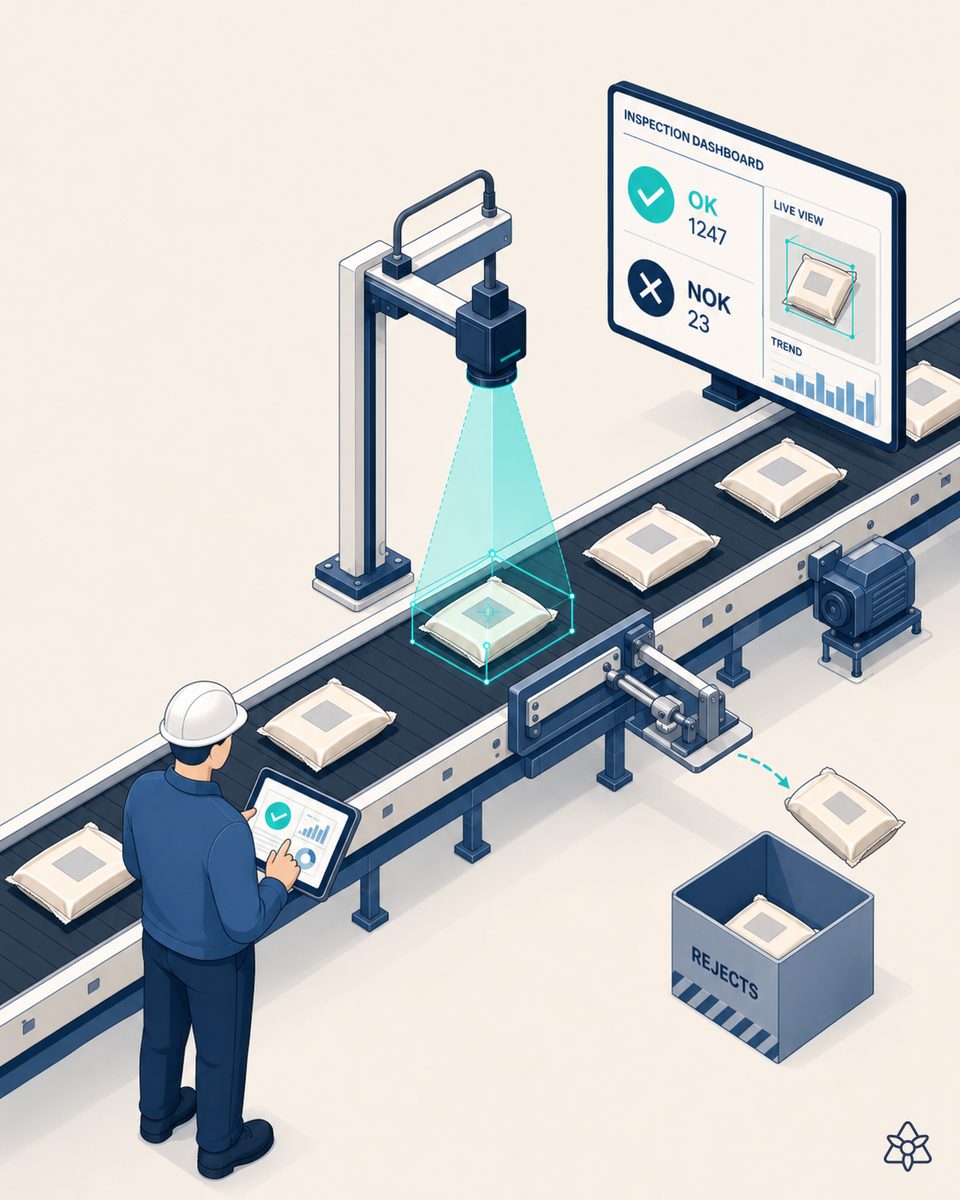
The date is there, but the OCR cannot see it.
On a cosmetics packing line, the manufacturing date (DOM) and the expiry / period-after-opening date (EXP / PAO) are stamped on the packaging by inkjet or laser. The packaging is curved plastic, often pearlescent or metallic, and it moves at speed. Classic OCR, which learned to read flat, contrasted text, collides with three realities:
- Reflection and curvature. Light bounces off the glossy plastic and deforms the character as seen from the camera. What on matte cardboard would be a trivial reading is, on a curved bottle, an angle lottery.
- Low contrast. Inkjet on a pearlescent background leaves a diffuse stroke. Laser on a metallic background burns the plastic just enough to be visible — or not.
- The SKU change. Every reference has its geometry, its stamp position and its date format. Manual calibration does not arrive in time and the first units after a changeover leave without effective verification.
The packing manager knows this, but when classic OCR starts firing "no read" on 5% of units, the plant ends up checking everything manually — and a human at 60 bottles/min does not scale. The classic system works 99% of the time. That 1% is what reaches the retailer as an illegible-date complaint or, worse, as an out-of-date unit on the shelf.
iLEAN Vision does not replace your inkjet — it seals the crack between what is stamped and what OCR can read.
The date-OCR problem is not a lack of information: it is information living in islands (the ERP's lot, the SKU's stamp position, the inkjet's configuration, the optical reading) that, at the critical moment (the bottle passing under the camera), is never cross-checked in time. iLEAN acts as the filler that closes those gaps without asking you to change the inkjet or the line.
Edge sees the date on the packaging. Connect reads the lot and the SKU's position from the ERP. The agent cross-checks with the print history and, if the reading does not fit, holds the bottle. The person signs off — never the other way round.
The iLEAN pieces applied to DOM/EXP OCR on curved packaging:
- iLEAN Vision (Edge) — a terminal with machine vision (CNN) trained on low-contrast stamps on curved plastic, with low-angle or coaxial lighting depending on the packaging. It reads, decodes the format and triggers the actuator (ejector, light signal) in milliseconds. It works with no network. If the plant loses its WiFi, Edge keeps reading and holding.
- Connect — captures from the ERP the lot, the expected manufacturing date and the PAO/EXP formula of each SKU. And it captures from the MES or the inkjet's PLC the actual print configuration (not what the sheet says, what is loaded in the machine).
- Agent — cross-checks the optical reading with the expected lot. If the average confidence drops (a degraded inkjet, a new supplier's plastic, a shifted position), it alerts before the first badly stamped unit reaches the retailer. The person validates and signs; the line never restarts on its own.
Classic OCR vs. ERP-anchored OCR with iLEAN Vision
| Aspect | Classic OCR + manual re-reading | With iLEAN Vision + Connect + Agent |
|---|---|---|
| Low-contrast stamping | Frequent "no read", discard by default | Plant-trained CNN reads even with poor contrast |
| Data validation | Blind optical reading | Cross-check with the ERP's lot, anchored OCR |
| SKU change | Manual zone and format calibration | The SKU's position and format read from the ERP |
| Degraded inkjet | Detected when the complaint arrives | Average confidence drop, early alert |
| Operation with no network | n/a | Edge keeps operating on cabinet power |
| EU 1223/2009 file | Reconstructed by hand per lot | Dossier per unit with a photo of the stamp, automatic |
Impact estimate for your plant — to be validated with your numbers.
The block below is an estimate to be validated with the specific figures of your plant. We set it out so the committee has an order of magnitude; we refine it during the diagnostic.
- A cream line with pearlescent PE bottles, side date inkjet, multi-SKU with weekly format changes and a manual re-reading percentage that weighs on the OEE.
- iLEAN Vision pilot on one line (camera with lighting adapted to the packaging, actuator, integration with the ERP's SKU master). First expected value within a few weeks.
- Indicative payback between 4 and 9 months, depending on the current manual re-reading percentage and the frequency of retailer claims for illegible dates.
- A reduction of units with inconclusive OCR of ≥ 30% over the baseline — the hard lever is a single avoided retailer withdrawal. One serious debit note pays for the pilot.
And the quality manager's reasonable doubt
"What if the AI invents a date that was not stamped properly?" — hallucination is a problem of free generation, not of anchored tasks. When the AI simply recontextualises a data point anchored to the ERP's lot (the date this bottle should carry), the best models brought the error below 1.5% [1]. And even so, what is critical is never decided alone: iLEAN holds the bottle if confidence does not reach the threshold and the person signs off. The three safety rings are there for exactly this.
[1] OpenAI paper "Why Language Models Hallucinate", 2025 — on the reliability of AI in anchored tasks.
What people ask about DOM/EXP OCR on curved cosmetic packaging
Why does classic OCR fail on curved plastic cosmetic packaging?
Classic OCR is designed for a flat image with well-contrasted characters. On a curved cosmetic bottle, light reflects off the plastic, the inkjet or laser leaves a low-contrast stroke on a pearlescent or metallic background, and the curved geometry deforms the character as seen from the camera. The result is intermittent reading, dependent on the bottle's exact position. iLEAN Vision uses a CNN trained on those real conditions, not on the standard flat-OCR dataset.
How does iLEAN Vision read a badly stamped or half-erased date?
Edge does not just read characters: it reads the context. It knows which manufacturing date this lot should carry (because Connect brings it from the ERP) and which format and position the date has on this SKU. If the optical reading returns something doubtful, the agent compares it with the lot's context and, if it fits within a reasonable tolerance, validates it; if it does not fit or confidence is low, it holds the bottle for human inspection. It is OCR anchored to the ERP, not blind OCR.
What if the inkjet fails mid-production and nobody notices?
Edge detects print degradation as a drop in the average reading confidence, not as a binary failure. The agent, seeing the average confidence drop below the lot's threshold, alerts the packing manager before the first complaint reaches quality. The line does not resume in marginal conditions without the person validating the decision.
How does it fit with EU Cosmetics Regulation 1223/2009 and traceability?
EU Cosmetics Regulation 1223/2009 requires product traceability along the supply chain. iLEAN Vision leaves a signed record of every reading (image of the stamp, decoded date, ERP lot, confidence), available as a dossier per unit and per lot. If an authority asks for evidence of when the packaging of a specific series was manufactured, the dossier comes out of the system, not out of the quality manager's manual reconstruction.
How much does an AI OCR pilot cost on a cosmetics line?
The order of magnitude of an Edge pilot on a cosmetics packing line is close to that of any Edge pilot in a plant: an initial investment covering the vision terminal, a camera with lighting suited to the packaging, a rejection actuator and the integration with your ERP/MES, plus an annual licence. The reasonable payback to present to the committee is a matter of several months — the hard lever is a single avoided retailer withdrawal or claim. Send us your plant's data and we will send back the estimated ROI within 48h.
More cases in ilean vision
- Multi-format reading on a 3PL sorter with AI — a "no read" is not a lost parcel, it is one more night operator.iLEAN Vision reads barcode, QR and text at once on a 3PL logistics operator's sorter — without slowing…
- O-ring verification in hydraulic assembly with AI — a twisted seal is not rework, it is a leak at the customer.iLEAN Vision verifies the presence and correct orientation of O-rings in hydraulic cylinders before…
- An aisle crossing 1.5 m from the AGV — and the safety stop arrives just in time.iLEAN Vision detects obstacles and operators in AGV/AMR aisles and stops the fleet before impact. An…
- OCR of heat numbers on hot aluminum ingots with AI — no reading, no traceability; and no traceability, no serious customer.How iLEAN Vision reads the heat number stamped on hot aluminum ingots and cross-checks it with the ERP…
- Repetitive posture control in automotive assembly — the pain arrives before the data, and the data arrives late.iLEAN Vision measures repetitive cycles and forced postures on the automotive final line to rotate…
- RULA / REBA posture control in meat deboning — anticipate the injury before it appears.iLEAN Vision computes RULA/REBA in real time in the meat deboning room to anticipate musculoskeletal…
Tell us your case and within 48h we will send you the estimated ROI of this AI project for your cosmetics line.
We work on your plant's real data, not on ours. Diagnostic with no commitment.
Request estimated ROI in 48h See iLEAN Vision