RULA / REBA posture control in meat deboning — anticipate the injury before it appears.
In a meat deboning room, the musculoskeletal injury does not arrive as a blow: it arrives as a hundred hours of flexed wrist that nobody measured. iLEAN Vision computes RULA and REBA in real time at every station and alerts the shift leader when it enters the risk zone. The prevention person adjusts the station — the operator does not endure it alone.
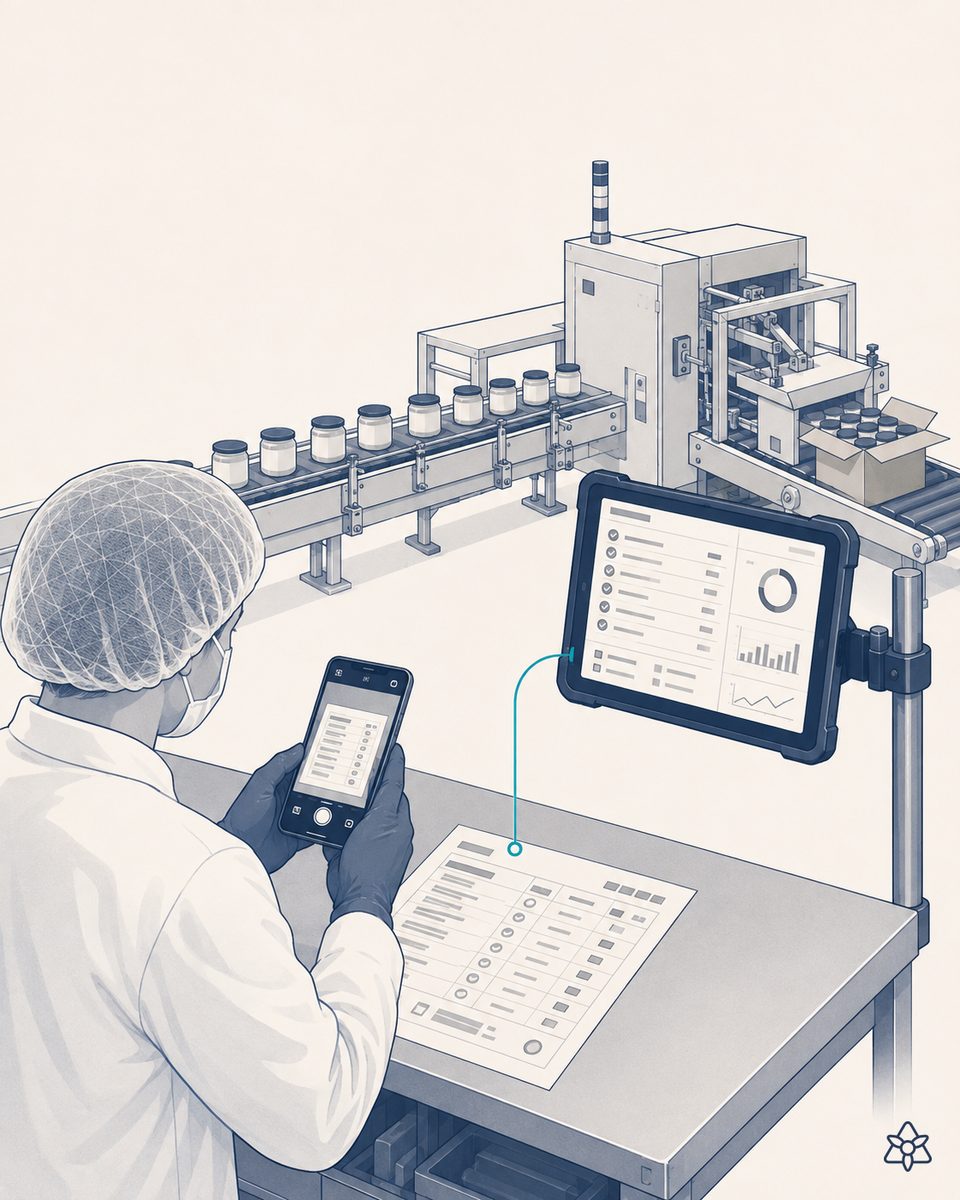
The injury that arrives as an accumulated dose — and the ergonomic assessment that arrived late.
In a meat deboning room, the operator makes the same gesture thousands of times per shift. The room sets the stations at a reasonable height, the prevention officer comes through with the template every quarter, and still the musculoskeletal injuries (MSD) arrive. Why?
- The load is accumulated — the posture "in one photo" can be fine, but four hours of flexed wrist holding a 1.2 kg piece no longer is.
- The assessment is periodic — the officer measures one day; the operator has been like this for three months since the last cutting-menu change.
- Rotation depends on judgement — the shift leader proposes it if they remember and if the roster allows; at campaign peak, there is no way.
The result is well known: the musculoskeletal injury is the most frequent occupational disease in deboning, and the company pays the cost years later through benefits surcharges, station adaptations or replacement by early retirement. The classic system acts when the injury is already there. What changes with industrial AI is that the accumulated dose is measured continuously, before the injury.
iLEAN does not replace the prevention officer — it gives them a continuous ergonomic assessment they could never sustain alone.
The problem with posture control is not a lack of method: RULA and REBA have been validated for decades. The problem is that the measurement lives in one person who physically cannot be at every station every hour. iLEAN acts as the filler that closes that gap, without asking you to change the room, the roster or the prevention system. See the category: full IRIS architecture.
Edge computes RULA and REBA continuously at every station. Connect reads the roster and the assessment procedure. The agent proposes rotation or adjustment to the shift leader. The person decides — never the other way round.
The three iLEAN pieces applied to posture control in meat deboning:
- iLEAN Vision (Edge) — one or several terminals with IP69K cameras at each critical station. The CNN extracts the operator's skeleton and calculates the RULA/REBA angles continuously. No facial recognition: the camera looks at the station, not at the person. It works with no network: Edge keeps measuring even if the line goes down, and synchronises when it comes back.
- Connect — captures the shift roster (which station each operator occupies), the prevention service's ergonomic-assessment procedure and the thresholds agreed with the health and safety committee. It also captures any change communicated through the supervisor's WhatsApp or the operator's own app.
- Agent — integrates the accumulated dose per station and, if it enters a zone of sustained risk, proposes concrete options to the shift leader: rotation with another station, table-height adjustment, knife check. The system assists; the shift leader and the prevention officer decide. And at the end of the shift, it leaves an ergonomic report per station, useful for the next assessment.
Periodic ergonomic assessment vs. continuous posture control with iLEAN Vision
| Aspect | Quarterly visit from the prevention officer | With iLEAN Vision + Connect + Agent |
|---|---|---|
| Coverage | One visit per quarter, station by station | Continuous RULA/REBA computation at every station, all shift |
| Accumulated-dose measurement | Qualitative estimate | Integration of angles per minute across the shift |
| Alert to the shift leader | After-the-fact report | Alert when a station enters a sustained red zone |
| Rotation proposal | General procedure | Concrete proposal with the MES roster in hand |
| Report for the prevention service | Manual template per station | Automatic ergonomic report per station and shift |
| Operator privacy | n/a | No facial recognition; analysis per station, not per person |
Impact estimate for your plant — to be validated with your numbers.
The block below is an estimate to be validated with the specific figures of your plant. We set it out so the committee has an order of magnitude; we refine it during the diagnostic.
- Deboning or cutting room with 15-30 repetitive stations, quarterly ergonomic assessment, a documented history of wrist, elbow or shoulder MSD.
- Edge pilot at 3-5 critical stations (IP69K cameras + integration with the shift roster and the prevention system). First expected value within a few weeks: a continuous ergonomic report per station.
- Indicative payback between 4 and 9 months, depending on the number of stations covered and the documented cost of MSD leave in recent years.
- Expected reduction in exposure time to risk postures of ≥ 30% versus the previous quarterly control, with a floor that is reasonably defensible before the committee.
- The hard lever is one long MSD leave avoided and/or one benefits surcharge avoided — the cost of a benefits surcharge for an out-of-date ergonomic assessment is what burns most in the P&L over several years.
And the prevention manager's reasonable doubt
"What if the AI measures the angles wrong and we alert over things that are not real?" — hallucination is a problem of free generation, not of anchored tasks. In tasks where the AI simply extracts the operator's skeleton and calculates joint angles with validated RULA/REBA templates, the best models brought the error below 1.5% [1]. And even so, the alert is a proposal, not an order: the shift leader and the prevention officer decide. The three safety rings are there for exactly this.
[1] OpenAI paper "Why Language Models Hallucinate", 2025 — on the reliability of AI in anchored tasks.
What people ask about RULA/REBA posture control in meat deboning
What are RULA and REBA and why do they matter in the deboning room?
RULA (Rapid Upper Limb Assessment) and REBA (Rapid Entire Body Assessment) are validated ergonomic methods that assign the station a score based on the angles of trunk, neck, shoulder, elbow and wrist and the sustained load. The higher the score, the more urgent the station adjustment. In a meat deboning room, the operator repeats the same gesture thousands of times per shift — and musculoskeletal injuries do not arrive as a blow: they arrive as a hundred hours of flexed wrist that nobody measured. The classic assessment is periodic (one visit from the prevention officer per quarter). What iLEAN adds is making it continuous, at every station, all shift long.
How does iLEAN Vision compute the RULA/REBA posture in real time?
With an Edge terminal and a camera aimed at the station. The vision neural network (CNN) extracts the operator's skeleton — pose estimation with key points (shoulder, elbow, wrist, hip, knee) — with no facial recognition. From the skeleton, it calculates the joint angles defined by the RULA and REBA templates and integrates them across the shift: not the posture "in one photo", but the posture "held for so many minutes". When a station enters the red zone (sustained high score), it alerts the shift leader to consider rotation or adjustment.
Does the system recognise faces or track operators individually?
No. iLEAN Vision does no facial recognition and does not tie the data to the operator's identity in its records — the analysis is done per station and per shift, not per person. The system looks at the station and measures the station's posture. When the shift leader needs to identify someone (because the person wants to rotate, or because prevention wants to reassign the station), they do it with the MES roster, not with the camera. The goal is to protect the operator, not to subject them to continuous individual control.
What kind of alert does the shift leader receive, and when?
Connect delivers the alert to the shift leader through whichever channel they use (earpiece, app, the room's control panel). It is not a daily email full of numbers: it is an alert when a station enters a zone of sustained postural risk. The agent proposes options — rotate the operator, adjust the table height, check the knife — and the shift leader decides. The system never rotates people by itself; the person always decides that. And at the end of the shift, it leaves an ergonomic-load report per station, useful for the prevention service.
What saving does anticipating a musculoskeletal injury generate?
In Spain, the musculoskeletal injury is the most frequent occupational disease in sectors with repetitive cutting and deboning. Every long leave (carpal tunnel syndrome, epicondylitis, shoulder tendinitis) means salary on leave, cover for a specialised station, a possible benefits surcharge if the ergonomic assessment was out of date, and the possibility of a station adaptation. Anticipating the rotation or the adjustment before the operator reaches the prevention service changes the annual cost. Send us your plant's data and we will send back the estimated ROI within 48h with your numbers.
More cases in ilean vision
- OCR of DOM/EXP on curved cosmetic packaging with AI — the blurry character reaches the shelf, and comes back as a claim.How iLEAN Vision reads DOM/EXP on curved plastic cosmetic packaging with low legibility — cross-checked…
- OCR of heat numbers on hot aluminum ingots with AI — no reading, no traceability; and no traceability, no serious customer.How iLEAN Vision reads the heat number stamped on hot aluminum ingots and cross-checks it with the ERP…
- Repetitive posture control in automotive assembly — the pain arrives before the data, and the data arrives late.iLEAN Vision measures repetitive cycles and forced postures on the automotive final line to rotate…
- Tablet counting in blisters with AI — the aluminium closes the blister in milliseconds; an under-dose only shows up when the patient opens it.How iLEAN Vision counts and verifies the shape of every tablet in the pharma blister before aluminium…
- Starting injection with the wrong tooling after a reference change — and not finding out until the first quality check.iLEAN Vision reads the injection mold's insert and cavity block and confirms the reference before…
- Twist-off cap verification in canning with AI — a tilted cap at 300 jars/min is not a failure, it is a burst in the autoclave.iLEAN Vision detects a missing or badly positioned twist-off cap on a canning line at over 300 jars/min…
Tell us your case and within 48h we will send you the estimated ROI of this AI project for your deboning room.
We work on your plant's real data, not on ours. Diagnostic with no commitment.
Request estimated ROI in 48h See iLEAN Vision