Twist-off cap verification in canning with AI — a tilted cap at 300 jars/min is not a failure, it is a burst in the autoclave.
Modern canning lines exceed 300 jars per minute — an inductive sensor sees metal, but not whether the cap is threaded the wrong way, tilted or overlapping the previous lot's. iLEAN Vision does. It detects the absent or badly positioned twist-off in milliseconds, ejects the jar before the steriliser and leaves the SKU-change sign-off to the person. The line never restarts on its own.
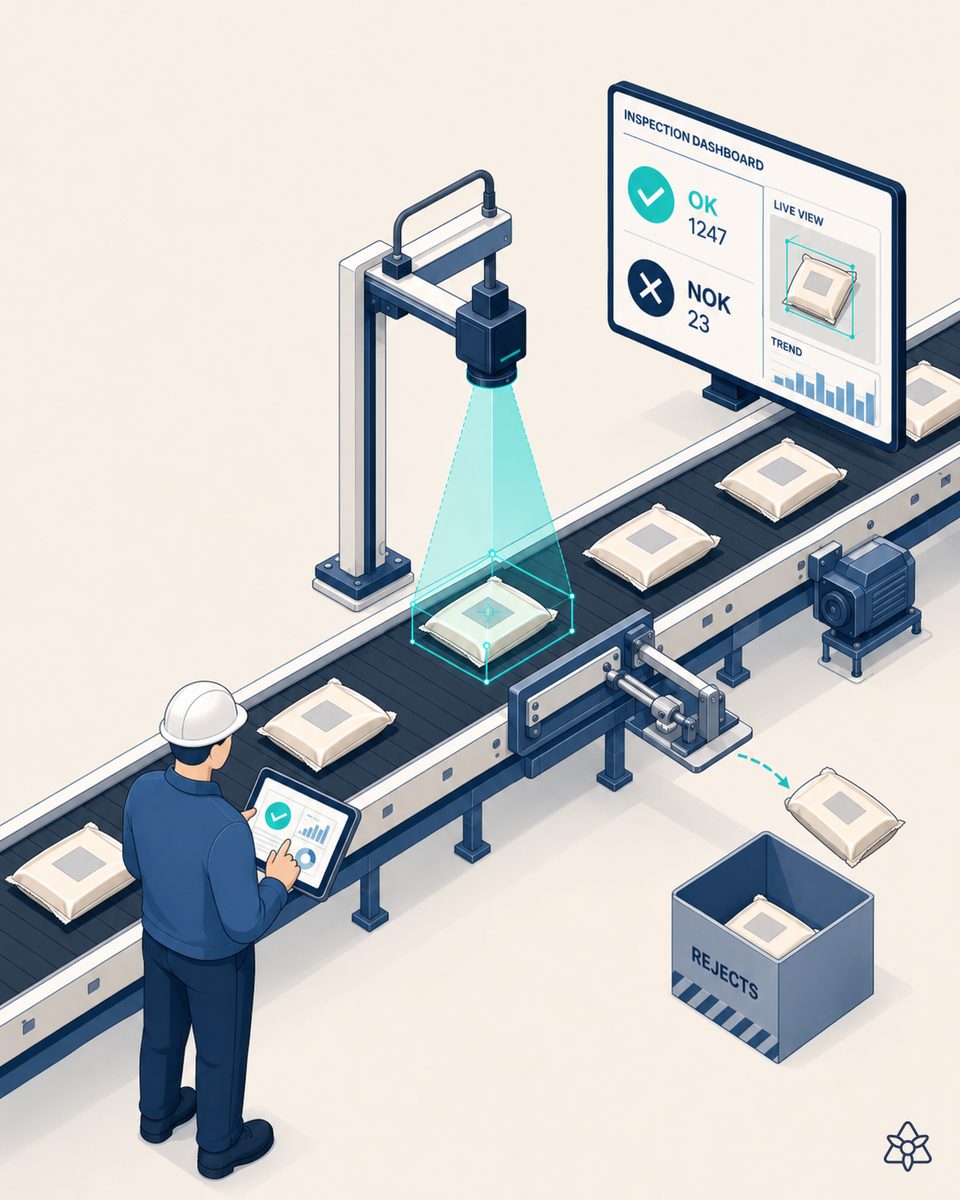
The inductive sensor only says "there is metal". The AI camera says "it is right".
On a canning line at 300 jars/min, the closing head fits twist-off caps at five per second. Most come out fine. Some do not:
- Absent cap — the head failed, the jar came out without a cap. The inductive sensor sees it. So far, no problem.
- Tilted or cross-threaded cap — the cap is there, there is metal, the inductive sensor passes it. It reaches the autoclave and, as the temperature rises, the closure gives way.
- Overlapping double cap — two caps snag on the head and come down together onto the jar. Plenty of metal. The sensor is happy. The line is not.
- The previous lot's cap — an SKU change, a mix of caps with a different lithography. The inductive sensor cannot tell lithographies apart. The jar reaches the consumer with the wrong brand.
The quality manager knows this. They cover it with manual sampling at the end of the shift and by crossing their fingers. The classic system works 99% of the time. That 1% is the swollen jars in the autoclave or the distributor's complaints — and in canning, an incident with a defective closure is not a phone call, it is a recall.
iLEAN does not add a fourth system — it seals the crack between the closing head and the autoclave.
The twist-off problem is not a lack of information: it is partial information (the inductive sensor sees metal, not position) reaching the autoclave with no visual verification. iLEAN acts as the filler that closes that gap, without asking you to change the canning machine or the SCADA.
Edge sees the cap on the head's outfeed belt. Connect reads the active SKU from the MES and the cap supplier's notices. The agent cross-checks reference, lithography and position. If something does not add up, it ejects before the autoclave and the person signs the restart.
The three iLEAN pieces applied to twist-off verification:
- Edge — a terminal with an industrial camera and a CNN trained on real samples from your line. It detects the cap's presence, orientation, alignment, overlap and lithography in milliseconds. It triggers the ejector by dry contact before the steriliser. It works with no network: if the plant loses its WiFi, Edge keeps verifying and ejecting.
- Connect — captures the active SKU from the MES, the lot's recipe from the ERP, and also what arrives from outside (the cap supplier's email about a lithography supplier change, the shift leader's WhatsApp with a production-order change). It brings it to the agent at second zero, without anyone forwarding anything.
- Agent — cross-checks the cap's image with the active SKU and the expected lithography. If it detects a sustained pattern (three tilted caps in five minutes = a misadjusted head), it does not just eject: it alerts maintenance with a photo and the position. The person signs the restart; the line never restarts on its own.
Classic inductive sensor vs. iLEAN Vision on canning closure.
| Aspect | Inductive sensor + sampling | With iLEAN Vision (Edge + Connect + Agent) |
|---|---|---|
| Absent cap | Detected | Detected and ejected in line |
| Tilted or cross-threaded cap | Not detected | Detected by visual orientation |
| Overlapping double cap | Not detected | Detected by height/silhouette analysis |
| Cap with the wrong lithography | Not detected | Cross-checked with the MES's active SKU |
| Reaction | Jars to the autoclave; later sampling | Ejection before the steriliser in ms |
| Alert to maintenance | Manual, with the operator's complaint | Sustained pattern → automatic alert with photo |
| No network | n/a | Edge keeps verifying and ejecting locally |
Impact estimate for your plant — to be validated with your numbers.
The block below is an estimate to be validated with the specific figures of your plant. We set it out so the committee has an order of magnitude; we refine it during the diagnostic.
- Canning plant (vegetables, fish, pulses) with one or several twist-off lines, throughput between 250 and 600 jars/min, multi-SKU with frequent lithography changes.
- Edge pilot on one line (industrial camera over the closing head's outfeed belt + pneumatic ejector + integration with the MES). First expected value within a few weeks.
- Expected reduction in defective caps reaching the autoclave of ≥ 30% over the baseline, depending on the throughput and the closing head's condition.
- Indicative payback between 4 and 9 months, depending on the frequency of incidents documented in recent years and the average cost of a stop from a jar bursting in the autoclave.
- The hard lever is a single avoided recall for a defective closure: product recovered from the shelf, reverse transport, destruction, brand damage. A single one pays for it with plenty to spare.
And the quality manager's reasonable doubt
"What if the AI gets it wrong and lets a badly closed jar through?" — hallucination is a problem of free generation, not of anchored tasks. In tasks where the AI extracts a data point from an image and compares it with a reference (seeing the cap and comparing it with the expected thread), the best models brought the error below 1.5% [1]. And even so, what is critical is never decided alone: iLEAN ejects the doubtful jar and the person signs the restart. The three safety rings are there for exactly this.
[1] OpenAI paper "Why Language Models Hallucinate", 2025 — on the reliability of AI in anchored tasks.
What people ask about AI twist-off verification in canning
Why isn't an inductive sensor enough to verify twist-off caps at high speed?
An inductive sensor detects the presence of metal; it does not detect orientation, a crossed thread, or a cap fitted the wrong way round. At 300 jars/min, a badly positioned cap passes the sensor (there is metal) and reaches the steriliser. There the heat lifts the badly threaded cap, the product is contaminated, the jar bursts in the autoclave or, worse, reaches the consumer with a defective closure. iLEAN Vision does look at how the cap sits — orientation, alignment with the mouth, absence of an overlapping double cap — because the camera sees the piece with the same judgement as an expert operator, but at belt speed.
How does AI twist-off inspection work on a canning line at 300 jars/min?
iLEAN Vision installs an Edge terminal with an industrial camera and a CNN trained on thousands of real samples from your line: cap present and well threaded, cap absent, tilted cap, cap from the previous lot with a different lithography, overlapping cap. The CNN classifies in milliseconds and, on a NOK, triggers a pneumatic ejector before the steriliser. The operator receives the ejected unit's dossier (photo + classification + position). The line keeps its pace — the NOK jar leaves the main flow, it never mixes with the OK ones.
What about SKU changes and caps with a different lithography?
The SKU change in canning is one of the most vulnerable moments: new jar, new cap, new label, and the operator juggling three references at once. iLEAN Vision cross-checks the active reference from the MES or the ERP with the lithography the camera sees — if the schedule says "sardines in oil SKU" but the arriving cap belongs to the previous lot of tuna in marinade, the agent holds the line before the first sealed jar. The system never restarts on its own: the plant manager signs the SKU change and the line starts.
How does it integrate with the canning machine without stopping it?
iLEAN Vision does not get into the canning machine's control loop — it lives alongside it. It reads the jar on the closing head's outfeed belt, decides OK / NOK by dry contact to the ejector and records the event via OPC-UA to the MES. The integration with the ERP/SCADA is via signed file drop between security rings: nothing enters the OT network that has not been validated and signed. If the AI goes down, the canning machine continues (with the classic inductive sensor as backup); if the machine goes down, the AI keeps recording the event line. It works with no network: Edge keeps verifying even if the plant loses the corporate WiFi.
How much does AI twist-off verification cost on a canning line?
The order of magnitude of an Edge pilot on a canning line is close to that of any Edge pilot in a food plant: an initial investment covering terminals + cameras + ejector + integration with the MES, plus an annual licence. The hard lever is a single avoided autoclave burst: a shift stop, cleaning the steriliser, potential damage to the autoclave's closure, a possible recall if the jar reached the consumer. A single one pays for it with plenty to spare. Send us your plant's data and we will send back the estimated ROI within 48h, with your numbers.
More cases in ilean vision
- RULA / REBA posture control in meat deboning — anticipate the injury before it appears.iLEAN Vision computes RULA/REBA in real time in the meat deboning room to anticipate musculoskeletal…
- Tablet counting in blisters with AI — the aluminium closes the blister in milliseconds; an under-dose only shows up when the patient opens it.How iLEAN Vision counts and verifies the shape of every tablet in the pharma blister before aluminium…
- Starting injection with the wrong tooling after a reference change — and not finding out until the first quality check.iLEAN Vision reads the injection mold's insert and cavity block and confirms the reference before…
- Unit counting per tray in nuts with AI — the half-empty tray ships like the full one, and the customer notices.How iLEAN Vision counts units per tray and detects under-filling in a bulk nut plant — without stopping…
- Coffee capsule sealing defects — the customer discovers them in their kitchen, and returns the lot.iLEAN Vision detects deformed capsules and faulty sealing on a high-speed single-serve coffee capsule…
- Aluminum coil for beverage cans with AI — the pinhole shows on the strip, not at the filler.iLEAN Vision detects pinholes, stains and scratches on aluminum coil before beverage-can cupping — the…
Tell us your case and within 48h we will send you the estimated ROI of this AI project for your canning line.
We work on your plant's real data, not on ours. Diagnostic with no commitment.
Request estimated ROI in 48h See iLEAN Vision