Tablet counting in blisters with AI — the aluminium closes the blister in milliseconds; an under-dose only shows up when the patient opens it.
Aluminium sealing closes the blister in milliseconds; a broken tablet, a missing one or one with a shape outside tolerance leaves with the batch and is only discovered when a patient opens the box. iLEAN Vision reads every cavity before sealing, counts, verifies the real geometry of the tablet and holds the blister back if something does not add up. The person signs.
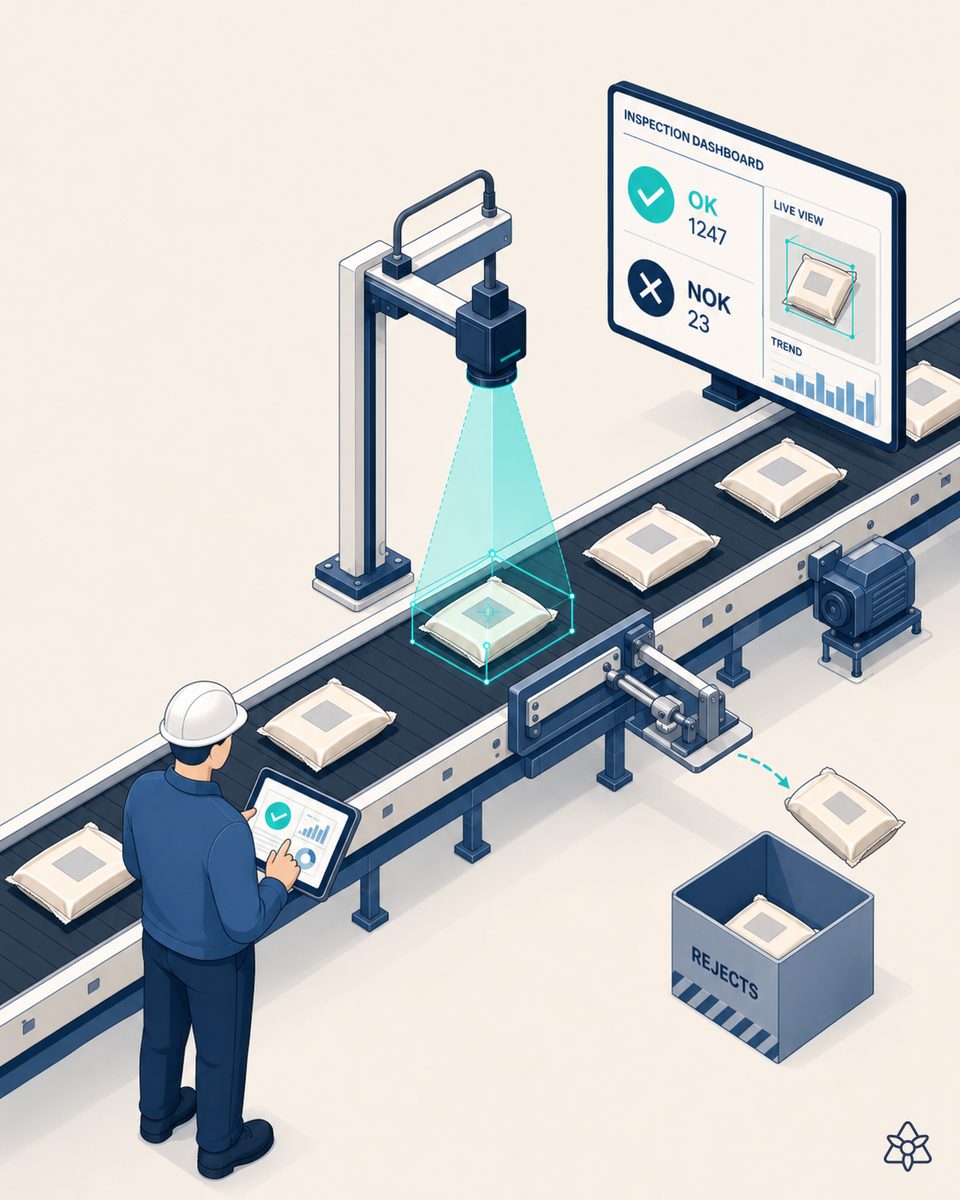
Counting tablets is not the problem; verifying that each one is intact is.
On a PVC/Alu or Alu/Alu blister line, the tablet drops from the feeder, fills the cavity and passes under the top foil. Between the feeder and the sealing station there are, depending on speed, a few tenths of a second. In that window someone has to decide whether the blister goes to market or is held back.
- Classic counting measures presence, not shape. A capacitive sensor or an optical barrier detects whether there is material; it does not tell an intact tablet from a broken one, nor a complete tablet from one with a chip on the edge caused by friction in the feeder.
- Weight control on the closed blister arrives too late. By the time the scale says the blister is underweight, the aluminium is already sealed: the whole blister goes to destruction, and the good tablet next to it is not recovered.
- The SKU changeover multiplies blind spots. Every format has its calibration table; when it is updated in a spreadsheet that never reaches the line, the first run of the new SKU passes with the tolerances of the previous one — and nobody sees it until quality sampling.
The packaging manager knows this, but cannot read 300 blisters/min with the naked eye. The classic system works 99% of the time. That 1% is the one that ends up in the adverse-event file — and each one costs what it costs to pull a whole batch out of the channel.
iLEAN Vision does not replace your scale or your sensor — it seals the gap between what they see and what a patient sees when opening the box.
The problem with tablet counting is not a lack of information: it is information living on islands (feeder sensor, blister scale, SKU table, operator record) that, at the critical moment (the fraction of a second before sealing), does not reach the person deciding in time. iLEAN acts as the filler that closes those gaps without asking you to change your blister machine or your thermoformer.
Edge sees the geometry of the tablet in every cavity. Connect reads the batch recipe and the SKU tolerance table. The agent cross-checks against the line history and, if something does not add up, holds the blister back. The person signs — never the other way round.
The iLEAN pieces applied to tablet count and shape in blisters:
- iLEAN Vision (Edge) — a terminal with machine vision (CNN) and a high-speed camera over the blister, before sealing. It reads every cavity, counts, verifies geometry (diameter, score line, bevel) and fires the actuator (ejector, failed-blister mark) in milliseconds. It works with no network. If the plant loses WiFi, Edge keeps reading and holding blisters back, because what is critical cannot depend on connectivity.
- Connect — captures the batch recipe and the SKU tolerance table, whether it comes from the ERP, from the vertical pharma MES, or from the master spreadsheet the validation manager keeps updating. And it captures what arrives from outside (a change of tablet supplier, a regulatory adjustment from the importer) at second zero, without anyone forwarding anything.
- Agent — cross-checks the blister reading against the recipe, the line history, the feeder deviations and the CSV validation plan. If there is a chipping pattern, it does not wait for quality sampling: it alerts the packaging manager and drafts the deviation note. The person validates and signs; the line does not restart on its own.
Classic counting vs. shape verification with iLEAN Vision
| Aspect | Sensor + blister scale | With iLEAN Vision + Connect + Agent |
|---|---|---|
| What is measured | Presence / aggregate weight | Real geometry of every tablet |
| Chipped tablet | Passes within weight tolerance | Detected by shape, blister held back |
| SKU changeover | Manual calibration, first run at risk | SKU table read from the ERP, no manual step |
| Error detection | Quality sampling or pharmacy complaint | Before sealing, in line, in milliseconds |
| Operation without network | n/a | Edge keeps operating on panel power |
| CSV / Annex 11 file | Rebuilt by hand for each batch | Dossier per failed blister, automatic, with a photo of the cavity |
Impact estimate for your plant — to be validated with your numbers.
The block below is an estimate to be validated with the actual data of your plant. We put it forward so the committee has an order of magnitude; we refine it during the diagnostic.
- Generic-pharma PVC/Alu blister line, multi-SKU with weekly format changeovers, scored tablets that tend to chip in the feeder.
- iLEAN Vision pilot on one line (high-speed camera over the blister, reject actuator, integration with the SKU table in the ERP/MES). First value expected within a few weeks.
- Indicative payback between 4 and 9 months, depending on the frequency of documented incidents and the average cost of a recall or a rework for under-dosing.
- Reduction of undetected defective blisters ≥ 30% against the baseline — the hard lever is one single recall avoided. One batch pulled from the channel pays for the pilot.
And the fair doubt of the quality manager
«What if the AI gets it wrong and lets a badly formed blister through?» — hallucination is a problem of free generation, not of anchored tasks. In tasks where the AI simply compares an image against a known pattern (the geometry of the batch tablet), the best models brought the error below 1.5% [1]. And even then, what is critical is not decided alone: iLEAN holds the blister and the person signs. The three safety rings are there for exactly this.
[1] OpenAI paper "Why Language Models Hallucinate", 2025 — on the reliability of AI in anchored tasks.
What people ask about tablet counting in blisters with AI
Why do classic tablet counts in blisters fail?
Classic counts by weight, by capacitive sensor or by optical barrier measure presence, not shape. A broken tablet weighs less but not zero — it falls inside tolerance. A tablet eroded at the edge by the feeder speed can pass the threshold. And the SKU changeover multiplies false alarms because calibration tables are not always updated. iLEAN Vision reads the geometry of the tablet, not its weight, and that is why it sees what the scale cannot see.
How does iLEAN Vision tell a broken tablet from a well-formed one?
Edge is a terminal with machine vision (CNN) trained on the real geometry of the tablet — diameter, score line, bevel, colour. It reads the blister cavity in the fraction of a second before the aluminium foil comes down, compares the shape against the batch pattern and, if it finds a fracture, a chip or an empty cavity, it fires the actuator before sealing. It is the same jidoka principle applied to powder coating in automotive: catch the defect while it can still be recovered.
What happens if the plant loses the network during packaging?
Edge keeps running. The terminal has the CNN loaded locally and a minimal inference agent that needs no connection to detect defects and hold blisters back. If the plant loses Internet, WiFi and the link to the ERP, the critical loop (see → decide → eject) keeps turning as long as the device has power. What is critical cannot depend on the network being up.
Is it compatible with GMP / Annex 11 and CSV validation?
Yes. The three-ring architecture of iLEAN is designed precisely for environments where human validation of critical operations is mandatory. Ring 1 (the OT network with the validated machines) accepts nothing that does not arrive packaged and signed from ring 2; inference records, model traceability and hold logs are available as audit evidence. The system can run in «mandatory human validation» mode without touching a line of code.
How much does an Edge pilot on a blister line cost?
The order of magnitude of an Edge pilot on a pharma packaging line is close to that of any Edge pilot in a plant: an initial investment covering terminals, high-speed cameras over the blister, the reject actuator and integration with your ERP/MES, plus an annual licence. A reasonable payback to present to the committee is several months — the hard lever is one single recall avoided: a full batch pulled back from the market for under-dosing costs more than the pilot. We ask for your plant data and send you the estimated ROI within 48h.
More cases in ilean vision
- OCR of heat numbers on hot aluminum ingots with AI — no reading, no traceability; and no traceability, no serious customer.How iLEAN Vision reads the heat number stamped on hot aluminum ingots and cross-checks it with the ERP…
- Repetitive posture control in automotive assembly — the pain arrives before the data, and the data arrives late.iLEAN Vision measures repetitive cycles and forced postures on the automotive final line to rotate…
- RULA / REBA posture control in meat deboning — anticipate the injury before it appears.iLEAN Vision computes RULA/REBA in real time in the meat deboning room to anticipate musculoskeletal…
- Starting injection with the wrong tooling after a reference change — and not finding out until the first quality check.iLEAN Vision reads the injection mold's insert and cavity block and confirms the reference before…
- Twist-off cap verification in canning with AI — a tilted cap at 300 jars/min is not a failure, it is a burst in the autoclave.iLEAN Vision detects a missing or badly positioned twist-off cap on a canning line at over 300 jars/min…
- Unit counting per tray in nuts with AI — the half-empty tray ships like the full one, and the customer notices.How iLEAN Vision counts units per tray and detects under-filling in a bulk nut plant — without stopping…
Tell us about your case and within 48h we'll send you the estimated ROI of this AI project for your blister line.
We work on the real data of your plant, not ours. Free diagnostic, no strings attached.
Request estimated ROI in 48h See iLEAN Vision