Repetitive posture control in automotive assembly — the pain arrives before the data, and the data arrives late.
On the automotive final line the same arms make the same flexion 1,200 times per shift — and the damage shows when it is already too late. iLEAN Vision sees the cycles and postures in real time, alerts the shift leader when a station calls for rotation, and leaves the decision with the person. It does not automate the change: it simplifies it.
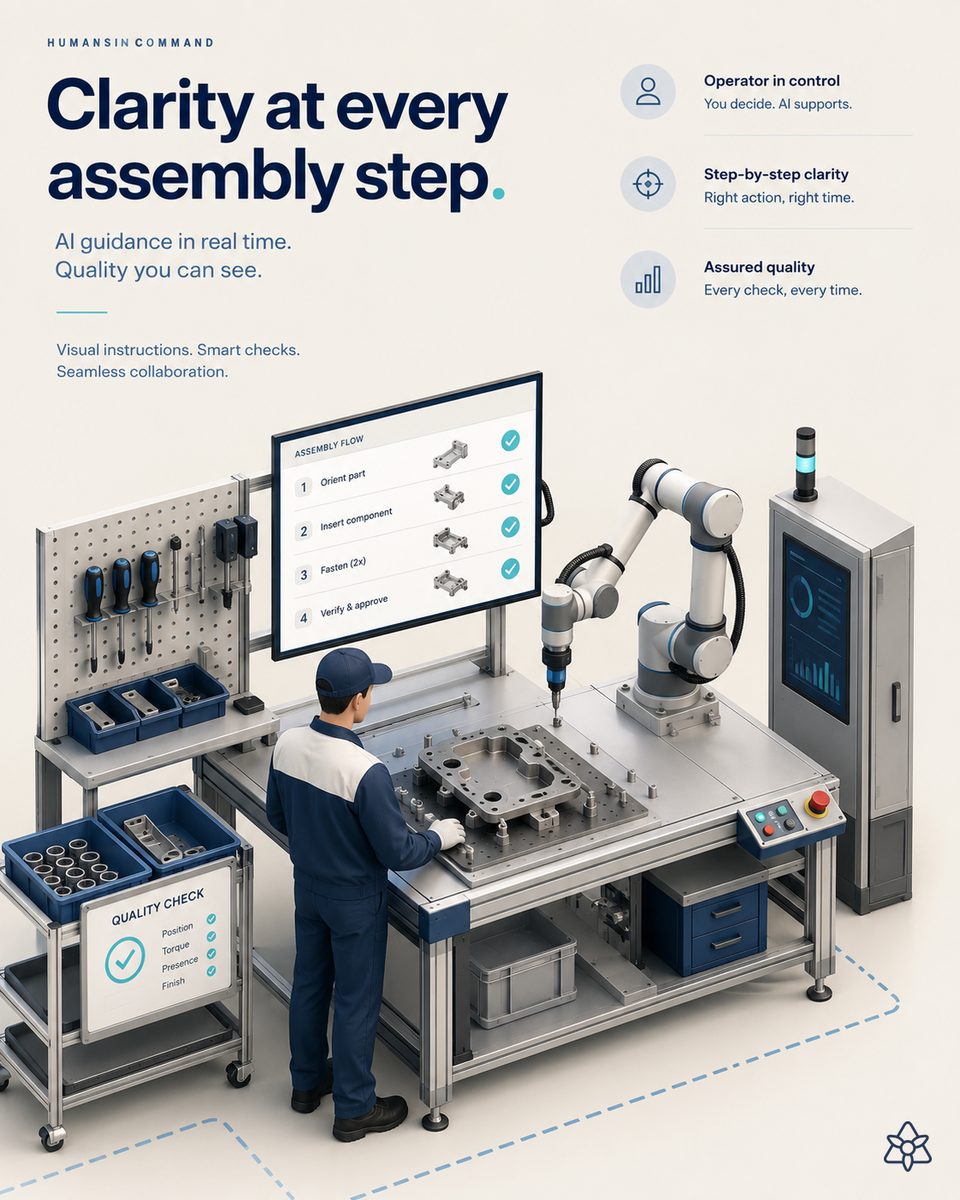
The musculoskeletal disorder does not arrive by surprise — it arrives because nobody was counting.
The musculoskeletal disorder (MSD) is the leading cause of sick leave in automotive final assembly. And it does not arrive by surprise: it arrives because the station rotation was decided in a versatility matrix drawn up months ago, with no idea of what was happening on the line this week.
- Cycles climb without anyone recording it. A line-rate change, a new part that demands more insertion effort, a tool that has gone stiff — the operator adapts without a word, and the data exists in no system.
- Postures drift without anyone scoring them. A part arriving on a lower pallet forces 200 extra trunk flexions per shift. Nobody measures it, everybody feels it after three weeks.
- Rotation is planned with Monday's spreadsheet. By the time Friday arrives and a station has accumulated ergonomic debt, it is already late — the rotation that was due on Wednesday never happened, and the following Monday someone goes on leave.
The shift leader knows this, but cannot be at all fourteen stations at once with a stopwatch and a goniometer. The classic system (team leader + observation + common sense) works 90% of the time. The remaining 10% is next Monday's sick leave — and the next, and the next, until the line loses the people who know.
iLEAN does not replace the shift leader — it gives them the data the plant was not recording.
The problem with repetitive posture control is not a lack of goodwill: it is information living in islands (stopwatches, informal observation, ergonomic matrices drawn up once a year) that, at the critical moment, does not reach the person who decides to rotate. iLEAN acts as the filler that closes that gap, without asking you to change the MES, the versatility matrix or the ergonomic methodology you already work with.
Vision sees the cycle and the posture. Connect cross-checks with the versatility matrix. The agent proposes the rotation to the shift leader. The person signs off — never the other way round.
The three iLEAN pieces applied to repetitive posture control in assembly:
- iLEAN Vision (Edge) — a terminal with machine vision (CNN) over the station. It processes the video locally, extracts the operator's silhouette, counts cycles and scores postures against RULA / REBA / OCRA. It records no faces, sends no image to the cloud. It works with no network: if the plant loses its WiFi, Edge keeps counting cycles and saving the data.
- iLEAN Connect — reads the versatility matrix and the planned rotation from the MES or from the team leader's spreadsheet. And it captures what arrives from outside: the insurer's report, the HR notice about an MSD case, the union delegate's WhatsApp asking for a station review. Everything enters the system at second zero.
- iLEAN Agents — cross-checks counted cycles, scored postures, planned rotation, and the ergonomic debt accumulated per station since the last change. If a station has crossed the threshold, it does not send an email at 10pm: it alerts the shift leader through whichever channel they use (phone, earpiece, tablet) with an argument and data. The shift leader validates, signs the rotation and the line continues.
Rotation by matrix vs. rotation with iLEAN Vision
| Aspect | Versatility matrix + observation | With iLEAN Vision + Connect + Agent |
|---|---|---|
| Cycle count per station | Estimated from the theoretical rate | Actual cycles counted frame by frame |
| Ergonomic scoring | External audit once a year | RULA / REBA / OCRA in real time, per station |
| Part or rate change | Discovered when the complaints arrive | The load delta shows in the first shift's data |
| Rotation decision | Monday's spreadsheet, no Wednesday data | Alert to the shift leader when the debt grows |
| Operator privacy | n/a | Local processing, silhouette yes, face no |
| File for insurer or ISO 45001 auditor | Reconstructed by hand | Dossier per station with quantitative data |
Impact estimate for your plant — to be validated with your numbers.
The block below is an estimate to be validated with the specific figures of your plant. We set it out so the committee has an order of magnitude; we refine it during the diagnostic.
- Automotive final line with 10-14 stations, two shifts, short cycle (45-90 s), multi-model and multi-variant. Rotation managed by a versatility matrix with monthly review.
- Vision pilot on 2-3 critical stations (the ones that concentrated the MSD complaints of the last year). First expected value within a few weeks: cycles counted, postures scored, first rotation alert with quantitative data.
- A reasonable reduction in accumulated ergonomic debt per station of ≥ 30% by the end of the first quarter, for the simple reason that rotation goes from reactive to anticipated.
- Indicative payback between 4 and 9 months, depending on the current cost of MSD, pain-related absenteeism and hours lost to sick leave. A single avoided long leave pays for a good part of the pilot.
And the plant director's reasonable doubt
"What if the AI scores a posture wrong and the union tells me I am rotating on faulty data?" — hallucination is a problem of free generation, not of anchored tasks. In tasks where the AI simply recontextualises (measuring an angle in an image, counting a cycle in a video), the best models brought the error below 1.5% [1]. And even so, what is critical is never decided alone: iLEAN proposes the rotation, the shift leader signs off. The three safety rings are there for exactly this.
[1] OpenAI paper "Why Language Models Hallucinate", 2025 — on the reliability of AI in anchored tasks.
What people ask about repetitive posture control in automotive
How does iLEAN measure repetitive cycles without intruding on the operator?
iLEAN Vision installs an overhead or side camera above the assembly station and processes the video locally with neural networks (CNN) — it extracts the operator's silhouette (no face, no personal data) and counts cycles, angles and posture-holding time. The data that comes out is aggregated per station, not per person. It follows GDPR logic applied to the plant: what is measured is the workstation, not the identity of whoever occupies it.
Which ergonomic standards does it recognise (RULA, REBA, OCRA, ISO 11228)?
All four, plus whichever apply to your sector. Vision calculates the trunk, arm, forearm and neck angles frame by frame, and scores them against RULA and REBA for postures, against OCRA for short-cycle repetitiveness and against ISO 11228 for manual load. What matters is not the number itself: it is that the number is cross-checked against the station's actual rotation and alerts the shift leader when the station's ergonomic debt is growing faster than the planned rotation.
Does it integrate with the MES station-rotation system?
Yes, with the one you already have. iLEAN Connect reads the versatility matrix and the planned rotation from the MES — or from the team leader's spreadsheet if that is where it lives — and the agent proposes to the shift leader: "station 7 has accumulated two shifts with a REBA index over threshold, it is worth rotating before the break". It never moves the matrix on its own. It proposes, the person signs off.
What if the operator simply does not want to be "measured"?
That conversation is won with the works council the day it understands the system does not measure the person, it measures the station. iLEAN Vision records no faces, does not identify who is at the station, sends no data to the cloud by default. What it sees, it processes locally on the Edge terminal, and what comes out is station data. The right question is not "is the camera watching me?" but "is the station I have worked at for six months damaging me?" — and to that question the operator wants an answer.
How long until it delivers first value on an automotive final line?
An Edge pilot on two or three critical stations of the final line can deliver first value within a few weeks: cycles counted, postures scored, first rotation alert argued with data. Indicative payback between 4 and 9 months depending on the current cost of musculoskeletal disorders, pain-related absenteeism and hours lost to sick leave — an estimate to be validated with your real HR and insurer figures.
More cases in ilean vision
- An aisle crossing 1.5 m from the AGV — and the safety stop arrives just in time.iLEAN Vision detects obstacles and operators in AGV/AMR aisles and stops the fleet before impact. An…
- OCR of DOM/EXP on curved cosmetic packaging with AI — the blurry character reaches the shelf, and comes back as a claim.How iLEAN Vision reads DOM/EXP on curved plastic cosmetic packaging with low legibility — cross-checked…
- OCR of heat numbers on hot aluminum ingots with AI — no reading, no traceability; and no traceability, no serious customer.How iLEAN Vision reads the heat number stamped on hot aluminum ingots and cross-checks it with the ERP…
- RULA / REBA posture control in meat deboning — anticipate the injury before it appears.iLEAN Vision computes RULA/REBA in real time in the meat deboning room to anticipate musculoskeletal…
- Tablet counting in blisters with AI — the aluminium closes the blister in milliseconds; an under-dose only shows up when the patient opens it.How iLEAN Vision counts and verifies the shape of every tablet in the pharma blister before aluminium…
- Starting injection with the wrong tooling after a reference change — and not finding out until the first quality check.iLEAN Vision reads the injection mold's insert and cavity block and confirms the reference before…
Tell us your case and within 48h we will send you the estimated ROI of this AI project for your final line.
We work on your plant's real data, not on ours. Diagnostic with no commitment.
Request estimated ROI in 48h See iLEAN Vision