Aluminum coil for beverage cans with AI — the pinhole shows on the strip, not at the filler.
The aluminum coil that feeds a beverage-can line carries pinholes, oil stains, scratches and crown marks that become critical at cupping, ironing or, worse, at the filler as a leak. iLEAN Vision reads the strip at the uncoiler's exit, marks the section and leaves the critical rejection in the quality manager's hands. The person signs off.
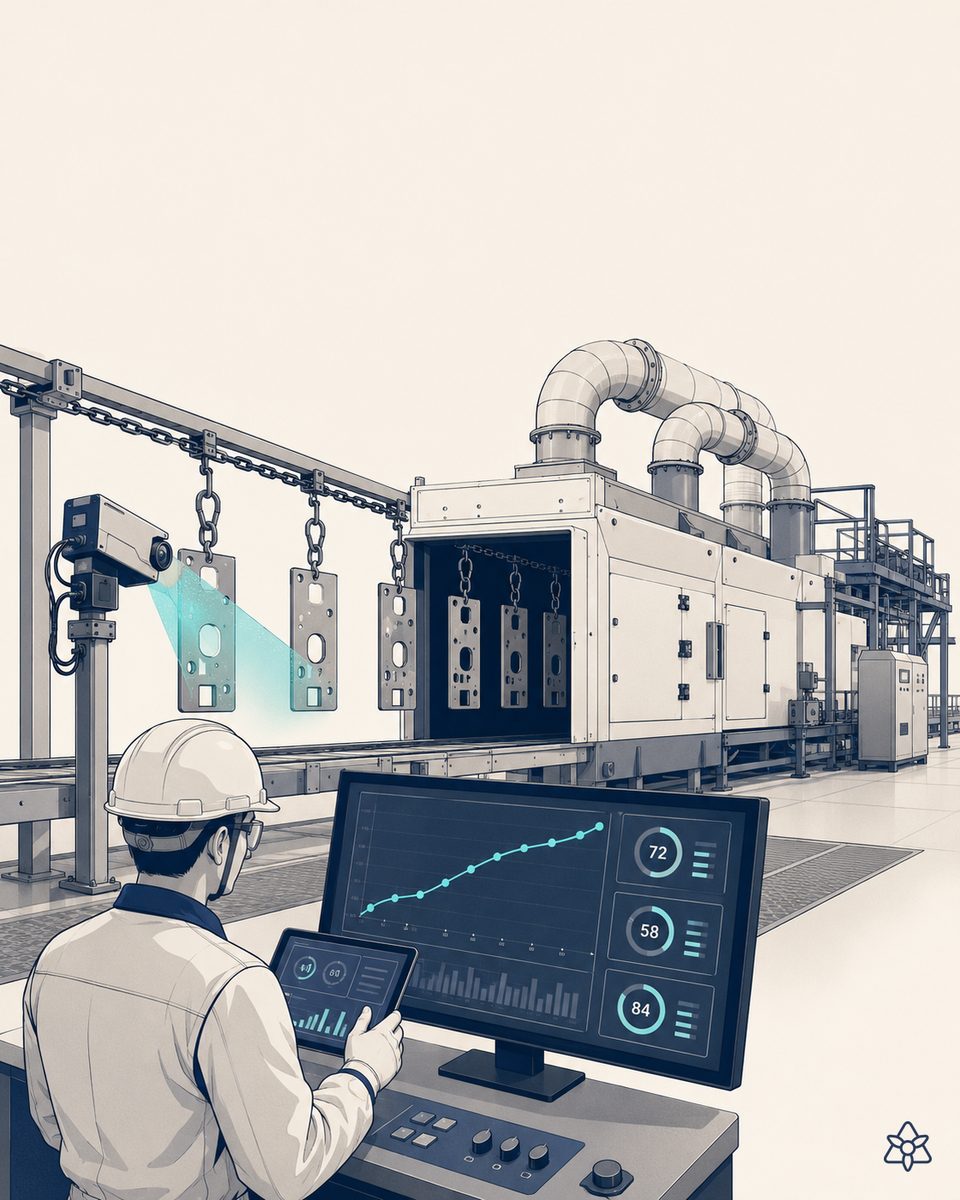
The defect that weighs the most is the pinhole that reaches the filler.
A beverage-can line can produce in the order of 2,000 cans/min at the body maker. The 3104/3004 coil that feeds it passes through uncoiling, lubrication, cupping, ironing, wash, base coat, decoration and necker before filling. Any microscopic pinhole, any oil stain, any longitudinal scratch travels with the strip and, if it passes cupping, becomes a growing risk process by process all the way to the filler — where a leak contaminates a volume far larger than the can itself.
- The defect is subtle on the coil, obvious as a leak. A pinhole of a few dozen microns passes general inspection and becomes visible scrap at wash or a leak at the filler.
- Human inspection at 2,000 cans/min does not exist. It is physically impossible and has always been substituted by downstream sampling.
- The cost of the leak exceeds the cost of the can. The contaminated product, the filler stop and the possible lot recall weigh orders of magnitude above the aluminum scrap.
Large fillers already work with tolerances in the order of 25 PPM in automotive [1] as a reference point — and the beverage can is not far from that demand. The classic system works 99% of the time. The filler leak is the one the customer remembers.
iLEAN Vision seals the crack between the uncoiler and the cupper — it adds no system, it fills the gaps.
Surface control of the aluminum coil is not missing because nobody knows how to do it: it is missing because until now it was expensive to install over every uncoiler, and because the coil supplier's data, the defect mark and the press cycle lived in different systems. iLEAN acts as the filler that closes that gap without asking you to change the press or the ERP.
Edge sees the strip before the blank cut. Connect reads the supplier's certificate and the press cycle. The agent cross-checks defect, certificate and SKU — if the section is critical, it marks it for skip or diversion. The person signs off.
The three iLEAN pieces applied to aluminum coil inspection for beverage cans:
- Edge — a terminal with machine vision (CNN) over the uncoiler. Directed lighting (bright/dark field at the right angle to resolve pinholes), line-scan cameras and a neural network trained for the typical defects: pinholes, oil stains, scratches, roller marks. It marks the section and records the defect's metre position on the coil. It works with no network: as long as the cabinet has power, the cycle continues.
- Connect — captures the coil's certificate whether it comes from the ERP, the aluminum supplier's email or the scanned delivery note, the cupper/body maker's parameters from the PLC, and the SKU's recipe (33 cl, 50 cl, slim format). The information arrives at second zero.
- Agent — cross-checks the defect's metre position, the coil's certificate and the cupping cycle to coordinate the skip or diversion of the section. If the defect is critical and cannot be diverted, it holds the coil and alerts the quality manager. The person validates and signs; the line never restarts on its own.
Downstream sampling vs. coil inspection with iLEAN Vision
| Aspect | Sampling + light test at wash | With iLEAN Vision + Connect + Agent |
|---|---|---|
| Detection point | Finished can (wash, light test, filler) | Coil at the uncoiler, before the cupper |
| Coverage | Downstream statistical sampling | 100% of the strip entering the cupper |
| Cost of the discovered defect | Complete can with varnish + ink or, worse, a leak | Coil section (recyclable aluminum) |
| Traceability to the supplier | Manual reconstruction of which coil it was | Automatic cross-check with the coil's certificate |
| Operation with no network | n/a | Edge keeps operating on cabinet power |
| File for the audit/filler | Manual reconstruction | Dossier per coil with photo and defect metre |
Impact estimate for your plant — to be validated with your numbers.
The block below is an estimate to be validated with the specific figures of your plant. We set it out so the committee has an order of magnitude; we refine it during the diagnostic.
- Beverage-can plant with uncoiler + cupper + body makers + wash + base coat + decoration + necker + filler.
- Edge pilot at the uncoiler (directed lighting + line-scan cameras + integration with the cupper). First expected value within a few weeks.
- Reduction in filler leaks attributable to coil defects: ≥ 30% as a defensible floor.
- Indicative payback between 4 and 9 months, depending on the documented frequency of filler leaks and the average cost of a lot contamination.
- The hard lever is the avoided leak at the filler: the can's material cost is marginal next to the contaminated product and the filling stop.
And the quality manager's reasonable doubt
"What if the AI marks as a defect something the cupper would have worked fine?" — hallucination is a problem of free generation, not of anchored tasks. In image classification against a learned pattern + recording of the coil metre, the best models brought the error below 1.5% [2]. And even so, what is critical is never decided alone: iLEAN marks the section and the person signs the diversion or the lot rejection. The three safety rings are there for exactly this.
[1] Automotive quality standard in the order of 25 PPM (Symestic), a comparable reference for large fillers.
[2] OpenAI paper "Why Language Models Hallucinate", 2025 — on the reliability of AI in anchored tasks.
What people ask about aluminum coil inspection for beverage cans
What typical defects appear on aluminum coil for beverage cans?
On the 3104/3004 coil that feeds a beverage-can line, the typical ones are: microscopic pinholes from rolling, oil stains from the rolling process, longitudinal scratches from rollers, adhered particles of dry lubricant, crown marks at the edges and subtle thickness variations. Most become critical at cupping and ironing — a pinhole that passes the press can cause a leak at the filler, far more expensive than setting aside the coil section.
Why inspect on the coil rather than on the finished can?
The beverage-can line is among the fastest that exist — in the order of 2,000 cans per minute at the body maker. Once the coil enters cupping, the part has already paid for the blank cut, the initial draw and the ironing before reaching wash, base coat and necker. A stain or a pinhole set aside at the coil is recyclable aluminum scrap; the same defect discovered at wash or, worse, at the filler, is a much higher cost: the can is discarded and, if it leaks, it contaminates the lot. iLEAN Vision reads the strip at the uncoiler's exit, before the blank cut.
How does iLEAN Vision read an aluminum coil at high speed?
iLEAN Edge combines directed lighting (bright/dark field) with line-scan cameras over the strip and a neural network trained for pinholes, oil stains, scratches and roller marks. The lighting is half the solution: the pinhole only shows with the source at the right angle, and the line-scan camera freezes it at strip speed. When a critical defect appears, it triggers the marker and records the defect's metre position so the press can skip or divert that section. The operator has the defect's image on screen in milliseconds.
Does it work with old presses that cannot stop and restart?
Yes. iLEAN does not force you to scrap the press or change its cycle. Edge marks the section and records the defect's metre position on the coil, and the agent cross-checks that record with the cupping speed so the press control system skips or diverts the section when it arrives. Connect captures the coil's certificate whether it comes from the ERP, the supplier's email or the scanned delivery note. And Edge works with no network — as long as the cabinet has power, detection and recording continue.
What payback is reasonable to expect in a beverage-can plant?
In a beverage-can plant a leak at the filler contaminates a volume of product that weighs far more than the can's material cost. The order of magnitude of an Edge pilot on the uncoiler covers directed lighting + line-scan cameras + integration with the press. The reasonable payback to present to the committee sits between several months and a year, and the hard lever is the avoided leak at the filler plus the scrap displaced to a set-aside coil section (recyclable, versus a discarded can with ink and varnish). Send us your plant's data and we will send back the estimated ROI within 48h.
More cases in ilean vision
- Twist-off cap verification in canning with AI — a tilted cap at 300 jars/min is not a failure, it is a burst in the autoclave.iLEAN Vision detects a missing or badly positioned twist-off cap on a canning line at over 300 jars/min…
- Unit counting per tray in nuts with AI — the half-empty tray ships like the full one, and the customer notices.How iLEAN Vision counts units per tray and detects under-filling in a bulk nut plant — without stopping…
- Coffee capsule sealing defects — the customer discovers them in their kitchen, and returns the lot.iLEAN Vision detects deformed capsules and faulty sealing on a high-speed single-serve coffee capsule…
- ANPR + ADR code at the chemical terminal gate — a truck that does not add up does not get in.iLEAN Vision reads plate and ADR panel at the chemical terminal gate, cross-checks the delivery note and…
- ANPR license plates at the B2B loading dock with AI — the truck docks and the order appears without anyone typing.How iLEAN Vision reads the truck plate at the B2B loading dock and links the ERP loading order with no…
- ATEX PPE in a refinery zone — the spark that must never come off the clothing.iLEAN Vision verifies helmet, footwear and antistatic/anti-spark clothing on every operator before…
Tell us your case and within 48h we will send you the estimated ROI of this AI project for your beverage-can plant.
We work on your plant's real data, not on ours. Diagnostic with no commitment.
Request estimated ROI in 48h See iLEAN Vision